


Manipur Chief Minister Yumnam Khemchand Singh has said that the state government is working to facilitate the return of internally displaced persons (IDPs) to their respective homes and villages.
Speaking at a programme in Imphal on October 5, the Chief Minister said the government has been making efforts since the formation of the new administration in February 2026 to create conditions for displaced people to return home safely.
Khemchand said the government has also held several rounds of discussions with representatives of civil society organisations (CSOs) in an effort to bridge the trust deficit that has emerged during the crisis.
Trust-Building Seen as Key to Resettlement
The Chief Minister said that restoring confidence among communities is an important part of the process of facilitating the return of IDPs.
The prolonged crisis has affected people in both the hills and the valley, with many families being forced to leave their homes and take shelter elsewhere. Khemchand acknowledged the difficulties faced by displaced people, saying that living in relief camps is not comfortable and that being unable to return home is deeply distressing.
He stressed that the government is working towards creating conditions in which displaced families can eventually return to their original places of residence.
Government Provides Financial Assistance
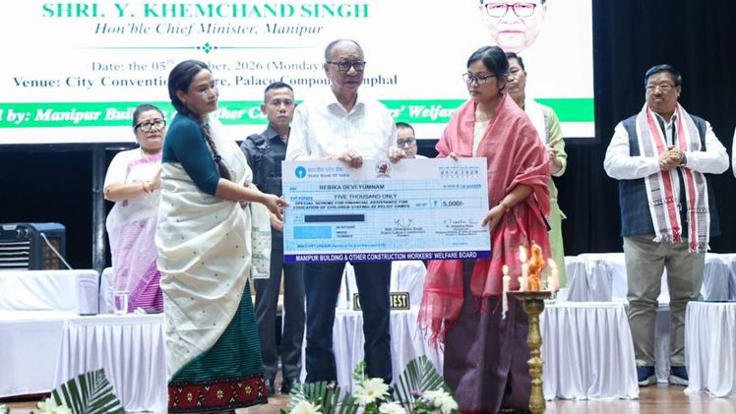
The remarks came during the distribution of benefits worth Rs 2.19 crore to eligible labour card holders, particularly internally displaced persons, under various welfare schemes of the Manipur Building and Other Construction Workers’ Welfare Board.
The programme was organised under the Seva Sankalp Abhiyan at the City Convention Centre in Imphal.
A major component of the assistance was financial support for the education of children staying in relief camps. A total of 2,531 beneficiaries received around Rs 1.42 crore under the special education assistance scheme for children of IDPs.
The initiative is aimed at ensuring that displacement does not prevent children from continuing their education.
2,531 IDPs Receiving Direct Assistance
Khemchand said nearly 2,531 IDPs are currently receiving financial assistance through Direct Benefit Transfer.
He urged displaced people who have not yet registered with the authorities to complete the registration process so they can access eligible government benefits.
The Chief Minister said the government was attempting to address the immediate needs of families who had been forced to leave their homes with little or no belongings.
Besides financial assistance, the government is also working to ensure that displaced children receive educational support through initiatives such as Mission Pathshala.
Government Holds Talks With IDP Representatives
The Chief Minister said regular meetings are being conducted with representatives of displaced people to understand their concerns and address their grievances.
Such consultations are intended to ensure that the government’s rehabilitation efforts take into account the needs of affected families.
The administration has indicated that the return and rehabilitation of IDPs will require coordination between government agencies, local communities and civil society organisations.
Resettlement Efforts Continue
The state government is also taking steps towards the resettlement of specific groups of displaced families.
Khemchand recently said efforts were underway to facilitate the resettlement of 30 families under Torbung Gram Panchayat. Plans include shifting security forces currently occupying the village and renovating damaged houses before the families return.
Such measures are part of the broader effort to restore normalcy and enable displaced people to return to their homes.
Bus Service Provides Relief to Students and Sportspersons
Khemchand also highlighted the resumption of bus services between Imphal and Guwahati via Dimapur.
According to the Chief Minister, the service has reduced the financial burden on students studying outside Manipur and sportspersons travelling to other states for tournaments, particularly because airfares remain expensive.
He said around 450 to 500 passengers are using the public transport service every day.
However, Khemchand cautioned that the resumption of transport services does not mean that complete peace and normalcy have returned to the state.
Peace and Rehabilitation Remain Challenges
The government’s efforts to facilitate the Manipur IDPs return home come against the backdrop of the continuing challenge of restoring trust and normalcy across affected areas.
Financial assistance and welfare programmes can provide immediate support, but the safe and sustainable return of displaced families also depends on security, rehabilitation of damaged homes and infrastructure, and confidence among communities.
The government has therefore continued discussions with civil society representatives and IDP groups as part of its wider efforts to address these challenges.
Government Promises Continued Support
The Chief Minister said the government would continue working to meet the needs of displaced families while creating conditions for their eventual return.
With thousands of people still affected by displacement, rehabilitation remains an important part of Manipur’s recovery process. The government’s approach combines financial assistance, educational support, consultations with stakeholders and efforts to facilitate resettlement.
As these initiatives continue, the safe return of IDPs to their homes is expected to remain a key priority for the Manipur government as it works towards restoring peace and normalcy across the state.