


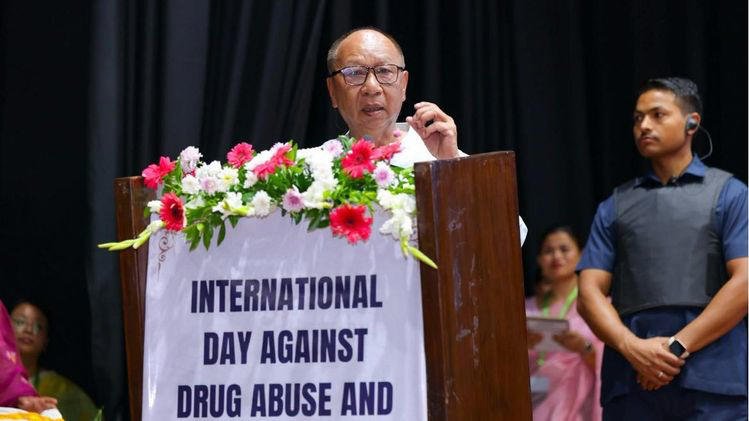
Manipur Chief Minister Khemchand Singh has said that drug trafficking routes in the state underwent significant changes following the ethnic violence and security crisis that erupted in 2023. According to the Chief Minister, the altered ground situation forced narcotics traffickers to adopt new routes and methods, creating fresh challenges for law enforcement agencies engaged in the state’s ongoing campaign against illegal drugs.
Speaking on the government’s anti-narcotics initiatives, Singh noted that while authorities have intensified surveillance and enforcement measures, criminal networks have continued to adapt to changing circumstances. He emphasized that the government remains committed to dismantling drug trafficking syndicates through coordinated action involving state police, central security agencies, and intelligence units.
The remarks come as Manipur continues to strengthen its “War on Drugs” campaign, focusing on disrupting narcotics supply chains, destroying illegal poppy cultivation, and enhancing border security.
Changing Dynamics of Drug Trafficking
The Chief Minister explained that the 2023 crisis significantly affected movement across several regions of Manipur, prompting traffickers to abandon traditional smuggling corridors and identify alternative routes.
According to Singh, criminal organizations often modify their transportation networks whenever security conditions change. Increased deployment of security personnel, intensified border checks, and restricted movement in certain areas have compelled traffickers to become more innovative in moving contraband.
He stated that law enforcement agencies are continuously studying these changing patterns to ensure that security measures remain effective against evolving criminal strategies.
Authorities believe understanding these shifting routes is essential for preventing illegal narcotics from reaching domestic and international markets.
Strengthening the War on Drugs Campaign
The Manipur government has consistently prioritized its “War on Drugs” initiative as one of its flagship law enforcement campaigns. Since its launch, the program has focused on eliminating illegal poppy cultivation, dismantling drug trafficking networks, and reducing the availability of narcotics within the state.
The Chief Minister reaffirmed the government’s commitment to pursuing a zero-tolerance approach toward drug-related crimes. He stated that security agencies have been directed to continue intelligence-based operations, strengthen surveillance, and coordinate closely with neighboring states and central agencies.
Officials believe sustained enforcement remains necessary because drug trafficking poses serious threats to public health, youth welfare, and national security.
Importance of Intelligence-Based Operations
Singh highlighted the growing importance of intelligence gathering in combating organized drug trafficking. As trafficking routes continue to evolve, authorities increasingly rely on information collected through surveillance, digital monitoring, and inter-agency cooperation.
Security agencies regularly analyze movement patterns, communication networks, and financial transactions to identify individuals and organizations involved in narcotics trafficking.
The Chief Minister stated that intelligence-led policing enables authorities to intercept illegal consignments more effectively while minimizing operational risks.
Such coordinated efforts have resulted in several successful drug seizures and arrests in recent years, demonstrating the importance of proactive policing.
Border Security Remains a Key Priority
Manipur shares an international border with Myanmar, making effective border management an essential component of anti-drug enforcement efforts. Officials have repeatedly noted that cross-border trafficking remains one of the major challenges confronting security agencies.
The government continues to strengthen surveillance along vulnerable border areas through increased deployment of security personnel, improved infrastructure, and enhanced coordination with central agencies.
Advanced monitoring technologies, regular patrols, and intelligence sharing have become integral components of efforts to prevent illegal cross-border movement of narcotics and other contraband.
According to the Chief Minister, securing the border remains crucial to reducing the flow of drugs into the state.
Eliminating Illegal Poppy Cultivation
Alongside intercepting trafficking networks, the Manipur government has intensified operations to eradicate illegal poppy cultivation in various districts. Authorities consider poppy destruction an important strategy for reducing the supply of raw materials used in narcotics production.
The government has conducted several eradication drives involving police, forest officials, district administrations, and security forces.
Officials have also encouraged local communities to transition towards legal and sustainable agricultural activities by promoting alternative livelihood opportunities.
The Chief Minister reiterated that eliminating illegal cultivation requires both strict enforcement and long-term socio-economic support for affected communities.
Multi-Agency Coordination
Combating organized drug trafficking requires close coordination among multiple agencies operating at both state and national levels. Singh noted that Manipur Police work alongside central armed police forces, intelligence agencies, the Narcotics Control Bureau, and other departments to strengthen enforcement efforts.
Regular information sharing and joint operations enable agencies to respond more effectively to emerging trafficking methods and organized criminal networks.
The Chief Minister emphasized that integrated law enforcement remains one of the strongest tools available in addressing increasingly sophisticated narcotics operations.
Such collaborative efforts also facilitate faster investigations and more effective prosecution of offenders.
Protecting Youth from Drug Abuse
Beyond law enforcement, the government continues to emphasize the importance of protecting young people from the harmful effects of drug abuse. Officials have repeatedly highlighted that narcotics trafficking directly contributes to substance abuse, addiction, and various social problems affecting communities.
Educational institutions, community organizations, and civil society groups have been encouraged to participate in awareness campaigns promoting healthy lifestyles and drug prevention.
The Chief Minister stressed that preventing addiction requires coordinated efforts involving families, schools, healthcare professionals, and local communities alongside police enforcement.
Public awareness remains an important pillar of the state’s broader anti-drug strategy.
Technology Enhancing Anti-Narcotics Efforts
Modern technology has become an increasingly valuable resource in combating organized crime. Authorities are using digital surveillance tools, forensic analysis, communication monitoring, and advanced investigative techniques to strengthen anti-narcotics operations.
Data analysis helps investigators identify trafficking patterns, financial networks, and operational linkages among criminal organizations.
Officials believe that continued investment in technology will improve the efficiency of future operations while enhancing the overall capability of law enforcement agencies to combat evolving threats.
The government also plans to further strengthen institutional capacity through training and modernization initiatives.
Looking Ahead
The Chief Minister acknowledged that drug trafficking networks remain highly adaptable and that enforcement agencies must continue evolving their operational strategies.
Future efforts will focus on expanding intelligence capabilities, strengthening border management, enhancing inter-state cooperation, improving technological resources, and sustaining anti-drug awareness campaigns.
Authorities also intend to continue targeting financial networks associated with narcotics trafficking, recognizing that disrupting illegal funding mechanisms is essential for weakening organized criminal groups.
The government remains optimistic that a combination of strong enforcement, community participation, and preventive measures will produce lasting results.
Conclusion
Chief Minister Khemchand Singh’s remarks underscore the changing nature of drug trafficking in Manipur following the 2023 crisis. While altered trafficking routes have created new challenges for law enforcement, the state government has reaffirmed its commitment to intensifying the “War on Drugs” through intelligence-based policing, strengthened border security, coordinated enforcement, and public awareness initiatives.
As traffickers continue adapting their methods, authorities are equally focused on enhancing surveillance, dismantling criminal networks, and preventing illegal narcotics from reaching vulnerable communities. Through sustained cooperation among security agencies, technological modernization, and community engagement, Manipur aims to build a more resilient and effective framework for combating drug trafficking while protecting public health and ensuring long-term security.