


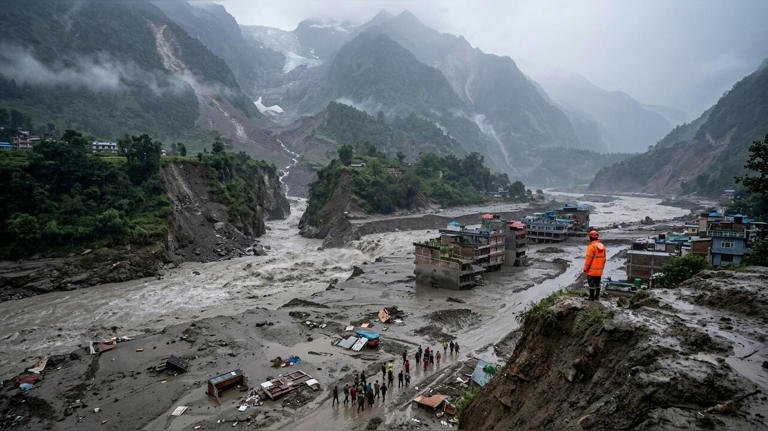
The Ministry of External Affairs (MEA) has said that 320 Indian nationals remain missing or uncontactable following the devastating flash floods that struck Nepal earlier this week, as India continues efforts to trace its citizens and assist the disaster-hit country.
The latest figure was provided by MEA spokesperson Randhir Jaiswal during a briefing on Friday. He stressed that the situation remains fluid and that the number of people reported missing could change as authorities establish contact with more individuals and reconcile information from different sources.
The disaster, which struck Nepal’s Rasuwa district and surrounding areas on August 26, has caused widespread destruction and claimed hundreds of lives. Search and rescue operations are continuing despite difficult terrain, damaged infrastructure and concerns over further flooding.
320 Indians Remain Uncontactable
According to the MEA, 320 Indian nationals are currently listed as missing or uncontactable in the flood-affected areas of Nepal.
The ministry has cautioned against treating the figure as a confirmed death toll. The term “uncontactable” refers to people whom authorities have not yet been able to reach or whose whereabouts have not been established.
The number is also expected to change as rescue teams reach previously inaccessible locations and communication networks are restored.
The MEA has set up control rooms in New Delhi, Kathmandu and Beijing to coordinate efforts to trace Indian nationals, assist their families and facilitate evacuations.
Around 100 People of Indian Origin Also Uncontactable
Apart from the 320 Indian nationals, the MEA said around 100 people of Indian origin holding other nationalities also remain uncontactable.
Many of them are believed to have been travelling in connection with the Kailash Mansarovar pilgrimage, which passes through areas affected by the disaster.
The ministry is coordinating with authorities in Nepal and China to establish the whereabouts of those individuals and facilitate assistance wherever possible.
The distinction between Indian nationals and people of Indian origin is important because the two groups fall under different nationality categories, even though both have connections with India.
400 Indians on Chinese Side Reported Safe
The MEA also provided an update on Indian nationals who were stranded on the Chinese side of the border.
Around 400 Indian nationals in China’s Tibet Autonomous Region have been reported safe and are in contact with their families, according to the ministry.
Indian diplomatic officials in Beijing are coordinating with Chinese authorities, local officials, travel agencies and group leaders to facilitate their eventual evacuation.
The MEA said that 96 Indian nationals who had been stranded on the Chinese side have already crossed into Nepal by land. Other updates put the number of people who have crossed safely at 149, reflecting the rapidly changing situation as evacuation operations continue.
21 Rescued Indians Reach Delhi
In a major relief for families, 21 Indian nationals from Tamil Nadu who had reached Kathmandu after being rescued from flood-hit areas arrived in New Delhi on Friday.
External Affairs Minister S Jaishankar received the rescued group at the airport and interacted with the survivors.
Their safe return offered some relief amid the continuing uncertainty surrounding hundreds of other Indian nationals whose whereabouts remain unknown.
The MEA also said that 63 Indian nationals working at the Trishuli-One hydropower project had been rescued from the affected area.
Nepal Flood Disaster Claims Hundreds of Lives
The flash floods have caused catastrophic destruction across parts of Nepal.
The disaster struck on August 26 following a sudden surge of water, ice, rock and debris in the Himalayan region. The resulting torrent damaged roads, bridges, buildings and hydropower infrastructure and swept through several downstream areas.
Nepal’s reported death toll rose to 579 as of Friday, while thousands of people remained missing or unaccounted for. The scale of the disaster continues to evolve as rescue teams gain access to areas that were previously cut off.
The difficult Himalayan terrain and damaged transportation links have made rescue operations particularly challenging.
Rescue Operations Face Difficult Conditions
Rescue teams in Nepal are facing major logistical challenges as they search for survivors and missing people.
Roads and bridges have been damaged, while mud and debris have blocked access to several affected areas. Communication disruptions have further complicated efforts to establish contact with people who may be stranded.
Authorities are using helicopters and other resources to reach isolated locations and evacuate survivors.
India is also preparing additional assistance at Nepal’s request. The MEA said a specialised tunnel rescue team and medical team are being sent, while India has offered Bailey bridges and associated technical support to help restore connectivity in affected areas.
India Steps Up Humanitarian Assistance
Alongside efforts to trace its citizens, India has increased humanitarian assistance to Nepal.
A third flight carrying around 10 tonnes of relief material has been sent to Kathmandu. The assistance includes portable generators, food packets, dignity kits and water purification tablets.
An 11-member team comprising doctors, paramedics and personnel involved in tunnel rescue assessment is also being deployed.
Earlier, India had sent more than 47 tonnes of emergency relief supplies to Nepal through two flights. The assistance is intended to support Nepal’s ongoing rescue and relief operations.
MEA Helplines Working Round the Clock
The Indian government has established round-the-clock mechanisms to assist families searching for relatives in the disaster zone.
The MEA control room in New Delhi is coordinating with Indian missions in Kathmandu and Beijing. Both embassies have also established 24-hour helplines for affected Indian nationals and their families.
The helplines are expected to play an important role in collecting information, verifying reports and connecting families with authorities working on the ground.
Given the fluid nature of the disaster, officials have urged people to rely on verified information rather than unconfirmed reports circulating on social media.
Missing Figure Could Change
The MEA has emphasised that the figure of 320 remains dynamic.
As rescue operations progress and communication networks are restored, some people currently listed as uncontactable could be located or confirmed safe. At the same time, authorities may identify additional people who were in affected areas but had not initially been reported missing.
The ministry is therefore continuing to reconcile information received from families, travel groups, local authorities and diplomatic missions.
India Continues Efforts to Trace Its Citizens
The latest MEA update highlights the scale of the challenge facing India following the Nepal flash flood disaster.
While 320 Indian nationals remain uncontactable, there have also been significant developments, including the rescue of 63 workers at the Trishuli-One hydropower project, the safe return of 21 Tamil Nadu residents to Delhi and the movement of stranded Indians from the Chinese side into Nepal.
With rescue operations still underway, India’s immediate priorities remain tracing missing nationals, supporting their families and facilitating safe evacuation.
The government is also continuing to assist Nepal with relief supplies, medical support and specialised rescue capabilities as the neighbouring country confronts one of its most devastating recent natural disasters.
For families waiting for news of their loved ones, however, the focus remains on one urgent objective: establishing contact with the 320 Indians still listed as missing or uncontactable and ensuring every possible effort is made to locate and bring them to safety.