

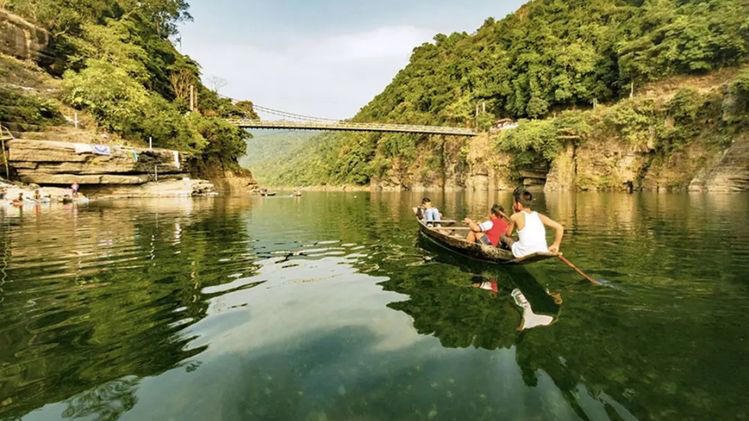
The pristine Umngot river in Meghalaya, known for its crystal-clear waters, has turned brown, sparking widespread concern. The discoloration, linked to an ongoing road construction project, has prompted Meghalaya MP Vincent H. Pala to seek urgent intervention from the Centre. He stressed that immediate action is needed to prevent further environmental damage and to preserve the state’s natural heritage.
Read More: Tripura Launches Food Support Scheme for TB Patients
Vincent Pala, who represents the Shillong constituency, raised the issue in Parliament and urged the Union Ministry of Environment, Forest and Climate Change to look into the matter. He warned that if the government fails to act swiftly, the ecological balance in the Dawki region could be permanently disrupted. Pala added that the discoloration threatens the livelihood of people dependent on the river’s tourism potential.
The Umngot river, flowing through Dawki near the India-Bangladesh border, is one of Meghalaya’s most popular tourist destinations. Its transparent waters draw thousands of visitors every year, contributing significantly to the local economy. However, in recent weeks, photos and videos showing the river’s brownish hue have gone viral, alarming residents and environmentalists alike. Locals have blamed the construction of the Dawki-Pynursla road for the change in water colour.
Pala explained that the project, aimed at improving road connectivity to the border areas, lacks proper environmental safeguards. He said the excavation and dumping of soil into nearby streams have led to excessive siltation in the river. “While development is essential, it should not come at the cost of nature,” Pala remarked, urging both the state and central governments to find a sustainable balance between progress and preservation.
Environmental groups in Meghalaya have echoed Pala’s concerns. Several organizations have demanded an immediate suspension of construction until proper impact assessments are conducted. They argue that the state’s fragile ecosystem cannot withstand unchecked development. The Federation of Khasi Jaintia and Garo People, an influential group in the region, has also urged authorities to ensure accountability and strict monitoring of all ongoing projects near sensitive water bodies.
Meanwhile, local residents have reported a decline in tourism due to the river’s changed appearance. Boat operators and homestay owners in Dawki say visitor numbers have dropped sharply since the river turned brown. “Earlier, people came to see the crystal-clear waters and take boat rides. Now, they leave disappointed,” said a local boatman. The tourism department fears a further dip in income if the situation is not addressed soon.
Experts point out that the problem could worsen during the monsoon if erosion and siltation are not controlled. They recommend constructing proper retaining walls, improving drainage systems, and enforcing strict regulations on waste disposal from construction sites. According to environmentalist Dr. Donkupar Rymbai, sedimentation from poorly managed projects poses a long-term risk to aquatic life and biodiversity.
The Meghalaya government has taken note of the issue and initiated a preliminary inquiry. Officials said samples from the Umngot river are being tested to determine the extent of pollution. The Public Works Department has also been directed to ensure that contractors follow environmental norms. However, opposition leaders and activists argue that these steps are insufficient and call for stronger oversight from the Centre.
The MP’s demand for central intervention has gained traction among civil society groups and environmental advocates. They believe that the Centre’s involvement could ensure stricter enforcement of environmental laws and promote sustainable infrastructure planning in ecologically sensitive zones. Many have also suggested that the government explore eco-friendly construction methods that minimize soil disturbance.
Tourism experts warn that the incident could harm Meghalaya’s image as an eco-tourism hotspot. The state’s scenic rivers and hills are its primary attractions, and any visible environmental degradation could reduce visitor confidence. “Protecting our natural assets should be the top priority,” said a tourism official. “Once we lose our clean rivers, we lose the identity of Meghalaya as a green destination.”
Local communities have started awareness drives to clean the smaller streams feeding into the Umngot river. They have appealed to tourists and construction workers to avoid dumping waste near the riverbanks. School students and environmental volunteers have also joined campaigns to highlight the importance of preserving the region’s water resources.
Vincent Pala concluded that restoring the Umngot river’s clarity will require coordinated efforts between the Centre, state agencies, and local communities. He urged the Union government to send an expert team to assess the situation and recommend measures for long-term conservation. “The Umngot is not just a river; it is the pride of Meghalaya. We must act before it’s too late,” he said.
The discoloration of the Umngot river serves as a warning about the fragile relationship between development and nature. While progress and connectivity remain vital, the state must adopt eco-sensitive planning to protect its natural beauty. As the government prepares to address the issue, Meghalaya’s residents hope the river will soon regain its lost clarity and sparkle once again as a symbol of purity and resilience.
Read More: NCW Urges Joint Action by Mizoram Police and Assam Rifles to Curb Cross-Border Trafficking