

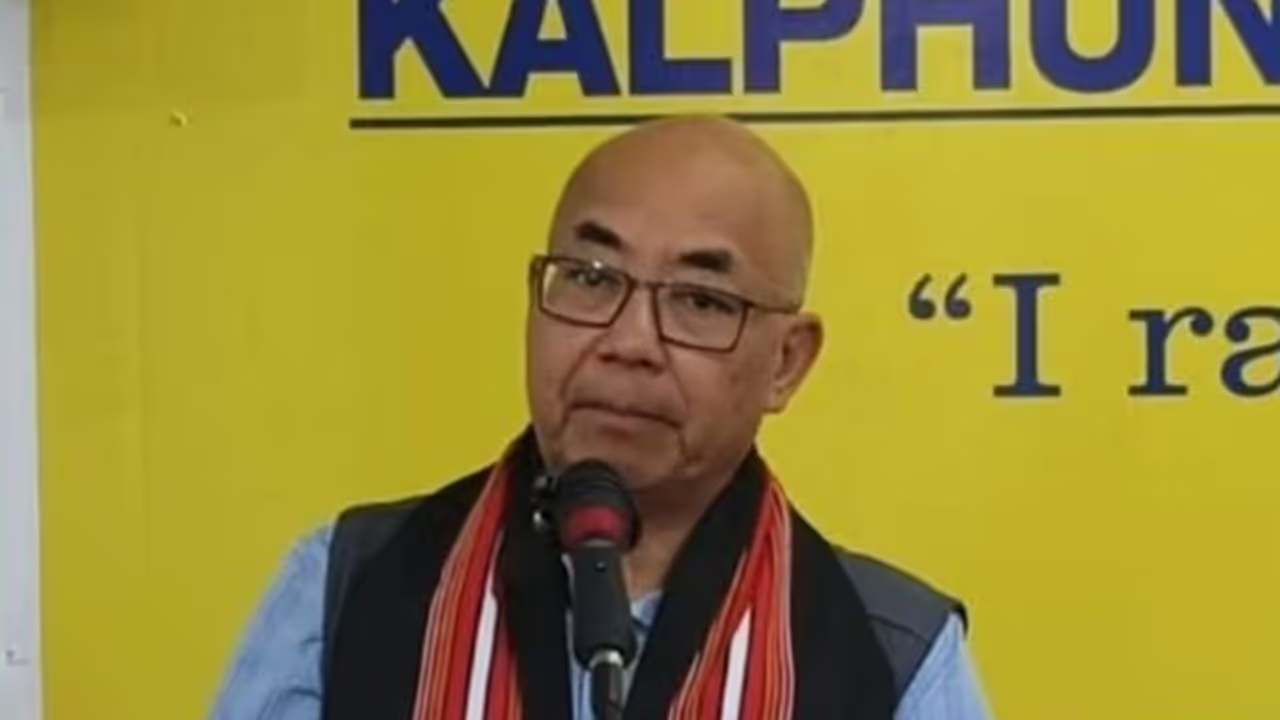
Mizoram Rajya Sabha MP Laltluangkima has stated that his party’s support to the National Democratic Alliance (NDA) will remain strictly issue-based. The clarification comes amid ongoing political discussions regarding regional party alignments at the national level. Moreover, the statement highlights the party’s intent to maintain autonomy while engaging with the Centre on specific matters. Political observers note that such positioning reflects a careful balance between cooperation and independence.
National Highway-10 Blocked Completely by Sudden Mudslides Near Rangpo, Cutting Off Sikkim
All Naga Students’ Association Manipur (ANSAM) Leads 4 km Rally Demanding Immediate Justice
Laltluangkima Clarifies Stand on NDA Support
Mizoram Rajya Sabha MP Laltluangkima states party support to NDA will strictly remain issue-based, emphasizing that backing will be extended only on selected matters. Consequently, the clarification aims to define the boundaries of political cooperation with the ruling alliance at the Centre.
The MP indicated that the party does not intend to enter into unconditional alignment with the NDA. Moreover, support will be determined based on the merits of individual issues rather than broader political affiliation. Therefore, the approach reflects a selective and case-by-case strategy.
Such positions are not uncommon among regional parties in India. Furthermore, they often maintain independent identities while cooperating with national alliances on policy matters. As a result, flexibility in political engagement remains a key feature of coalition politics.
Meanwhile, the statement has drawn attention in political circles in Mizoram and beyond. Consequently, discussions continue regarding the implications of issue-based support in parliamentary decision-making.
Issue-Based Politics Reflects Regional Priorities
The assertion by Mizoram Rajya Sabha MP Laltluangkima that support to the NDA will remain issue-based highlights the importance of regional priorities. Moreover, regional parties often seek to ensure that local concerns are addressed in national policy discussions. Therefore, selective support allows them to safeguard their interests.
Mizoram, like other northeastern states, has unique developmental and administrative needs. Consequently, representatives often evaluate national policies based on their impact on the state. Such considerations influence parliamentary positions and voting behavior.
Furthermore, issue-based alignment allows flexibility in addressing diverse policy areas such as infrastructure, education, and development. As a result, regional parties can support beneficial initiatives while opposing policies they find unsuitable.
Meanwhile, this approach also reflects the evolving nature of coalition politics in India. Similarly, it underscores the importance of negotiation and consensus-building in parliamentary systems.
Regional Parties Maintain Independent Political Identity
The statement by Mizoram Rajya Sabha MP Laltluangkima underscores the broader trend of regional parties maintaining independent political identities while engaging with national alliances. Moreover, such arrangements are often driven by practical governance considerations. Therefore, cooperation does not necessarily imply full political alignment.
Regional parties frequently navigate complex political landscapes to balance state interests with national engagement. Consequently, issue-based support provides a structured way to participate in parliamentary processes without compromising autonomy.
Furthermore, this model allows parties to respond dynamically to changing political and policy environments. As a result, it enhances their ability to represent local constituencies effectively.
Meanwhile, political analysts note that such arrangements can contribute to more nuanced decision-making in Parliament. Similarly, they reflect the diversity of India’s federal political structure.
Implications for Parliamentary Cooperation and Governance
Mizoram Rajya Sabha MP Laltluangkima states party support to NDA will strictly remain issue-based, indicating a continued focus on selective parliamentary cooperation. Moreover, this approach may influence how the party engages in legislative discussions in the future.
Issue-based support can contribute to constructive debate in Parliament. Therefore, it allows parties to engage with policies on a case-by-case basis. Such a system can also help ensure that regional voices are heard in national policymaking.
Furthermore, this approach may encourage greater accountability and policy scrutiny. As a result, legislative decisions may benefit from broader consultation and evaluation.
Meanwhile, the evolving nature of political alliances continues to shape governance dynamics. Similarly, regional parties remain key stakeholders in India’s parliamentary framework.
Conclusion
Mizoram Rajya Sabha MP Laltluangkima states party support to NDA will strictly remain issue-based, reaffirming a position of selective cooperation at the national level. Moreover, the statement reflects the party’s intent to balance engagement with independence.
Regional priorities continue to play a significant role in shaping political decisions. Therefore, issue-based alignment allows for flexible yet focused participation in parliamentary affairs.
As Mizoram Rajya Sabha MP Laltluangkima states party support to NDA will strictly remain issue-based, it highlights the continuing importance of regional perspectives in India’s evolving political landscape.
FAQs
1. What did Laltluangkima say about NDA support?
He stated that party support to the NDA will remain strictly issue-based.
2. What does issue-based support mean?
It means support is given only on selected matters, not as part of full political alignment.
3. Why do regional parties use issue-based approaches?
To balance national cooperation with regional interests and priorities.
4. Does this mean full alliance with NDA?
No, the statement indicates selective support rather than full alignment.
5. Why is this statement politically significant?
It highlights the role of regional parties in shaping parliamentary decisions.