

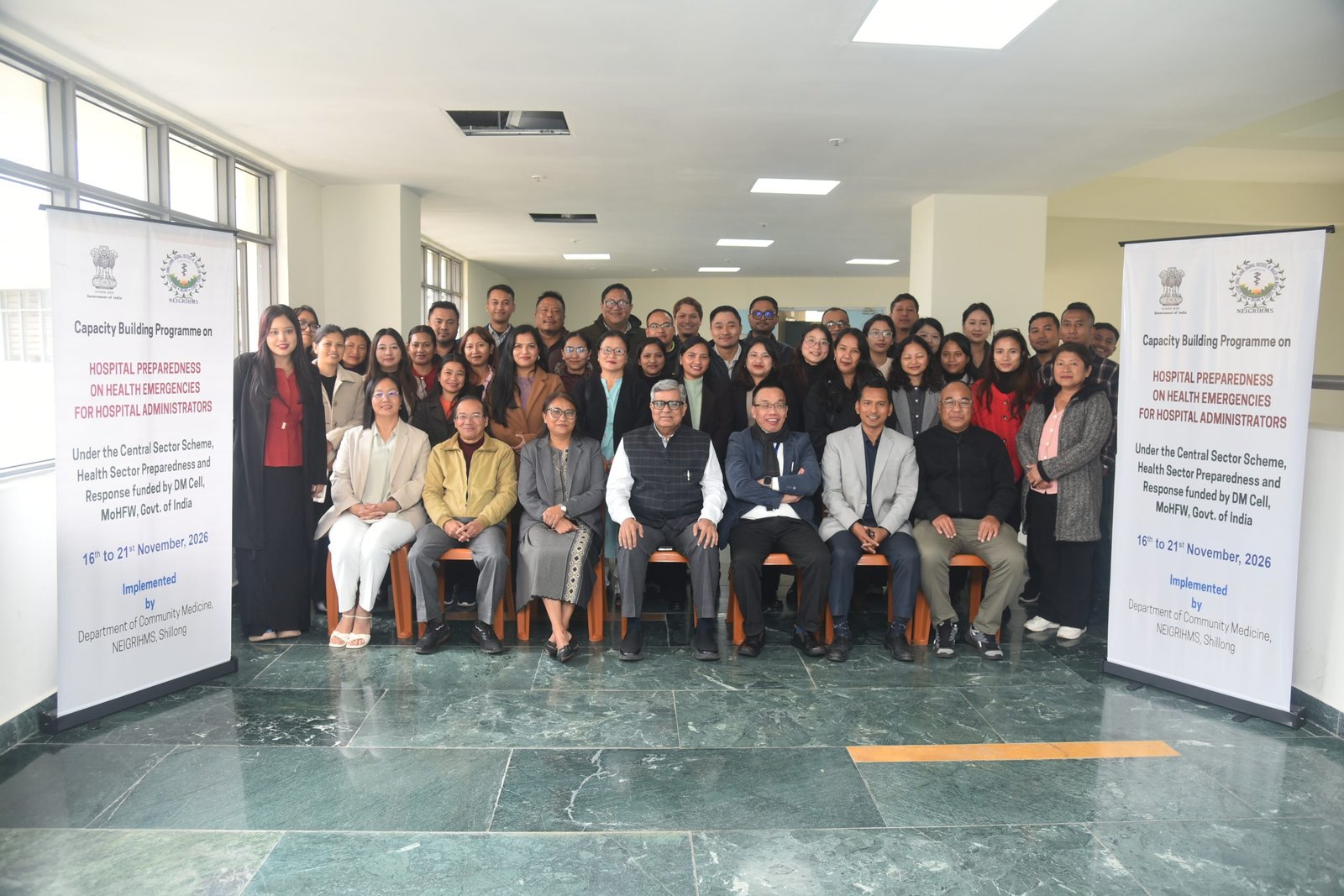
The North Eastern Indira Gandhi Regional Institute of Health and Medical Sciences (NEIGRIHMS) in Shillong has completed a six-day capacity-building programme for hospital administrators from five Northeastern states. The training focused on strengthening hospital preparedness for public health emergencies, disasters and mass-casualty situations. Held from November 16 to 21, 2026, the programme brought together 38 participants from Manipur, Meghalaya, Mizoram, Nagaland and Tripura. The institute organised the course under the Disaster Management Cell of the Union Ministry of Health and Family Welfare. It combined classroom sessions with practical exposure at hospitals in Shillong.
Manipur Toxic Liquor Tragedy Triggers Urgent Probe
NEIGRIHMS Conducts Six-Day Emergency Preparedness Course
NEIGRIHMS conducted the programme under the title “Hospital Preparedness for Health Emergencies for Hospital Administrators”.
The six-day course aimed to strengthen the ability of hospital administrators to prepare for and manage emergency situations. It covered different aspects of disaster management and hospital readiness.
A total of 38 participants attended the programme. They represented healthcare institutions across Manipur, Meghalaya, Mizoram, Nagaland and Tripura.
Prof. Star Pala from the Department of Community Medicine served as the course coordinator. Resource persons from different agencies across the Northeast conducted the training sessions.
The programme focused on the administrative responsibilities involved in emergency response. It also highlighted the need for hospitals to maintain effective systems before disasters occur.
Five Northeastern States Participate in Training
The participation of administrators from five states gave the programme a regional focus.
Hospitals across the Northeast operate in varied geographical and infrastructure conditions. Floods, landslides, road accidents and other emergencies can place considerable pressure on healthcare facilities.
Therefore, hospital administrators need to coordinate staff, resources and emergency services during critical situations.
The training provided a common platform for participants to discuss disaster management practices and strengthen their preparedness.
It also encouraged the exchange of experiences among administrators working in different parts of the region.
Such regional cooperation can support better coordination when emergencies affect multiple districts or require assistance from neighbouring states.
Hospital Visits Provide Practical Exposure
The course included visits to two tertiary care hospitals in Shillong: NEIGRIHMS and Nazareth Hospital.
These visits formed an important practical component of the training.
Participants received exposure to hospital operations and emergency management arrangements. They could observe how healthcare facilities organise services and prepare for different emergency situations.
The visits also helped connect the classroom modules with practical hospital administration.
By combining instruction with field exposure, the programme aimed to improve participants’ understanding of emergency preparedness.
The involvement of resource persons from different regional agencies further added practical perspectives to the sessions.
NEIGRIHMS Director Highlights Timely Emergency Response
During the valedictory programme, NEIGRIHMS Director Prof. Nalin Mehta emphasised the importance of timely action during health emergencies.
He said effective preparedness could save valuable lives. He also stressed that hospital administrators must remain ready to respond when disasters create sudden pressure on healthcare services.
Mehta highlighted the role of routine emergency management in preparing hospitals for larger incidents.
He explained that efficient handling of trauma and other emergency cases during daily operations provides an important foundation for managing mass casualties.
His remarks underlined the need for hospitals to maintain discipline, coordination and timely decision-making.
The Director also thanked the resource persons who contributed to the training programme.
Medical Superintendent Calls for Regular Emergency Drills
NEIGRIHMS Medical Superintendent Prof. Stephan Sailo also addressed the valedictory programme.
He emphasised the importance of regular drills to improve hospital preparedness.
Emergency exercises help hospital teams understand their responsibilities and identify gaps in response arrangements.
They can also improve coordination among medical staff, administrators and support services.
Regular practice becomes particularly important during mass-casualty incidents, when hospitals may need to manage a large number of patients within a short period.
Sailo stressed that hospitals must continue strengthening their disaster management systems rather than relying only on training sessions.
Certificates Distributed to Participants
The programme concluded on November 21 with a valedictory ceremony.
Dignitaries distributed course completion certificates to the participants.
The six-day training marked another effort to strengthen disaster preparedness among healthcare administrators in the Northeast.
Its regional participation also highlighted the value of cooperation between medical institutions and government agencies.
As hospitals face different emergency risks, trained administrators can play an important role in organising resources and supporting timely medical response.
The programme sought to build that administrative capacity through structured learning, practical visits and interaction with regional experts.
Conclusion
NEIGRIHMS has completed a six-day emergency preparedness training programme for 38 hospital administrators from Manipur, Meghalaya, Mizoram, Nagaland and Tripura. Organised under the Ministry of Health and Family Welfare’s Disaster Management Cell, the course combined disaster management sessions with visits to NEIGRIHMS and Nazareth Hospital. Institute Director Prof. Nalin Mehta and Medical Superintendent Prof. Stephan Sailo highlighted timely action and regular emergency drills. The initiative aims to strengthen hospital readiness and improve the Northeast’s capacity to manage public health emergencies and mass-casualty situations.
FAQs
1. What training programme did NEIGRIHMS conduct?
NEIGRIHMS conducted a six-day course titled “Hospital Preparedness for Health Emergencies for Hospital Administrators”.
2. When did the training take place?
The programme ran from November 16 to 21, 2026, in Shillong.
3. How many administrators participated?
A total of 38 hospital administrators attended the training.
4. Which states were represented?
Participants came from Manipur, Meghalaya, Mizoram, Nagaland and Tripura.
5. Which hospitals did participants visit?
They visited NEIGRIHMS and Nazareth Hospital in Shillong.
6. Who coordinated the training programme?
Prof. Star Pala of the NEIGRIHMS Department of Community Medicine served as the course coordinator.