


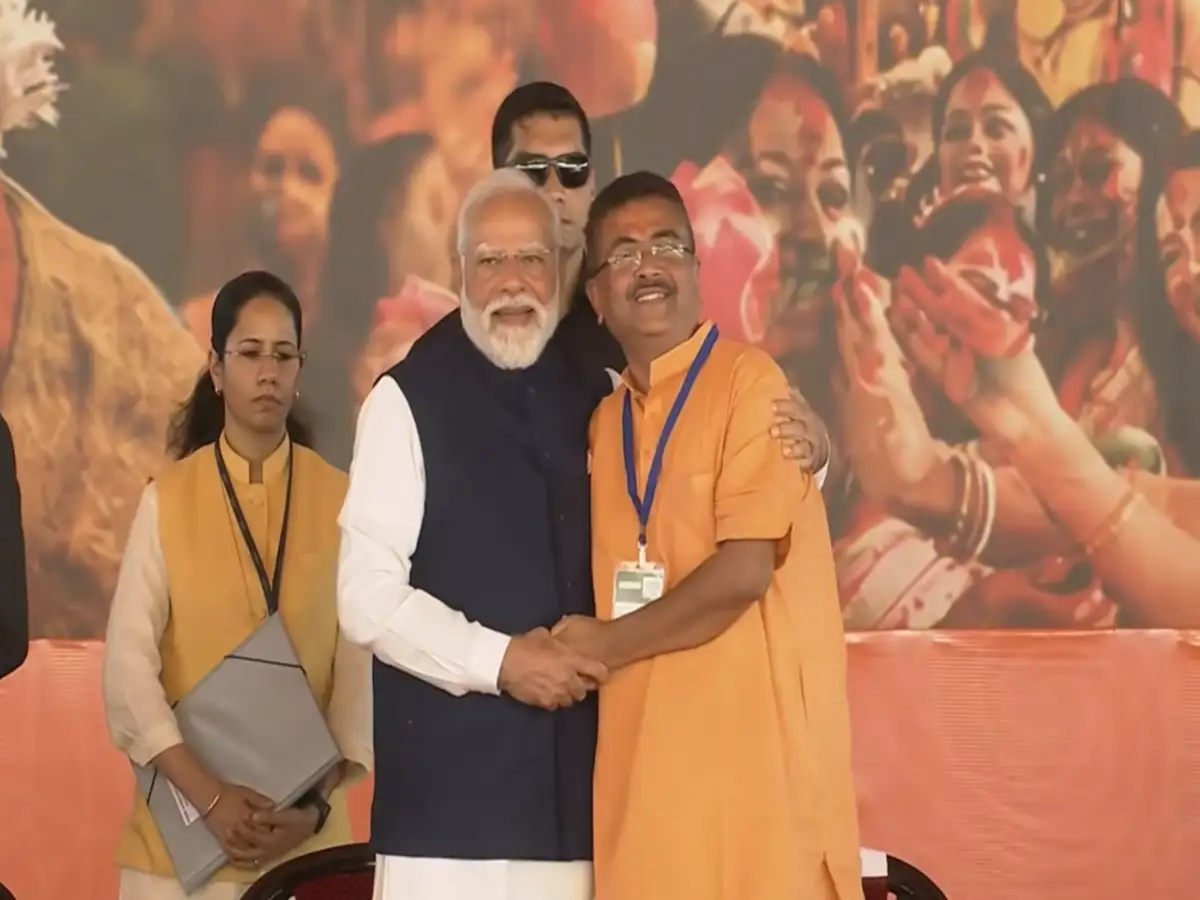
Suvendu Adhikari began his tenure as the first BJP chief minister of West Bengal by paying tribute to Nobel laureate Rabindranath Tagore, highlighting the cultural and historical significance of Bengal’s literary heritage.
Soon after taking oath as chief minister, Adhikari remembered Tagore and praised his contribution to literature, philosophy, music, and Indian civilisation. The gesture drew attention because Tagore remains one of Bengal’s most respected cultural icons and a symbol of Bengali identity.
Political observers viewed the tribute as both a cultural and symbolic message from the newly formed BJP government as it begins a historic political chapter in Bengal.
The BJP recently ended the 15-year rule of the Trinamool Congress and formed its first government in the state under Adhikari’s leadership.
Read More: Suvendu Adhikari’s Cabinet Reflects Bengal’s Geographical And Ethnic Diversity
Suvendu Adhikari Pays Tribute To Tagore
After assuming office, Suvendu Adhikari paid homage to Rabindranath Tagore and highlighted the poet’s lasting influence on Bengal and India.
According to officials, the chief minister described Tagore as a timeless figure whose ideas continue inspiring generations across the world.
Adhikari reportedly said Bengal’s cultural identity remains deeply connected with Tagore’s literary and philosophical legacy.
The tribute came during a politically significant period as Bengal witnessed a major transition in leadership after the Assembly elections.
Political analysts believe the gesture reflected the BJP government’s attempt to connect with Bengal’s cultural and intellectual heritage.
Observers also noted that references to Tagore carry deep emotional and symbolic significance in the state’s political landscape.
Historic Political Shift In Bengal
Suvendu Adhikari’s oath-taking marked a historic moment in Bengal politics.
The Bharatiya Janata Party formed its first government in the state after defeating the All India Trinamool Congress in the Assembly elections.
Political experts described the result as one of the biggest political shifts in Bengal in recent decades.
For years, the state’s politics revolved around the Left Front and later the Trinamool Congress led by Mamata Banerjee.
However, the BJP expanded rapidly through aggressive organisational campaigns, social outreach, and regional political strategies.
Observers believe Adhikari’s rise symbolises the BJP’s growing influence in eastern India.
Tagore’s Importance In Bengal’s Identity
Rabindranath Tagore occupies a unique place in Bengal’s cultural and intellectual history.
Born in Bengal in 1861, Tagore became one of India’s greatest literary figures and the first Asian Nobel laureate in Literature.
His poetry, songs, essays, novels, and educational ideas shaped modern Bengali cultural identity and influenced generations across India and the world.
Tagore also composed India’s national anthem and remains deeply respected across political and ideological lines.
Political leaders in Bengal frequently invoke Tagore’s legacy because of his emotional and cultural importance in the state.
Experts say public tributes to Tagore often carry symbolic value in Bengal’s political discourse.
BJP Attempts Cultural Outreach
Political analysts believe Suvendu Adhikari’s tribute to Tagore reflects the BJP’s broader attempt to strengthen cultural outreach in Bengal.
Over the years, critics accused the BJP of lacking deep cultural roots in the state. However, the party increasingly highlighted Bengali icons, traditions, and historical figures during election campaigns.
Observers say the BJP now wants to project itself not only as a political force but also as a government connected with Bengal’s cultural heritage.
The tribute to Tagore therefore carried political significance beyond ceremonial respect.
Experts believe cultural symbolism may remain an important part of the BJP’s governance and political messaging in Bengal.
Suvendu Adhikari’s Rise In Bengal Politics
Suvendu Adhikari emerged as the BJP’s strongest political face in Bengal after leaving the Trinamool Congress.
Once considered a close associate of Mamata Banerjee, he later became one of her fiercest political rivals.
His political journey gained momentum during the Nandigram movement against land acquisition during the Left Front era.
Political observers say Adhikari’s organisational strength and grassroots influence played major roles in the BJP’s electoral success in Bengal.
His repeated victories against Mamata Banerjee in Nandigram further elevated his political stature.
Now, as chief minister, Adhikari faces the challenge of leading the BJP’s first government in the state.
New Government Focuses On Governance
Soon after taking office, BJP leaders stated that governance and development would remain top priorities for the new Bengal government.
The administration is expected to focus on infrastructure, employment, industrial investment, and law and order.
Political analysts say the BJP also wants to project a culturally inclusive image while strengthening governance structures in the state.
Observers believe symbolic gestures such as paying tribute to Tagore may help the government connect with wider sections of Bengali society.
At the same time, experts stress that governance performance will remain the key factor shaping public opinion in the coming years.
Swearing-In Ceremony Drew National Attention
The swearing-in ceremony at Kolkata’s Brigade Parade Grounds attracted major national political attention.
Narendra Modi, senior Union ministers, NDA chief ministers, and BJP leaders attended the event.
RN Ravi administered the oath of office and secrecy to Suvendu Adhikari and members of the new cabinet.
The ceremony marked the official beginning of BJP rule in Bengal.
Political observers described the event as a major milestone in the BJP’s national expansion strategy.
Party workers and supporters celebrated the victory across several districts in the state.
Bengal Politics Enters New Phase
The formation of the BJP government has significantly changed Bengal’s political narrative.
For decades, regional and Left parties dominated the state’s politics. Now, the BJP has emerged as the central governing force.
Political analysts believe the new administration will attempt to balance governance, cultural outreach, and social representation in the coming years.
The cabinet composition itself reflected regional and community balancing, including representation from Matua, Rajbanshi, tribal, OBC, and urban groups.
Observers say the BJP wants to establish long-term political roots in Bengal through both governance and symbolic cultural engagement.
Tagore’s Legacy Continues To Influence Politics
Rabindranath Tagore’s influence extends beyond literature and culture into public and political life in Bengal.
Political leaders across party lines frequently invoke his ideas related to humanity, education, nationalism, and cultural identity.
Experts say Tagore represents a shared cultural figure capable of transcending ideological divisions.
Suvendu Adhikari’s tribute therefore carried significance not only as a cultural gesture but also as an attempt to align the new government with Bengal’s intellectual heritage.
Observers believe references to Tagore may continue appearing prominently in the BJP government’s public messaging.
Attention Now On Governance And Delivery
As the BJP government begins its first term in Bengal, attention will now shift toward governance priorities and administrative delivery.
Citizens across the state expect improvements in infrastructure, employment opportunities, public services, and law and order.
Political analysts say symbolic gestures and cultural outreach may strengthen public perception initially, but long-term success will depend on governance performance.
For now, Suvendu Adhikari’s decision to begin his tenure with a tribute to Rabindranath Tagore has added a strong cultural dimension to the beginning of BJP rule in West Bengal.
Read More: BJP Legislature Party To Elect Next Assam Chief Minister On May 10