

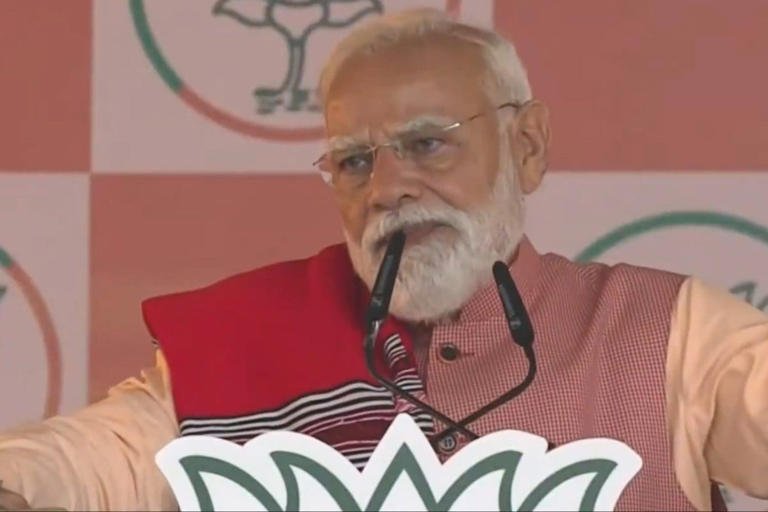
Prime Minister Narendra Modi launched a sharp attack on Congress leader Rahul Gandhi during a high-energy campaign rally in Assam, referring to him as a “self-proclaimed prince” and claiming that he represents a “century of defeats.” The remark has intensified the ongoing political contest in the state ahead of the Assembly elections.
The PM Modi Rahul Gandhi Assam comment came as part of a broader critique of the Congress party’s electoral performance over the years. Addressing supporters, Modi argued that the Congress leadership has repeatedly failed to connect with the aspirations of the people.
The statement quickly gained attention, triggering strong reactions from both BJP and Congress leaders, further heating up the political atmosphere in Assam.
Read More: Himanta expands Orunodoi scheme for women from large families
Modi targets Congress leadership and legacy
During his speech, Narendra Modi questioned the leadership capabilities of Rahul Gandhi. He alleged that Congress has struggled due to what he described as ineffective leadership and outdated political approaches.
The PM Modi Rahul Gandhi Assam remark emphasized what the Prime Minister called a long history of electoral setbacks for the Congress. He argued that voters have consistently rejected the party’s policies and leadership.
Moreover, Modi highlighted the BJP’s narrative of development and governance. He contrasted this with what he termed as Congress’s legacy of missed opportunities.
He also accused the opposition of lacking a clear vision for the future. According to him, leadership should focus on delivering results rather than relying on political lineage.
Congress responds with strong criticism
The remarks by Narendra Modi drew immediate criticism from Congress leaders. Party representatives accused the Prime Minister of using personal attacks instead of addressing key issues.
They argued that such statements divert attention from important topics like unemployment, price rise, and economic challenges. According to Congress, voters are more concerned about these issues than political rhetoric.
Rahul Gandhi himself has often emphasized policy-driven politics. His supporters claim that personal attacks reflect a lack of substantive arguments.
Congress leaders also pointed out that political discourse should remain respectful. They urged leaders to focus on constructive debate rather than targeting individuals.
Assam elections witness intense rhetoric
The PM Modi Rahul Gandhi Assam exchange reflects the increasingly intense nature of election campaigns in the state. Political parties are using strong language to capture public attention and mobilize support.
In Assam, the BJP is focusing on development achievements, infrastructure projects, and welfare schemes. Meanwhile, Congress is highlighting issues related to governance and accountability.
This contrast in narratives has created a highly competitive environment. Both parties are working to strengthen their voter base through rallies, campaigns, and outreach programs.
Moreover, regional dynamics add another layer of complexity. Local issues and community concerns continue to influence voter behavior.
BJP highlights development and governance
As part of his campaign, Narendra Modi reiterated the BJP’s commitment to development in Assam. He highlighted improvements in infrastructure, connectivity, and social welfare programs.
The Prime Minister argued that these achievements demonstrate the effectiveness of BJP’s governance model. He urged voters to support the party to ensure continued progress.
The PM Modi Rahul Gandhi Assam remark was therefore positioned within a broader narrative. It aimed to contrast BJP’s performance with Congress’s track record.
Additionally, BJP leaders have emphasized stability and strong leadership as key factors in their campaign.
Congress focuses on counter-narrative
In response, Congress has sought to shift the focus back to policy issues. The party argues that development claims must be evaluated based on ground realities.
Leaders have highlighted concerns related to employment, economic growth, and social equity. They claim that these issues require urgent attention.
The PM Modi Rahul Gandhi Assam debate has therefore become part of a larger political narrative. Congress is attempting to present itself as a viable alternative.
At the same time, the party is working to strengthen its grassroots presence. It aims to connect with voters through local engagement and targeted campaigns.
Public reaction and electoral implications
The PM Modi Rahul Gandhi Assam remark has sparked varied reactions among the public. Some supporters of the BJP view it as a strong political statement that highlights Congress’s weaknesses.
Others, however, believe that election campaigns should focus more on substantive issues. They argue that personal attacks may not resonate with all voters.
Political analysts suggest that such remarks can energize party supporters. However, their overall impact on voting behavior remains uncertain.
Importantly, voter priorities will play a decisive role. Issues such as development, employment, and governance are likely to influence final decisions.
Broader significance of political rhetoric
The exchange between Narendra Modi and Rahul Gandhi underscores the role of rhetoric in Indian politics. Strong statements are often used to shape narratives and capture attention.
However, experts note that balanced discourse is essential for healthy लोकतांत्रिक engagement. While criticism is a part of politics, it should ideally be accompanied by constructive solutions.
The PM Modi Rahul Gandhi Assam episode reflects the evolving nature of political communication. Leaders are increasingly using sharp language to stand out in a crowded electoral landscape.
At the same time, voters are becoming more discerning. They evaluate not only statements but also policies and performance.
Conclusion
The PM Modi Rahul Gandhi Assam remark has added intensity to the election campaign in Assam. By targeting Rahul Gandhi, Narendra Modi has sought to reinforce BJP’s narrative of strong leadership and development.
Meanwhile, Congress has pushed back, emphasizing the need to focus on real issues. This exchange highlights the competitive nature of the political battle.
In conclusion, as the Assam elections approach, both parties are likely to continue using strong messaging to connect with voters. Ultimately, the electorate will decide which narrative resonates most, shaping the future political landscape of the state.
Read More: Priyanka Gandhi accuses BJP of curbing free speech in Assam