


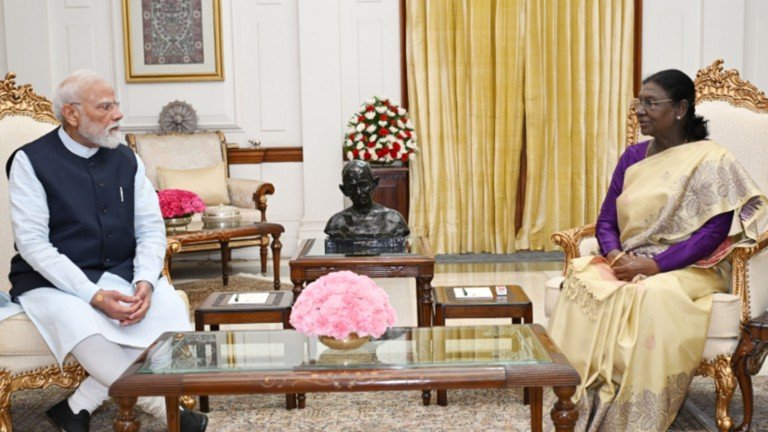
Prime Minister Narendra Modi called on President Droupadi Murmu amid growing political speculation over a possible reshuffle of the Union Cabinet, triggering widespread discussion in political circles and among observers of national affairs. The meeting between the Prime Minister and the President has attracted considerable attention, with many viewing it through the lens of potential changes in the government’s ministerial lineup.
While official details regarding the discussions have not been publicly disclosed, the meeting comes at a time when reports and political conversations regarding possible Cabinet adjustments have gained momentum. Such meetings between the Prime Minister and the President are part of the constitutional framework of governance, but their timing often sparks speculation, particularly when political developments are being closely watched.
The development has led to renewed interest in the functioning of the Union Cabinet and the government’s approach to governance as it continues to pursue its policy priorities and developmental agenda.
Meeting Draws Political Attention
The meeting between Prime Minister Modi and President Murmu quickly became a subject of discussion among political commentators and analysts. Whenever the Prime Minister meets the President during periods of heightened political activity, attention naturally turns to the possibility of administrative or political developments.
Observers noted that while such interactions are a regular feature of governance, the current political context has added significance to the meeting. Reports and discussions regarding a potential Cabinet reshuffle have circulated in recent weeks, leading many to speculate about possible changes in ministerial responsibilities.
Political analysts cautioned, however, that no official announcement has been made regarding any reshuffle, and interpretations remain speculative until confirmed by the government.
Importance of Cabinet Reshuffles
Cabinet reshuffles are a common feature of parliamentary democracies and are often undertaken to improve governance, enhance administrative efficiency, and align ministerial responsibilities with evolving priorities. Governments may periodically review the performance of ministries and make adjustments to strengthen policy implementation.
A reshuffle can involve changes in portfolios, induction of new ministers, promotion of existing members, or reallocation of responsibilities. Such exercises are generally viewed as opportunities to bring fresh perspectives and reinforce administrative effectiveness.
Political experts note that Cabinet adjustments often reflect strategic considerations related to governance, regional representation, policy priorities, and organizational requirements.
Constitutional Role of the President
Under India’s constitutional framework, the President plays an important role in the appointment of ministers. While the Prime Minister advises on ministerial appointments and changes, such decisions are formally executed through the office of the President.
As a result, meetings between the Prime Minister and the President often attract attention when speculation regarding ministerial changes is circulating. Constitutional procedures require coordination between the executive leadership and the President’s office whenever appointments or portfolio changes are made.
Officials have not indicated whether the latest meeting was related to any such developments, but the timing has naturally generated political interest.
Governance and Administrative Priorities
The discussion surrounding a possible reshuffle has also renewed focus on the government’s governance agenda. Since assuming office, the Modi government has emphasized infrastructure development, economic growth, digital transformation, social welfare initiatives, and international engagement.
Political observers suggest that any Cabinet restructuring would likely be evaluated in the context of these priorities. Ministries play a crucial role in implementing government policies, and effective coordination is often considered essential for achieving desired outcomes.
A Cabinet reshuffle, if undertaken, could be aimed at strengthening the government’s ability to deliver on its objectives and respond to emerging challenges.
Speculation and Political Discussions
The possibility of ministerial changes has led to extensive discussions within political circles. Various reports have suggested potential adjustments, although no official confirmation has been provided.
Political parties, analysts, and media organizations often closely monitor developments related to Cabinet composition because such changes can influence governance strategies and political dynamics. Speculation typically increases whenever senior leaders engage in significant meetings or consultations.
Despite the ongoing discussions, government representatives have not publicly commented on any plans regarding a reshuffle. Until an official announcement is made, political observers continue to rely on speculation and analysis rather than confirmed information.
Significance for the Ruling Alliance
Any changes in the Union Cabinet would also carry significance for the ruling alliance. Ministerial appointments often reflect considerations related to regional representation, organizational balance, and political strategy.
Political analysts note that Cabinet composition can influence perceptions of inclusivity and representation within the government. Decisions regarding appointments may therefore be evaluated from both administrative and political perspectives.
At the same time, governance performance remains a key factor in shaping public expectations regarding ministerial responsibilities and effectiveness.
Focus on Development Agenda
The government has repeatedly emphasized its commitment to development-oriented governance and policy implementation. Infrastructure projects, economic reforms, social welfare programs, and technological initiatives continue to form central pillars of its agenda.
Observers believe that any future ministerial changes, if they occur, would likely be assessed in terms of their potential impact on these priorities. Strengthening implementation mechanisms and enhancing administrative efficiency often feature prominently in discussions surrounding Cabinet reviews.
The focus remains on ensuring that government programs are delivered effectively and that development objectives continue to receive sustained attention.
Political Implications of a Potential Reshuffle
Cabinet reshuffles often have broader political implications beyond administrative considerations. They can influence internal party dynamics, leadership structures, and political messaging.
Political observers suggest that changes in ministerial responsibilities can signal evolving priorities or strategic adjustments within a government. As a result, speculation regarding a reshuffle frequently generates considerable public and media interest.
However, analysts also caution against drawing conclusions based solely on meetings or reports, emphasizing that official decisions remain the only reliable basis for assessing political developments.
Looking Ahead
Prime Minister Narendra Modi’s meeting with President Droupadi Murmu has generated significant attention amid ongoing speculation regarding a possible Cabinet reshuffle. While no official details regarding the discussions have been disclosed, the timing of the interaction has fueled political conversations and media interest.
As discussions continue, attention will remain focused on whether any formal announcements emerge in the coming days. Until then, the meeting remains part of the broader political narrative surrounding governance, administrative priorities, and potential ministerial changes.
For political observers, the development underscores the importance of constitutional processes and the role of leadership consultations in the functioning of government. Whether or not a reshuffle ultimately takes place, the episode highlights the continued public interest in the composition and direction of the Union Cabinet.
As the government advances its policy agenda and developmental initiatives, any future decisions regarding ministerial responsibilities are likely to be closely watched by political parties, analysts, and citizens alike. For now, the meeting between the Prime Minister and the President remains a focal point of national political discussion amid persistent speculation about possible changes within the government.