


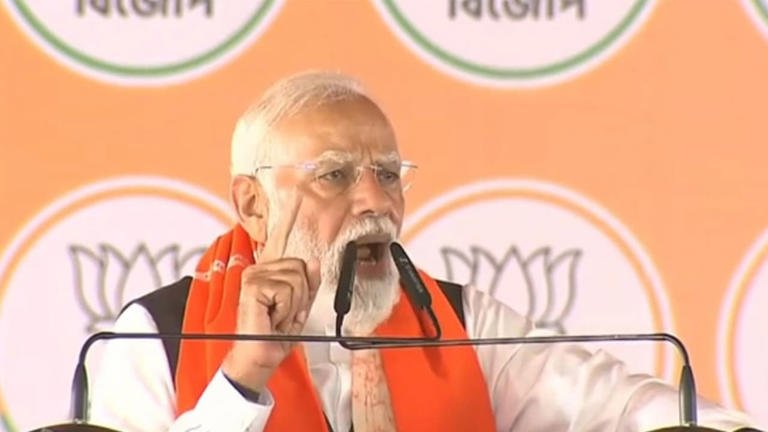
Prime Minister Narendra Modi launched a sharp attack on the ruling All India Trinamool Congress, alleging that West Bengal is witnessing “jungle raj.” He further remarked that “maa is crying,” referring to the condition of the state under the current administration.
The comments came during a high-energy political rally, where Modi addressed supporters and outlined his party’s stance on governance and development. His remarks have intensified the political contest between the BJP and the TMC ahead of the upcoming elections.
Read More: India to sign RE power deals for 10–12 GW in next 3–4 months
Sharp Criticism of TMC Governance
Prime Minister Narendra Modi accused the TMC government of failing to maintain law and order in West Bengal. He claimed that the state has witnessed rising incidents of violence and instability, which have affected ordinary citizens.
According to him, the situation reflects a breakdown of governance, which he described as “jungle raj.” He argued that such conditions hinder development and create an atmosphere of fear among residents.
Furthermore, Modi emphasized that the people of West Bengal deserve a government that ensures safety, stability, and progress. He urged voters to consider these factors while making their electoral decisions.
Emotional Appeal in Campaign Speech
During his speech, Modi used an emotional tone to connect with voters. By stating that “maa is crying,” he sought to highlight what he described as the suffering of the people in the state.
This phrase also carries cultural significance, as it resonates with the image of Bengal as a mother figure. Therefore, the statement aimed to evoke a strong emotional response from the audience.
Political observers note that such appeals often play a key role in election campaigns, as they help leaders establish a personal connection with voters.
BJP’s Campaign Strategy in Bengal
The BJP has been actively campaigning in West Bengal, positioning itself as an alternative to the ruling TMC. The party has focused on issues such as governance, corruption, and development.
Prime Minister Modi’s remarks align with this broader strategy. By criticizing the TMC government, the BJP aims to highlight perceived shortcomings and present its own vision for the state.
In addition, the party has emphasized its achievements at the national level, seeking to build credibility among voters. Campaign rallies, roadshows, and public meetings have formed a key part of this effort.
TMC Responds to Allegations
Leaders from the TMC have strongly rejected Modi’s allegations, calling them politically motivated. They have defended their governance record and highlighted achievements in social welfare and infrastructure development.
The party has also accused the BJP of attempting to create a negative narrative about West Bengal for electoral gain. TMC leaders argue that the state has made significant progress under their leadership.
This exchange of accusations reflects the intense political rivalry between the two parties. Both sides are trying to shape public perception ahead of the elections.
Political Climate in West Bengal
West Bengal remains one of the most politically active states in India. The contest between the BJP and the TMC has created a highly competitive environment, with both parties investing significant resources in their campaigns.
Issues such as law and order, economic development, and social welfare dominate political discussions. Voters are evaluating the performance of the current government as well as the promises made by opposition parties.
In this context, statements by national leaders like Narendra Modi carry considerable weight. They influence not only party supporters but also undecided voters.
Impact on Voter Sentiment
The Prime Minister’s remarks are likely to influence voter sentiment, particularly among those concerned about governance and security. Supporters of the BJP may view his statements as a reflection of strong leadership.
At the same time, TMC supporters may perceive the comments as exaggerated or politically driven. This divergence highlights the polarized nature of the electoral landscape.
Neutral voters, meanwhile, may focus on comparing the claims made by both sides. They are likely to consider factors such as past performance, policy proposals, and leadership qualities before making their decisions.
What Lies Ahead
As the election campaign progresses, more rallies and public statements are expected from leaders of both parties. The political discourse is likely to remain intense, with each side trying to gain an advantage.
The outcome of the elections will depend on how effectively parties connect with voters and address their concerns. While rhetoric plays a role, issues such as development and governance will remain central.
For now, Prime Minister Narendra Modi’s remarks have added momentum to the BJP’s campaign in West Bengal. They underscore the high stakes involved and the fierce competition between the BJP and the TMC as the state moves toward a crucial electoral battle.
Read More: Assam: Kamrup Hargila initiative shines during voting day