

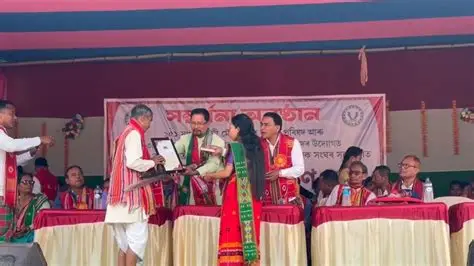
Rabha councils from Assam and Meghalaya held a joint meeting along the Assam–Meghalaya border, placing strong emphasis on education and cultural preservation as key pillars of community development. The interaction brought together representatives from autonomous and traditional bodies to discuss shared challenges and opportunities facing Rabha-inhabited areas on both sides of the inter-state boundary.
Participants said the Rabha councils focus on education and culture reflects a growing consensus that social empowerment and identity preservation must go hand in hand with infrastructure-led development. The meeting also underscored the need for coordination between councils and state administrations to address border-area concerns effectively.
The gathering marked a rare cross-border dialogue aimed at strengthening community ties and aligning development priorities.
Read More: Tripura CM Warns of Exposing ‘Unethical’ Conduct of TTAADC
Rabha councils focus on education and culture
Leaders attending the meet said the Rabha councils focus on education and culture arises from persistent gaps in access to quality schooling and cultural institutions in border regions. They noted that many Rabha villages still lack adequate educational infrastructure, trained teachers, and culturally relevant curricula.
Council members stressed that education should not only improve employment prospects but also preserve Rabha language, history, and traditions. Therefore, they called for textbooks, cultural programmes, and extracurricular activities rooted in indigenous knowledge.
They said education remains the most sustainable tool for long-term community advancement.
Importance of cultural preservation
Cultural preservation formed a central theme of the meeting. Participants said Rabha customs, festivals, oral traditions, and art forms face pressure from modernisation and migration.
The Rabha councils focus on education and culture, leaders said, aims to prevent erosion of identity while embracing progress. They proposed cultural centres, archives, and annual festivals to document and promote Rabha heritage.
Council representatives also emphasised the role of elders and cultural practitioners in transmitting knowledge to younger generations.
Border location shapes shared challenges
The Assam–Meghalaya border location creates unique challenges for Rabha communities, including administrative overlap, access to services, and coordination between states. Participants said these issues often affect education delivery and cultural initiatives.
The meeting highlighted that border villages sometimes fall between jurisdictions, leading to delays in funding and implementation. Therefore, councils called for joint mechanisms to streamline development work.
The Rabha councils focus on education and culture, they said, must account for these ground realities.
Role of autonomous councils
Representatives from bodies such as the Rabha Hasong Autonomous Council discussed their initiatives in Assam, including school support programmes and cultural events. They said collaboration with counterparts in Meghalaya can amplify impact.
Council leaders noted that autonomy offers opportunities to tailor education and cultural policies to local needs. However, they stressed that coordination with state governments remains essential for funding and policy alignment.
The meeting aimed to strengthen institutional cooperation across the border.
Education initiatives discussed
Participants discussed several education-focused proposals, including scholarships for Rabha students, hostels in remote areas, and recruitment of teachers familiar with local language and culture.
They said vocational education and skill training should complement formal schooling to address employment challenges. Linking education with livelihoods, they added, can reduce dropout rates.
The Rabha councils focus on education and culture, leaders said, requires sustained investment rather than short-term schemes.
Cultural exchange and joint programmes
The meeting also explored joint cultural programmes between Assam and Meghalaya. Leaders suggested inter-state cultural exchanges, youth camps, and shared festivals to strengthen unity.
Such initiatives, they said, would reinforce cultural pride and foster mutual understanding among Rabha communities separated by administrative boundaries.
The Rabha councils focus on education and culture thus extends beyond local initiatives to a broader inter-state vision.
Call for government support
Council members urged both Assam and Meghalaya governments to support education and culture-focused initiatives with adequate funding and policy backing. They said councils alone cannot bridge systemic gaps without state cooperation.
Participants called for inclusion of Rabha-specific priorities in state education and culture budgets. They also sought recognition of Rabha language and heritage in official programmes.
The meeting resolved to submit joint representations to the respective state governments.
Youth and women participation
Youth and women representatives highlighted their role in sustaining education and cultural practices. They said empowering women educators and cultural leaders can strengthen community institutions.
Youth leaders called for platforms that allow young people to engage with heritage while acquiring modern skills. They stressed that cultural pride and professional growth need not conflict.
The Rabha councils focus on education and culture, they said, must actively involve younger generations.
Addressing migration and identity concerns
Participants discussed how migration for education and employment affects cultural continuity. While migration offers economic opportunity, it can weaken community ties.
Council leaders suggested community centres and digital platforms to keep migrants connected to Rabha culture. Education programmes, they said, should also prepare youth to represent their identity confidently outside the region.
The focus on education and culture aims to balance mobility with identity.
Outcomes of the meeting
The meeting concluded with a consensus on strengthening cooperation, sharing best practices, and pursuing joint advocacy. Councils agreed to maintain regular dialogue and review progress periodically.
They said the Rabha councils focus on education and culture will guide future initiatives across the border region. The participants expressed optimism that collaborative efforts can deliver tangible results.
What lies ahead
In the coming months, councils plan to formalise proposals discussed during the meeting. Joint memoranda to state authorities are expected to seek support for education infrastructure and cultural programmes.
Participants said follow-up meetings will assess implementation and refine strategies. Sustained engagement, they added, remains crucial.
Conclusion
The meeting of Rabha councils along the Assam–Meghalaya border highlighted a shared commitment to strengthening education and preserving culture as foundations of community development. By prioritising learning, language, and heritage, the councils aim to empower present and future generations.
If supported by effective coordination and government backing, the Rabha councils focus on education and culture could become a model for inclusive, identity-sensitive development in border regions.
Read More: Sikkim Prepares for 2026 Municipal Polls with New Wards