


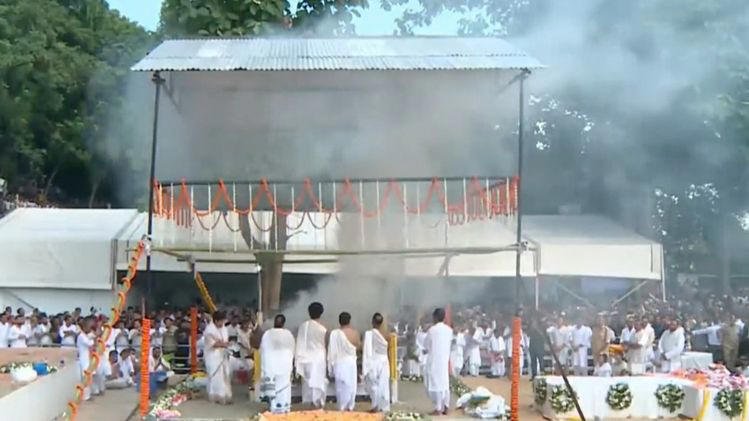
The sudden and tragic passing of Assamese cultural icon Zubeen Garg left an irreparable void in the hearts of millions across Assam and the Northeast. Revered not just as a singer and composer but also as a powerful social voice and filmmaker, Zubeen Da’s influence defined a generation. In a move that reflects the immense public sentiment and his contributions to the state’s cultural renaissance, the Assam government has initiated a high-priority project for the development of Zubeen Garg’s Samadhi Khetra (memorial site) at the cremation ground in Sonapur. This project is a solemn commitment to immortalize the artist, ensuring his legacy continues to inspire.
Read More: CM Manik Saha seeks J P Nadda’s support for Tripura medical college
Special Committee to Oversee Samadhi Khetra Development
To ensure that the memorial is a fitting tribute to a figure of his stature, the Assam government has constituted a special, high-level committee. This crucial body is tasked with guiding every step of the memorial’s construction at Kamarkuchi, Sonapur, the site of his final rites. This isn’t merely a government construction job; it’s a collaborative effort designed to capture the essence of Zubeen Garg’s life.
The committee’s composition is thoughtfully curated, including family members such as his wife, Garima Saikia Garg, and his sister, Palmee Borthakur, alongside prominent personalities from Assam’s cultural and social spheres. This inclusion is vital to ensure that the memorial is imbued with personal and cultural authenticity. The committee’s mandate involves reviewing the initial blueprint prepared by the Public Works Department (PWD), finalizing the design, and providing recommendations to the government. This oversight mechanism guarantees that the final structure is not only a structurally sound monument but also an emotionally and aesthetically resonant space for his fans. The commitment involves developing the 10-bigha plot of land, transforming it into a dignified cultural landmark.
Dual Memorials to Honor a Widespread Legacy
The decision to establish the primary Zubeen Garg’s Samadhi Khetra in Sonapur, near Guwahati, was made in close consultation with the singer’s family. This location respects the family’s wishes, particularly the practical need for a nearby site to perform monthly and yearly rituals, given his father’s ill health. The site’s accessibility is also crucial for the countless fans who wish to pay their respects.
Recognizing Zubeen Garg’s widespread connection across the state, the government has also planned a second memorial in Jorhat, his hometown where he spent his formative years. A portion of his ashes was taken to Jorhat for traditional rituals, and the Jorhat memorial will serve as another focal point for preserving his artistic journey and humanitarian spirit. This dual memorial approach underscores the government’s acknowledgment of his pervasive influence across different regions of Assam. In addition to the Samadhi Khetra projects, a 25-foot bronze statue has also been planned in Morigaon, symbolizing the multi-dimensional efforts to commemorate his contributions.
A Lasting Cultural Landmark for Generations
The establishment of Zubeen Garg’s Samadhi Khetra is more than an act of remembrance; it is an investment in Assam’s cultural heritage. The government’s move to fast-track the memorial’s construction, alongside implementing a fast-track court for legal proceedings related to his demise, highlights the official resolve to honor the icon with both dignity and swift action. The resulting Samadhi Khetra is envisioned to be a pilgrimage site for music lovers, a center for cultural reflection, and a permanent beacon celebrating the legacy of the man who became the undisputed cultural voice of Assam. It will be a place where future generations can connect with the spirit of Zubeen Garg—a star whose music crossed genres and whose passion for his homeland was unparalleled.
Read More: Assam Education Minister Updates on CTET Verification