

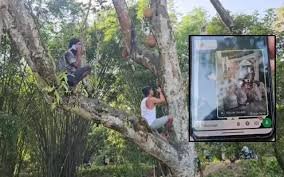
Sribhumi villagers climb trees for mobile signal to overcome poor connectivity amid India’s digital push. Discover their inspiring struggle, efforts, and community hope.
Sribhumi villagers climb trees for mobile signal — that striking reality vividly illustrates the digital gap still present in parts of Assam despite India’s ambitious push toward complete connectivity. Deep in the lush green landscapes of Sribhumi, residents resort to scaling treetops to catch a meager bar of reception, all for a single important phone call or school lesson. Their story is both inspiring and unsettling—shining a light on challenges that need urgent solutions.
The Reality Behind Why Sribhumi Villagers Climb Trees for Mobile Signal
In Sribhumi, a small rural area of Assam, the mobile signal drops sharply as you move away from the village center. Many families live in remote pockets surrounded by dense foliage. With calls dropping and mobile data inconsistently available, villagers have devised a resourceful, albeit inconvenient, workaround: climbing nearby tall trees. From these elevated perches, they manage to access a fragile connection that brings them online—for essential calls, urgent messages, or children’s remote classes.
Daily Life Is Disrupted by Poor Connectivity
For many families, the act of climbing a tree isn’t a rare adventure—it’s a regular, somewhat stressful chore. Mothers climb slender trunks to submit assignments for children’s remote schooling, while others risk wobbly branches to dial doctors or relatives. The act itself speaks volumes: modern needs are met using traditional, makeshift methods. This powerful image of resilience is heartwarming—yet it underscores not just a gap, but a neglect in digital infrastructure.
Community Resilience Seeds Hope
Though the situation is disheartening, what emerges is an uplifting display of community resilience.Sribhumi Villagers Neighbors support each other, lending hands to steady ladders or sharing spotty connections during emergencies. The act of climbing with care, watching out for each other’s safety, carries a communal spirit that warms the heart. The villagers’ determination showcases hope, an underlying optimism that connectivity and change can eventually reach them.
Why This Matters in the Digital India Vision
The Promise of Digital India vs. Ground Realities
India’s Digital India initiative promises universal access to digital services—e-government, remote education, telehealth, etc. Yet, in places like Sribhumi, the gap between promise and reality remains glaring. The fact that Sribhumi villagers climb trees for mobile signal highlights systemic challenges: lack of rural network towers, patchy service from operators, and possibly limited investment in remote areas.
Educational Impact
For students, only occasional connectivity from treetop spots means missed online lessons, incomplete assignments, and diminished opportunities. The educational impact is immediate and consequential. Children are eager and capable, but the digital barrier dims their bright future.
Health and Emergency Communication
In health emergencies, every second counts. When villagers scramble up trees for a signal to call for help, it’s not just inconvenient—it’s dangerous. Mothers dialing for medical advice, elders seeking assistance—every moment of poor connection can have serious implications.
Solutions That Can Make Change Possible
Community-Based Signal Boosters
Portable signal boosters—or community Wi-Fi mesh systems—could be installed at strategic points. These low-cost units could capture and amplify weak signals without requiring each individual to climb trees daily.
Installation of Rural Cell Towers
If telecom operators and local administrations prioritize deploying small cell towers or even mobile base units in areas like Sribhumi, families could access consistent signal in their homes. The digital push isn’t just about urban areas—it must reach these remote hamlets.
Mesh Networks and Satellite Options
Emerging technologies like rural mesh networks or low-orbit satellite internet (e.g., Starlink or other ISPs) could deliver reliable connectivity to far-flung areas—potential game-changers for places where terrain and logistics make traditional towers tough to build.
The Human Story Behind Sribhumi Villagers Climb Trees for Mobile Signal
Let’s walk with a family to feel what this looks like in daily life:
Rani, Sribhumi Villager a school-aged girl, waits anxiously for her online class. Her tablet can only connect when she climbs into her elder brother’s arms, reaching a tall banyan branch. “From up there, I can see the school feed—but it’s bumpy,” she laughs, a brave smile in her voice. The connection drops mid-lesson, and she quietly climbs down, undeterred.
Ramesh, Sribhumi Villager a farmer, climbs a mango tree every day at dawn to check market prices online. He balances carefully, aware that a fall could injure him badly. Yet, knowledge of rates helps him decide where to sell his produce—every rupee counts.
Bhaskar, Sribhumi Villager the village schoolteacher, organizes group sessions. Four children take turns perched atop a sturdy jackfruit tree, attending virtual lessons together. They giggle as they wait; each class is precious.
These scenes are touching, humbling, and charged with hope. They humanize the stark phrase Sribhumi villagers climb trees for mobile signal, reminding us that behind every data bar are real people with stories worth telling.
What You Can Do to Help
- Raise Awareness: Share this inspiring yet sobering story. Awareness can drive action—by policy-makers, NGOs, or local representatives.
- Support Connectivity Initiatives: Many non-profits and social entrepreneurs work on rural digital solutions. Backing or connecting them can help Sribhumi-like communities.
- Encourage Telecom Outreach: Write to service providers or government digital bodies requesting focused attention for remote coverage expansion.
Ream More: PM Modi to Inaugurate Mizoram’s Bairabi-Sairang Railway Line in September