

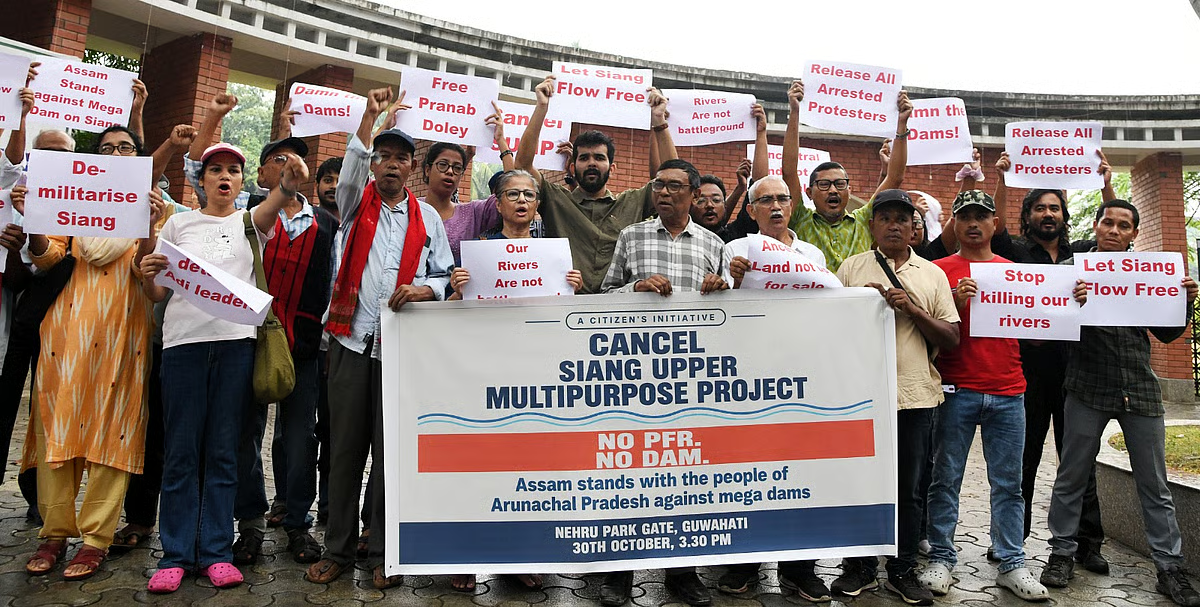
Hundreds of demonstrators gathered in Assam’s Tinsukia on November 20, 2026, to oppose the proposed 11,200-megawatt Siang Upper Multipurpose Project in Arunachal Pradesh. The protest brought together local activists, political representatives and members of organisations from Arunachal Pradesh. They demanded an immediate halt to large hydroelectric projects across Northeast India, citing concerns over indigenous communities, river ecosystems and downstream livelihoods.
The demonstration highlighted growing opposition to mega dam projects in the Siang basin. Organisers also urged the government to reconsider its hydropower development plans in the region.
Manipur Toxic Liquor Tragedy Triggers Urgent Probe
People’s Forum Against Big Dam Organises Tinsukia Protest
The People’s Forum Against Big Dam organised the demonstration near the Tinsukia District Commissioner’s office. It marked the forum’s first sit-in protest in the town against the proposed Siang project.
Hundreds of participants marched through Tinsukia’s main streets. They raised slogans demanding an end to large dam construction across the Northeast. Representatives of several organisations from Arunachal Pradesh also joined the gathering.
Furthermore, protesters carried placards highlighting their concerns about rivers, land and indigenous rights. Their messages called on authorities to consider the interests of communities living near proposed project sites.
Activists said they were not opposing development in general. Instead, they questioned projects that they believe could threaten local lives, livelihoods and natural resources.
President Murmu to Attend Hornbill Festival
Siang Upper Multipurpose Project Draws Regional Opposition
The demonstration focused on the proposed 11,200 MW Siang Upper Multipurpose Project in Arunachal Pradesh. The project is planned on the Siang River and forms part of the region’s wider hydropower development plans.
Its proposed capacity has made it a major subject of public debate. Supporters present the project as a strategic water-management and hydropower initiative. However, opponents have raised concerns about its possible effects on communities and the river basin.
The Siang River flows into Assam, where it joins the Lohit and Dibang rivers to form the Brahmaputra. Therefore, changes to the river system could raise concerns among downstream communities.
Moreover, protesters questioned whether large infrastructure projects adequately address the region’s geological and environmental conditions. They pointed to earthquake risks, landslides and heavy rainfall across the eastern Himalayan region.
The project remains subject to investigation and further development processes. A 2024 parliamentary response described the Upper Siang project as being at the preliminary investigation stage. It also stated that environmental clearance would be required before construction could begin.
Protesters Raise Concerns Over Indigenous Rights and Livelihoods
Participants argued that large dams could affect communities that depend on rivers, forests and agricultural land. They highlighted possible consequences for fishing, farming, biodiversity and traditional livelihoods.
The forum also expressed concern about the impact of multiple projects across Arunachal Pradesh. Its memorandum referred to proposed or ongoing hydropower developments on the Siang, Dibang, Subansiri, Siyom and Kamla rivers.
According to the organisation, these projects could affect indigenous communities and downstream areas in Assam. It urged authorities to examine the combined effects of large dam construction rather than assess each project separately.
Meanwhile, activists called for meaningful consultation with people who could face direct or indirect impacts. They argued that local communities should have a voice in decisions involving their land and natural resources.
Forum Submits Memorandum to Prime Minister
Following the demonstration, the People’s Forum Against Big Dam submitted a memorandum addressed to Prime Minister Narendra Modi through the Tinsukia District Commissioner.
The document demanded an immediate halt to ongoing and proposed mega hydroelectric projects across Northeast India. Chief Advisor Sarat Chandra Neog and Chief Convenor Uttam Kumar Chetia signed the memorandum.
The forum described the Northeast as a geologically fragile and earthquake-prone region. It also cited heavy rainfall and recurring landslides as factors that require careful consideration before large infrastructure projects move forward.
In addition, the memorandum called for the suspension of the proposed Siang Upper Multipurpose Project and the 278-metre-high Dibang Multipurpose Project. It also raised objections to the proposed Demwe Hydroelectric Project on the Lohit River.
The organisation further urged the Centre to raise concerns through international platforms over China’s proposed hydropower development on the Yarlung Tsangpo River in Tibet. The forum argued that large-scale activity upstream could have implications for downstream regions.
Tinsukia Rally Highlights Wider Northeast Debate
The November 20 demonstration brought attention to concerns that extend beyond one proposed dam. Organisations from Assam and Arunachal Pradesh used the gathering to highlight shared interests in river protection, indigenous rights and environmental safeguards.
The debate also involves questions about energy generation, water management, public consultation and regional development. While authorities and project proponents have cited strategic and hydropower objectives, opponents continue to demand stronger safeguards and greater community participation.
The Tinsukia rally therefore added another public demonstration to the ongoing debate over mega dam projects in the eastern Himalayas. The forum has called for an immediate halt to such projects and asked the government to reconsider its approach to hydropower development.
Conclusion
The Tinsukia protest on November 20 brought hundreds of people together against the proposed 11,200 MW Siang Upper Multipurpose Project. With organisations from Arunachal Pradesh joining local demonstrators, the rally highlighted concerns over environmental risks, indigenous livelihoods and downstream communities. The memorandum submitted to the Prime Minister has also placed demands for a halt to mega dam projects before the authorities.
FAQs
1. Why did people protest in Tinsukia on November 20, 2026?
Hundreds gathered to oppose the proposed Siang Upper Multipurpose Project and demand a halt to mega hydroelectric projects across Northeast India.
2. What is the proposed capacity of the Siang project?
The Siang Upper Multipurpose Project has a proposed installed capacity of 11,200 MW.
3. Which organisation led the Tinsukia demonstration?
The People’s Forum Against Big Dam organised the sit-in protest near the Tinsukia District Commissioner’s office.
4. Did organisations from Arunachal Pradesh join the protest?
Yes. Representatives of several organisations from Arunachal Pradesh participated alongside demonstrators from Assam.
5. What did the forum demand through its memorandum?
It sought an immediate halt to ongoing and proposed mega hydroelectric projects across Northeast India.
6. Why are downstream communities concerned about the Siang project?
Opponents fear possible effects on river systems, agriculture, fisheries, biodiversity and livelihoods in downstream areas of Assam.