

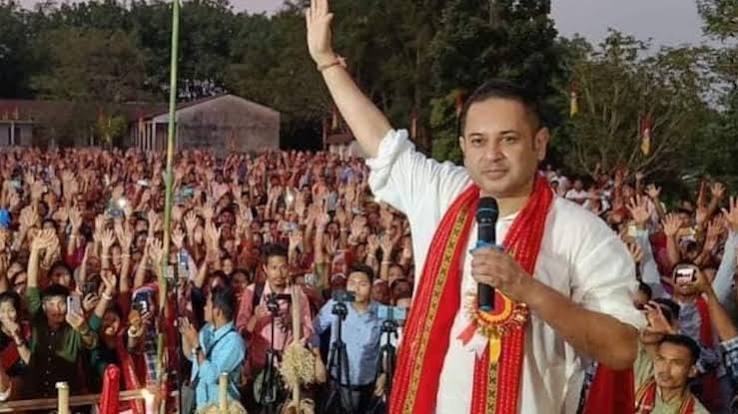
Tiprasa Accord implementation remains the central demand of Tipra Motha founder Pradyot Kishore Manikya Debbarma, who says securing constitutional rights for Tripura’s indigenous community is his responsibility. On October 28, 2026, he reiterated that fulfilling the 2024 agreement mattered more than holding political office. Speaking to reporters after arriving at Maharaja Bir Bikram Airport in Agartala, he expressed concern over delays and referred to discussions with the BJP leadership. His remarks have renewed attention on the agreement and its implications for indigenous rights, governance and political relations in Tripura.
Donyi Polo Airport Upgrades Strengthen Night Operations in Arunachal Pradesh
Pradyot Debbarma Reaffirms Tiprasa Accord Implementation Demand
Pradyot Debbarma reaffirmed his position after arriving in Agartala on October 28. He said the implementation of the Tiprasa Accord remained the principal issue he wanted to resolve.
The Tipra Motha founder stressed that the matter concerned the constitutional rights of the Tiprasa people rather than political positions or personal benefits. He said fulfilling the agreement would benefit Tripura and help address long-standing concerns within the indigenous community.
“There is only one issue, the implementation of the Tiprasa Accord,” he said, according to reports of his interaction with reporters.
Debbarma also recalled assurances made before the Village Committee elections. He said the community had expected progress on the agreement, but concerns remained over delays in fulfilling those commitments.
Moreover, he emphasised that his responsibility to the people would continue even if he stepped away from active politics. He had announced earlier in October that he intended to leave active politics after the following month, citing health reasons.
His latest remarks reinforced the distinction he draws between holding political office and advocating for community rights. He said his commitment would not depend on his future role within the party or the political system.
However, his statement did not provide a detailed implementation timetable. The public also did not receive a complete account of the specific measures discussed with BJP leaders.
The immediate question, therefore, concerns how the governments involved will translate the commitments in the accord into concrete measures. Debbarma has made clear that he expects progress rather than further assurances without a clear outcome.
What the 2024 Tiprasa Accord Seeks to Address
The Tiprasa Accord was signed in March 2024 by representatives of Tipra Motha, the Union government and the Tripura government. The agreement aimed to address issues affecting Tripura’s indigenous population through a negotiated framework.
The agreement has remained an important political commitment for Tipra Motha. The party has repeatedly linked its demand for implementation to constitutional safeguards, indigenous rights and the future of the Tripura Tribal Areas Autonomous District Council (TTAADC).
Land rights and the council’s financial autonomy have featured prominently in discussions about the agreement. These issues matter because the TTAADC administers substantial areas of Tripura under the Sixth Schedule framework of the Constitution.
For indigenous communities, questions of land, representation and access to resources can have long-term consequences. Therefore, the agreement’s implementation has significance beyond party politics.
At the same time, the precise legal and administrative steps required for each commitment matter. Authorities must clarify which provisions require government orders, legislative measures, administrative changes or further consultation.
A credible implementation process would also need to explain the responsibilities of the Union government and the state government. Clear timelines and transparent progress updates could help affected communities understand how the agreement is advancing.
Debbarma has argued that the process should deliver constitutional rights rather than focus on benefits for a small number of political representatives. His position places the wider community at the centre of the demand.
Nevertheless, the accord’s full implementation depends on decisions by the governments involved. Public statements alone do not establish that every commitment has been fulfilled or that a final timeline has been formally notified.
Talks With BJP Leadership and Tripura Government
Debbarma’s renewed statement came amid discussions between Tipra Motha and BJP leaders over the pending agreement. On October 28, he referred to a possible meeting with the BJP, indicating that implementation remained the main issue under discussion.
The following day, reports said he had met Tripura Chief Minister Manik Saha and Chief Secretary J. K. Sinha. Debbarma described the discussions as constructive and said he had received an assurance that implementation would proceed within a time-bound framework.
He also indicated that a further phase of discussions involving the Union government was expected. However, he did not publicly disclose the full details of the discussions or a definitive schedule for implementing individual provisions.
The reported assurance represents a development in the dialogue, but the government’s detailed position remained unclear when the reports appeared. A formal timeline, the division of responsibilities and the measures to be implemented will be important indicators of progress.
Debbarma also clarified that his meeting with the Chief Minister was not intended to negotiate seats or political arrangements for the upcoming Urban Local Body elections. He said he had approached the Chief Minister to discuss the rights of Tripura’s people.
This distinction matters because Tipra Motha is a partner in the BJP-led state government, while the accord remains an unresolved issue between the parties. The demand has therefore continued alongside their political cooperation.
The next stage will depend on whether the discussions lead to formal decisions and measurable action. Both state and central authorities have roles in the process, making coordination essential.
Indigenous Rights and Tipra Motha’s Political Priorities
Tipra Motha has consistently presented the Tiprasa Accord as a central reason for its engagement with the BJP. Debbarma has repeatedly argued that political office should not take precedence over securing the rights of the indigenous population.
The issue also shapes the party’s decisions about future political cooperation. In earlier statements, Debbarma said the party would need to reconsider its political course if the agreement remained unimplemented.
His latest remarks came as Tipra Motha leaders discussed the party’s strategy ahead of the upcoming urban civic elections. The leadership reviewed the agreement’s progress and considered its future course, but had not announced a final decision on participation in the polls as of October 28.
The party’s position creates a link between the accord and its wider political strategy. However, the final decision on electoral participation remains separate from the government’s legal and administrative responsibilities under the agreement.
Debbarma has also called for an approach that protects indigenous rights without harming other communities. He has said that people across Tripura should be able to live peacefully and that the future of children from different communities must remain secure.
That emphasis is important in a state with diverse communities and a complex history of ethnic and political tensions. Effective implementation will require clear rules, consultation and attention to the rights of affected groups.
Ultimately, the accord’s significance will depend on its practical results. Communities will look for clear decisions on the commitments made, while the governments involved will need to demonstrate progress through formal measures and transparent communication.
Conclusion
Pradyot Debbarma has reaffirmed that implementing the Tiprasa Accord remains his sole political priority, even as he considers stepping away from active politics. His October 28 remarks focused on securing constitutional rights for Tripura’s indigenous Tiprasa community and addressing concerns over delayed commitments. He has maintained that the issue concerns the people’s rights rather than political office or personal gains.
The 2024 agreement addresses important questions concerning indigenous rights, land and the functioning of the TTAADC. However, its full implementation requires concrete action by the Union and state governments. Reports of a constructive meeting with Chief Minister Manik Saha and an assurance of time-bound implementation indicate renewed dialogue, but authorities still need to clarify the specific measures and deadlines.
The coming weeks may provide greater clarity on the next phase of discussions and the implementation process. For Tipra Motha, the accord remains closely linked to its political priorities and relationship with the BJP. The decisive measure of progress will be whether the governments translate their commitments into clear, verifiable action while protecting the rights and interests of communities across Tripura.
FAQs
1. What is Pradyot Debbarma’s main demand regarding the Tiprasa Accord?
He wants the Union and Tripura governments to implement the 2024 agreement and secure the constitutional rights of the Tiprasa community.
2. When was the Tiprasa Accord signed?
The tripartite agreement was signed in March 2024 by representatives of Tipra Motha, the Union government and the Tripura government.
3. What issues are associated with the Tiprasa Accord?
Discussions have included indigenous rights, land-related concerns, constitutional safeguards and the financial autonomy of the TTAADC.
4. Did Pradyot Debbarma meet Tripura Chief Minister Manik Saha?
Reports published on October 29 said Debbarma met Chief Minister Manik Saha and Chief Secretary J. K. Sinha. He described the discussions as constructive and said he received an assurance of time-bound implementation.
5. Will Pradyot Debbarma continue to advocate for Tiprasa rights if he leaves active politics?
Yes. He has said that his responsibility to secure the community’s rights will continue regardless of whether he remains active in electoral politics.