

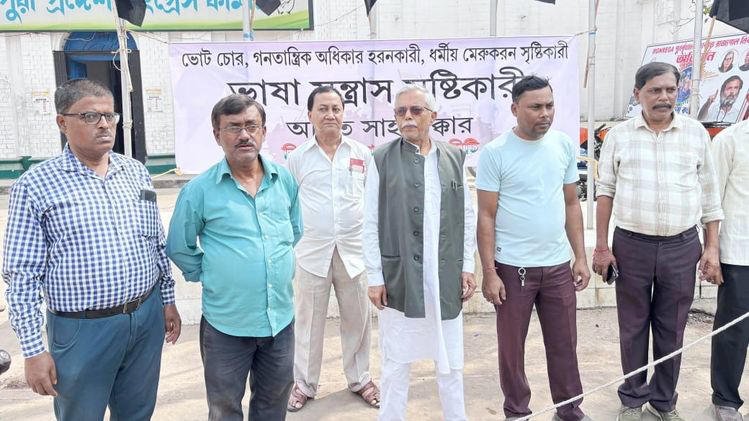
The Tripura Congress protest Amit Shah visit gathered momentum as party workers staged demonstrations ahead of the Union Home Minister’s arrival in the state. Leaders accused the ruling establishment of attempting to impose Hindi through recent language discussions, linking the issue to ongoing debates around Kokborok script policy. As political tensions rose, the Tripura Congress protest Amit Shah visit became a focal point in the state’s evolving political landscape.
Congress leaders organised rallies in several areas, raising slogans and holding placards highlighting concerns over linguistic identity and cultural autonomy. They claimed that recent remarks related to script adoption triggered fears among sections of the population. Therefore, the Tripura Congress protest Amit Shah visit aimed to draw attention to what the party described as an attempt to reshape language policy without adequate consultation.
Read More: Amit Shah backs Devanagari script for Kokborok in Tripura
Tripura Congress protest Amit Shah visit centres on language concerns
During the demonstrations, Congress leaders alleged that discussions around adopting Devanagari script for Kokborok could lead to the gradual imposition of Hindi. They argued that language policies should reflect the preferences of local communities rather than political decisions from outside the state. Moreover, party representatives said linguistic diversity remains a core part of Tripura’s cultural identity.
Speakers at the protest emphasised that the Tripura Congress protest Amit Shah visit does not oppose development initiatives but seeks respect for regional languages. They urged authorities to engage in dialogue with cultural organisations and education experts before taking any decision related to script or language reforms.
Meanwhile, party workers marched through key locations, calling for greater transparency in policy discussions. Observers noted that language issues often carry emotional significance in Tripura, which makes the Tripura Congress protest Amit Shah visit particularly sensitive.
Ruling party responds to allegations
Leaders from the ruling party rejected the Congress claims, stating that no decision has been taken to impose any particular language. They said discussions around scripts focus on educational standardisation and linguistic development rather than political agendas. According to them, the Tripura Congress protest Amit Shah visit reflects an attempt to create controversy ahead of a major political event.
Supporters of the government argued that adopting certain scripts can help strengthen academic resources and improve communication across regions. However, they also maintained that any policy change would involve consultations with stakeholders. As debates continued, both sides called for calm and urged citizens not to spread misinformation.
Political analysts observed that language politics often intensifies before high profile visits. Therefore, the Tripura Congress protest Amit Shah visit may influence the tone of political discourse in the coming days.
Public reactions and community perspectives
Reactions among the public have remained mixed. Some residents supported the Tripura Congress protest Amit Shah visit, saying language and identity deserve careful consideration. Others felt that political parties should avoid escalating tensions and instead focus on constructive dialogue.
Cultural organisations also shared their views, emphasising the importance of preserving Kokborok while promoting educational growth. Several groups suggested that authorities explore inclusive solutions, such as recognising multiple scripts or encouraging broader consultations. Consequently, the Tripura Congress protest Amit Shah visit has sparked wider conversations about language policy and community representation.
Educational experts highlighted the need to balance tradition with practicality. They noted that script decisions can affect textbooks, digital resources, and classroom learning. Therefore, policymakers must consider the long term implications before implementing any changes.
Security and administrative preparations ahead of the visit
As the Tripura Congress protest Amit Shah visit continued, authorities increased security measures across key locations. Police personnel monitored protest sites to ensure peaceful demonstrations and prevent disruptions. Officials urged participants to maintain discipline and follow legal guidelines during rallies.
Administrative teams also reviewed arrangements for the Home Minister’s schedule, which includes meetings with state leaders and public engagements. Despite the protests, officials expressed confidence that the visit would proceed smoothly. They emphasised that democratic expression remains a fundamental right as long as it remains peaceful.
Observers believe that the political atmosphere surrounding the Tripura Congress protest Amit Shah visit reflects broader debates about governance and cultural identity. Such discussions may shape future political narratives in the state.
Political implications after Tripura Congress protest Amit Shah visit
The Tripura Congress protest Amit Shah visit highlights the growing importance of language issues in regional politics. Analysts suggest that debates around script and identity could influence party strategies ahead of upcoming elections. While Congress leaders have framed the protests as a defence of cultural autonomy, the ruling party has accused the opposition of politicising sensitive matters.
As the situation evolves, many leaders have called for dialogue and mutual respect. They emphasised that language policies should strengthen unity rather than create divisions. Consequently, the Tripura Congress protest Amit Shah visit may serve as a catalyst for broader discussions on linguistic diversity and governance in Tripura.
With political activity intensifying, the coming days will reveal how the debate unfolds during and after the Home Minister’s visit. For now, the Tripura Congress protest Amit Shah visit remains a significant development that underscores the intersection of language, culture, and politics in the state.