

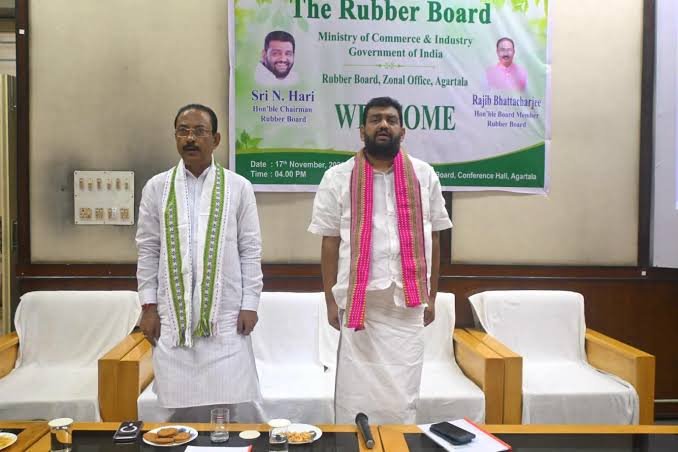
Tripura is stepping up efforts to strengthen its rubber industry through better production quality, local manufacturing and additional income opportunities for growers. On November 18, 2026, the Tribal Welfare Department held a meeting with agencies implementing the Chief Minister’s Rubber Mission and Rubber Board Chairman N. Hari. The discussions focused on improving rubber sheet quality, promoting rubber-based industries and exploring beekeeping in rubber plantations. Officials also discussed a phased action plan for post-plantation activities. These measures aim to help growers earn more from rubber cultivation while increasing the value of locally produced raw materials.
Tripura: Radhacharan Debbarma Criticises BJP Government Over Civic Issues During AMC Poll Campaign
Tripura Reviews Chief Minister’s Rubber Mission
The Tribal Welfare Department convened the meeting with representatives of the agencies implementing the Chief Minister’s Rubber Mission. Participants included the Tripura Tribal Areas Autonomous District Council (TTAADC), TRP & PTG and the Rubber Board.
Rubber Board Chairman N. Hari attended the discussions along with officials from the participating institutions. The meeting reviewed progress under the mission and considered ways to strengthen its economic benefits for rubber-growing communities.
Officials appreciated the collective efforts of the Tribal Welfare Department and implementing agencies for exceeding the targets set under the programme.
The discussion also focused on moving beyond plantation expansion. Officials recognised the need to improve processing, product quality and local industrial use so that growers can receive better returns from their produce.
Rubber Sheet Quality to Receive Greater Attention
Improving the quality of rubber sheets emerged as a major priority during the meeting. N. Hari stressed the need for intensive training and capacity-building programmes for rubber growers.
Better production practices can help farmers produce cleaner and more consistent rubber sheets. This can improve product quality and make locally produced rubber more attractive to buyers and manufacturers.
Training may also help growers strengthen their harvesting and processing techniques. However, officials have not announced a detailed training calendar or a specific number of beneficiaries for the latest initiative.
The Tribal Welfare Department’s Additional Secretary, Subhashis Das, highlighted the need for a phased action plan. The department agreed to facilitate training and other necessary support for the proposed activities.
Government Pushes Rubber-Based Manufacturing
Another major focus involves expanding rubber-based industries within Tripura. The Rubber Board chairman stressed that the state should make greater use of its locally produced rubber instead of depending mainly on raw-material sales.
Downstream manufacturing can create additional value from rubber before products reach consumers. It can also support processing units, transport services, traders and other businesses connected to the supply chain.
Tripura has substantial potential in this sector because it ranks among India’s leading natural rubber producers. However, the state’s industrial policy has identified limited local value addition as an important gap.
Encouraging rubber-based manufacturing could help address this challenge. It may also create new employment opportunities and strengthen connections between plantation growers and local industries.
The November meeting discussed the need to promote such industries, but officials have not announced specific new factories, investment amounts or implementation deadlines.
Rubber Honey Proposal Could Add Farmer Income
The meeting also explored an additional income opportunity through beekeeping in rubber plantations.
The proposal involves placing beekeeping activities within rubber-growing areas and producing what officials and reports described as rubber honey. This could give plantation-dependent families another source of earnings alongside income from rubber latex.
The idea could also encourage growers to diversify their activities without moving away from existing plantations.
However, the proposal remains under consideration. Officials have not yet announced a rollout date, production target, investment requirement or number of participating farmers.
A phased plan and appropriate training will be important before growers can adopt the activity on a wider scale.
₹27.50 Crore Rubber Processing Support in Tribal Areas
The latest discussions build on earlier investment in rubber processing infrastructure. In February 2026, the Tribal Welfare Department sanctioned ₹27.50 crore under the Centre’s Special Assistance to States for Capital Investment scheme for rubber processing facilities in tribal areas.
The allocation supports the Rubber Processing Scheme, which aims to establish local rubber sheet production units.
The planned infrastructure includes smoke houses, roller machines and skill development training. Officials estimated the cost of each unit at approximately ₹75 lakh.
Local processing facilities can help growers improve the quality and marketability of rubber sheets. They can also reduce dependence on outside processing arrangements and intermediaries.
The February allocation represents a separate, previously sanctioned measure. It should not be confused with a new financial package announced during the November meeting.
Chief Minister’s Rubber Mission Supports Tribal Livelihoods
The Chief Minister’s Rubber Mission remains a major part of Tripura’s efforts to expand rubber cultivation and improve rural incomes.
The mission began on August 14, 2021, with an initial plantation target of 30,000 hectares. The government later increased the target to 69,000 hectares.
According to figures reported by the Tribal Welfare Department in September 2026, rubber cultivation covered 69,944.45 hectares and benefited 89,895 people.
The mission also supports training, capacity building, processing and value addition. Its implementation involves several institutions, including the Tribal Welfare Department, Rubber Board, NABARD, TTAADC and other state agencies.
These activities aim to strengthen long-term livelihoods, particularly among tribal and marginalised communities.
Tripura Seeks Greater Value from Its Rubber Economy
Tripura’s rubber sector supports a wide network of growers, plantation workers, processors, traders and transport operators. Expanding local manufacturing could create stronger links between these groups.
The latest government discussions reflect a broader shift towards value addition and income diversification. Better rubber sheet quality, processing facilities and rubber-based industries could help the state retain more economic value within its own economy.
Meanwhile, the proposed beekeeping initiative could offer plantation families another livelihood option.
The next stage will depend on detailed action plans, training support and coordination among implementing agencies. Clear timelines and practical assistance will determine how quickly the proposed initiatives reach growers.
Conclusion
Tripura is pursuing a wider strategy to strengthen its rubber economy through improved product quality, local manufacturing and supplementary farmer incomes. The November 18 meeting under the Chief Minister’s Rubber Mission highlighted grower training, rubber-based industries and proposed honey production through plantation beekeeping. These discussions build on earlier investments in processing infrastructure and the expansion of rubber cultivation. If implemented effectively, the initiatives could improve product value and create additional livelihood opportunities for rubber-growing communities.
FAQs
1. What new rubber industry initiatives has Tripura discussed?
The state has discussed improving rubber sheet quality, promoting rubber-based industries and exploring beekeeping and honey production in rubber plantations.
2. Who attended the November 18, 2026, rubber development meeting?
Rubber Board Chairman N. Hari attended the meeting with the Tribal Welfare Department, TTAADC, TRP & PTG and other implementing agencies.
3. What is the purpose of training rubber growers?
Training aims to improve harvesting and processing practices so growers can produce higher-quality rubber sheets and improve their market value.
4. How could rubber honey benefit plantation owners?
Beekeeping in rubber plantations could provide growers with supplementary income alongside earnings from rubber latex.
5. How much funding did Tripura sanction for rubber processing infrastructure in 2026?
The Tribal Welfare Department sanctioned ₹27.50 crore in February 2026 for processing infrastructure in tribal areas.
6. How many people have benefited from the Chief Minister’s Rubber Mission?
Figures reported in September 2026 stated that the mission had benefited 89,895 people and brought 69,944.45 hectares under rubber cultivation.