


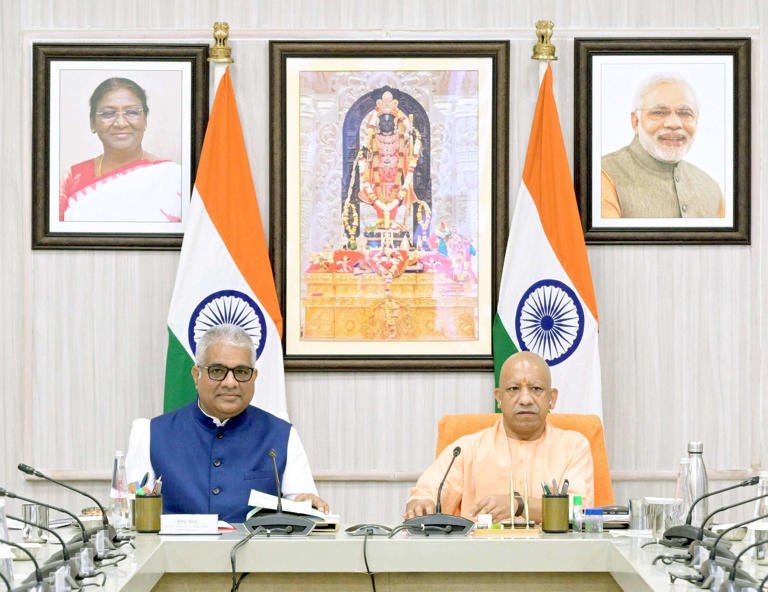
Uttar Pradesh Chief Minister Yogi Adityanath and Union Environment Minister Bhupender Yadav reviewed measures to control air pollution in the National Capital Region on September 18. The meeting took place at the Chief Minister’s residence in Lucknow.
The review focused on eight Uttar Pradesh districts linked to the NCR. These include Noida, Ghaziabad, Hapur, Meerut and Bulandshahr. Officials examined measures covering vehicle emissions, industrial pollution, road dust and waste management.
The meeting came ahead of the winter months. Air quality often deteriorates across the NCR during this period. The Centre and Uttar Pradesh government therefore discussed measures to implement pollution-control plans before the winter pollution season.
Focus on Eight NCR-Linked Districts
The meeting covered pollution-control measures in eight Uttar Pradesh districts that form part of the NCR. Noida, Ghaziabad, Hapur, Meerut and Bulandshahr were among the districts discussed.
Officials reviewed existing measures and examined areas that require stronger implementation. The discussions focused on major local sources of pollution and coordination between different departments.
The strategy also seeks to strengthen coordination with other NCR states. Pollution moves across administrative boundaries, making joint action important for the region.
Vehicle Pollution Comes Under Review
Vehicular emissions formed one of the key areas of discussion.
Yadav said the meeting examined measures related to old vehicles, Uttar Pradesh’s new electric vehicle policy, electric buses and mandatory pollution certificates. Officials also discussed vehicles operated by aggregators.
The focus on older vehicles comes as authorities seek to reduce emissions from high-polluting vehicles. Greater use of electric buses and other cleaner vehicles also forms part of the proposed approach.
Officials will need to coordinate transport departments and local authorities to implement these measures effectively.
Push for Electric Mobility
Electric mobility received attention during the review.
The government plans to accelerate the deployment of electric buses and charging infrastructure across NCR municipal areas. The Centre has also called for better implementation of the EV policy.
Electric buses can reduce direct tailpipe emissions in urban areas. However, wider adoption also requires adequate charging infrastructure and supporting systems.
The government is therefore looking at electric mobility as part of a broader strategy rather than as a standalone measure.
Industrial Pollution Monitoring
Industrial emissions formed another major part of the discussions.
Officials informed the meeting that around 80 per cent of industries have installed Online Continuous Emission Monitoring Systems, or OCEMS. These industries have also installed air pollution control devices.
Authorities are working to cover the remaining industrial units. The monitoring systems can provide data on emissions and help regulators identify cases that require action.
The Centre has also stressed stronger enforcement against industries that fail to comply with pollution-control requirements.
Dust Pollution Gets Special Attention
Road and construction dust remain important sources of pollution in NCR cities.
The meeting discussed a detailed plan for mechanised and deep cleaning. The approach aims to improve road cleanliness and reduce the amount of dust entering the air.
The Centre has also proposed measures such as better road management, roadside greening and monitoring of mechanical road-sweeping machines. The government wants machines to use geo-tagging for real-time monitoring.
These measures will require regular monitoring by municipal bodies.
Waste Management Rules to Be Enforced
Solid waste and construction waste also featured in the meeting.
Officials discussed the implementation of the Solid Waste Management Rules and Construction and Demolition Waste Management Rules. The Centre and state government plan to hold consultations with departments and other stakeholders.
Improper waste disposal can create local pollution and contribute to poor air quality. Construction waste can also generate significant dust when authorities do not manage it properly.
The proposed consultations aim to improve implementation at the local level.
Stubble Burning Remains a Concern
Stubble burning also remains part of the wider NCR pollution strategy.
Yadav said the Centre is coordinating with the Union Agriculture Ministry and agriculture departments of states concerned with crop-residue management.
The government plans to work with states to reduce stubble burning during the harvest season. The issue has remained part of discussions on seasonal pollution in the NCR.
Coordination between agriculture and environment departments will be important for implementing alternatives to open-field burning.
Coordination With Other NCR States
The Centre is also seeking cooperation from other states in the NCR region.
Yadav said he had already met Haryana Chief Minister Nayab Singh Saini and Delhi Chief Minister Rekha Gupta. Further discussions with the chief ministers of Rajasthan and Punjab are planned.
These meetings aim to improve coordination across state borders. The approach recognises that pollution sources in one state can affect air quality in another.
A coordinated regional strategy can therefore help authorities address common sources more effectively.
More Than 30 Meetings Held Since December
Yadav said more than 30 meetings have taken place since December to strengthen pollution-control efforts across the NCR.
The Commission for Air Quality Management has also engaged with local bodies and public representatives in 63 smaller cities. Authorities have directed these local bodies to appoint nodal officers to oversee implementation.
The move aims to improve accountability at the local level. Nodal officers can help coordinate different departments and track progress on pollution-control measures.
City-Specific Action Plans Prepared
The Centre has prepared detailed action plans for municipal corporations across the NCR.
These plans are designed to address local pollution sources rather than applying a single approach to every city. Officials will focus on issues such as road dust, waste, vehicle emissions and industrial pollution based on local conditions.
Yadav said the government has now moved towards implementing city-specific plans in each state. The approach also involves local governments, panchayats and other stakeholders.
Preparing for the Winter Pollution Season
The September 18 meeting comes before the period when NCR cities typically face increased pollution levels.
The discussions focused on implementing preventive measures ahead of winter. Authorities want local bodies and departments to act before pollution levels rise sharply.
The strategy combines several measures. These include cleaner transport, industrial monitoring, dust control, waste management and crop-residue management.
The Centre and Uttar Pradesh government will also continue coordination with other NCR states.
Public Participation Seen as Important
Yadav has also highlighted the role of public participation in improving air quality.
Authorities alone cannot address every source of pollution. Residents, businesses, industries and local organisations also play a role in reducing emissions and managing waste.
The government has therefore sought greater involvement from local bodies and communities. Officials have linked public participation with the effective implementation of city-level action plans.
Wider NCR Strategy Takes Shape
The meeting between Yogi Adityanath and Bhupender Yadav adds to the Centre’s ongoing efforts to address air pollution across the NCR.
The strategy covers several major pollution sources. It combines measures targeting old vehicles, industrial emissions, road dust, construction waste, solid waste and stubble burning.
The Centre has also begun discussions with other NCR states and local bodies. With winter approaching, authorities are now focusing on implementing the prepared plans at the city and district levels.
The effectiveness of the strategy will depend on enforcement, coordination and timely implementation across the region.