

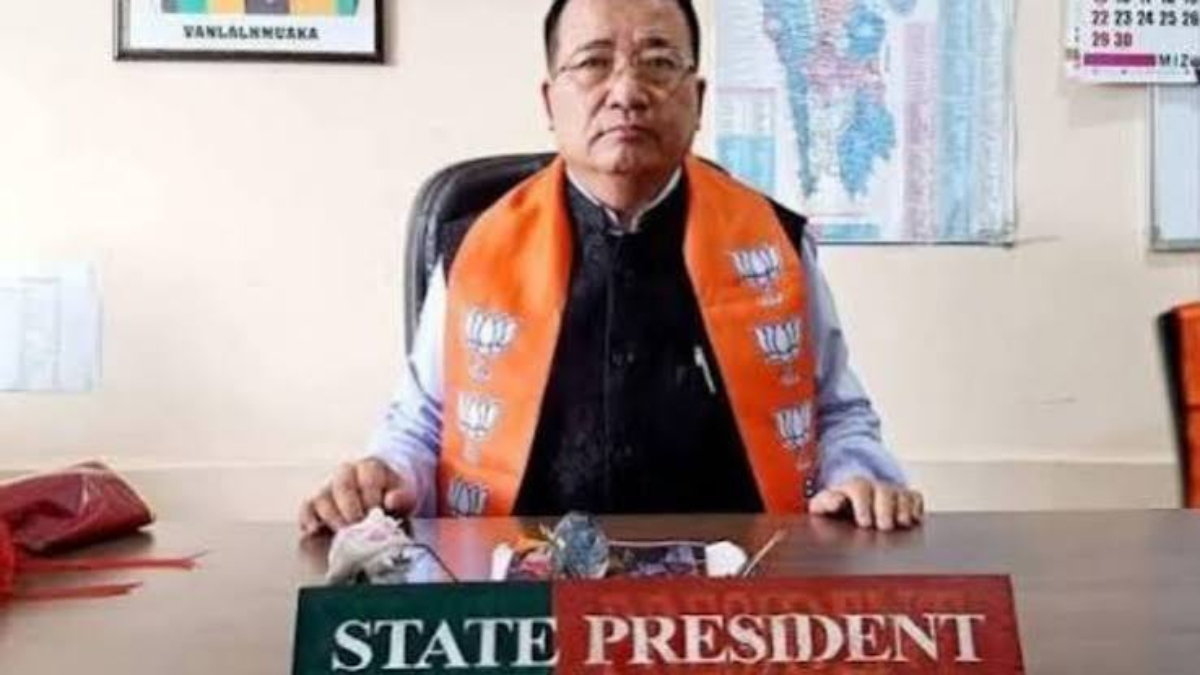
BJP Mizoram 2028 has emerged as a clear political target for the Bharatiya Janata Party as it seeks to expand its footprint in the northeastern state and form its first government in Mizoram. State BJP president Dr K. Beichhua has said the party will work towards becoming the “brightest alternative” for voters and aims to form the government after the 2028 Assembly elections.
The announcement marks a significant step in the BJP’s long-term strategy in Mizoram. The party currently has two legislators in the 40-member Mizoram Assembly, while the ruling Zoram People’s Movement (ZPM) has 27 seats, followed by the Mizo National Front (MNF) with 10 and Congress with one.
BJP Mizoram 2028 strategy gains momentum
Beichhua made the latest remarks during a political programme at the BJP’s state office in Aizawl on August 28. He said the central leadership would support the Mizoram unit in its efforts to strengthen the organisation and prepare for the next Assembly election.
The BJP state president recently attended a meeting in New Delhi chaired by BJP national president Nitin Nabin. According to Beichhua, the Mizoram unit’s organisational activity report received appreciation from the central leadership, with party workers’ unity and cooperation highlighted as strengths.
The party’s strategy is focused not only on electoral campaigning but also on strengthening its grassroots network. Beichhua has previously said that the BJP intends to establish more units in rural areas and increase its organisational presence across the state. In 2025, he claimed the party had 327 units and more than 75,000 members in Mizoram.
Development remains BJP’s main pitch
The BJP is linking its electoral ambitions to a development-focused message. Beichhua has argued that stronger coordination between Mizoram and the Centre can help accelerate infrastructure and other development projects.
Road connectivity is one of the issues highlighted by the state BJP. In July 2025, Beichhua said that improving National Highway 306, regarded as a key lifeline connecting Mizoram with Assam and the rest of India, would be a priority if the BJP came to power. He also spoke about filling vacancies in departments such as the police.
The party has also pointed to central funding as part of its development argument. In March 2025, the Mizoram BJP said the Centre had approved projects worth Rs 60 crore for Siaha district, including a hospital, youth centre, hostel, school buildings and other infrastructure.
Youth outreach gets greater focus
Youth participation is another important component of the BJP’s 2028 strategy. Beichhua has called on young people to join the party and take a more active role in politics. The state unit has indicated that expanding opportunities for younger workers will be part of its organisational efforts ahead of the election.
The BJP also faces the challenge of addressing its image among sections of Mizoram’s predominantly Christian population. Beichhua has previously said the party would conduct awareness campaigns to counter the perception that it is anti-Christian, while stressing its stated commitment to respecting all religions and promoting development.
A tougher contest against ZPM and MNF
The BJP’s road to government will not be easy. The ZPM swept the 2023 Assembly election with 27 seats and currently leads the state government under Chief Minister Lalduhoma. The MNF remains the principal opposition force with 10 legislators.
Recent political developments, however, have created an interesting landscape. In June, the ZPM won its first Rajya Sabha seat after K. Laltluangkima secured 26 of 36 votes cast in the Assembly. Two BJP MLAs abstained from the vote.
At the local level, the BJP and ZPM also joined hands in June to form the Chakma Democratic Alliance Legislature Party in the Chakma Autonomous District Council. Lalduhoma later clarified that the arrangement was a local political necessity and did not mean the ZPM had joined the BJP-led NDA.
BJP seeks a larger electoral footprint
For the BJP Mizoram 2028 campaign, converting organisational expansion into votes will be the central challenge. The party has already identified development, youth participation, rural outreach and closer coordination with the Centre as key themes.
With the 2028 election still ahead, the BJP has time to expand its network and build a wider voter base. Whether that effort can translate into a majority in the 40-member Assembly will depend on the party’s ability to compete with Mizoram’s established regional political forces while maintaining a strong grassroots presence.
The BJP’s latest declaration makes one point clear: Mizoram is no longer being treated merely as a state where the party seeks incremental gains. It is now being presented as a serious long-term target for government formation in the 2028 Assembly polls.
Asmita Dey Wins Historic Commonwealth Gold as Tripura Assembly Hails Judo Star