

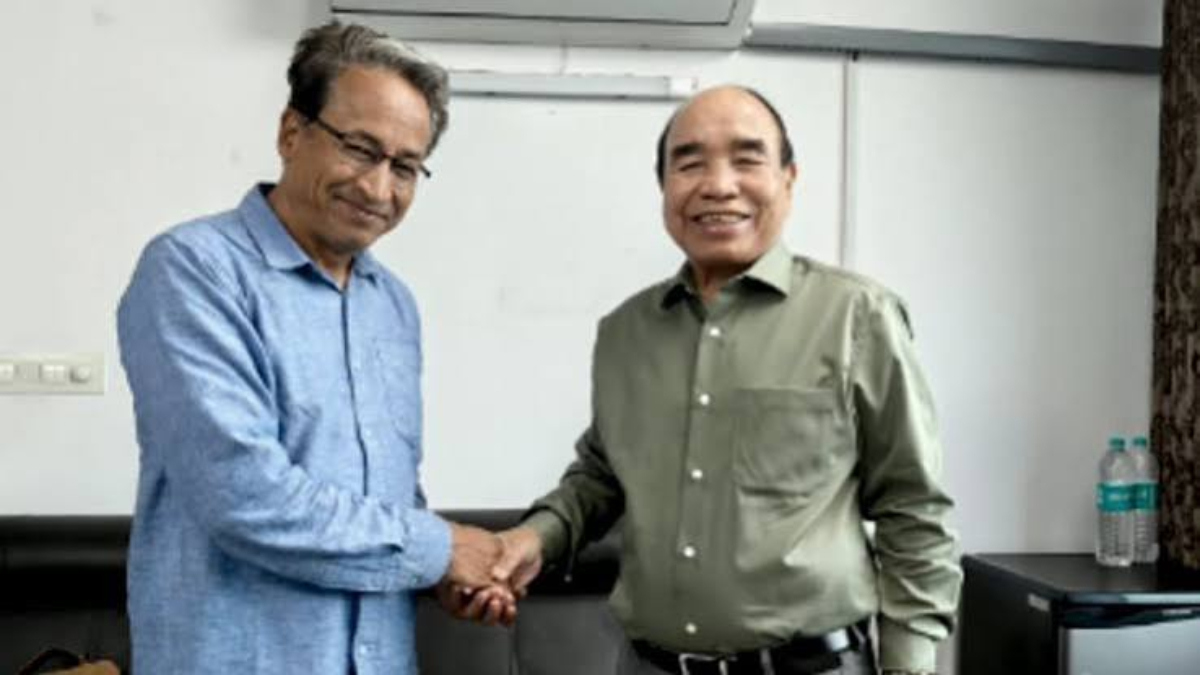
Mizoram Peace Accord has drawn renewed attention after Ladakh-based activist, engineer and educator Sonam Wangchuk met former Mizoram Chief Minister and Mizo National Front (MNF) president Zoramthanga in New Delhi to study the state’s experience of conflict resolution and reconciliation.
Wangchuk met Zoramthanga at Mizoram House on September 28. The meeting lasted for more than an hour and focused on the peace process, political and social issues, and the circumstances surrounding the settlement between the Government of India and the MNF.
Why the Mizoram Peace Accord matters
The Mizoram Peace Accord was signed on June 30, 1986, between the Government of India, the Government of Mizoram and the Mizo National Front. The Memorandum of Settlement sought to end years of armed conflict and restore normalcy in the state.
Under the agreement, the MNF committed to bringing its underground personnel into the mainstream with their arms and ammunition, returning them to civilian life and giving up violence. The settlement also covered political, administrative and economic issues linked to restoring peace and normalcy.
The accord marked a major transition in Mizoram’s political history. The state subsequently attained statehood on February 20, 1987, becoming the 23rd state of the Indian Union.
The agreement completed 40 years in June 2026. During this year’s Remna Ni observance, Mizoram Governor General Vijay Kumar Singh described the accord as a historic settlement that ended years of conflict and opened a new phase of reconciliation and development.
Sonam Wangchuk seeks lessons from Mizoram
During his meeting with Zoramthanga, Wangchuk expressed interest in studying Mizoram’s settlement and understanding the experiences of those involved in the peace process.
“I want to study a successful Memorandum of Settlement like the one in Mizoram,” Wangchuk said, according to reports. He also said he wanted to better understand Zoramthanga’s experiences and role in the process that led to the peace accord.
Zoramthanga shared details about the circumstances surrounding the agreement and the reconciliation process. According to the MNF, he highlighted the role played by the Centre in facilitating negotiations and bringing different stakeholders into the settlement.
The former chief minister also described the agreement as a durable peace settlement that has attracted interest from people and organisations studying conflict resolution and reconciliation.
Link to Ladakh’s ongoing concerns
Wangchuk’s interest in the Mizoram Peace Accord comes against the backdrop of his involvement in issues concerning Ladakh.
Ladakhi groups have been seeking greater constitutional safeguards for the Union Territory, with demands including statehood, Sixth Schedule protection, a dedicated public service recruitment mechanism and separate Lok Sabha representation for Leh and Kargil. Discussions between Ladakhi representatives and the Union government have continued over the demands and the form of safeguards sought.
Against this background, Mizoram’s experience offers a historical case study of how an armed movement moved towards a negotiated settlement and constitutional politics. However, the circumstances of the two regions are distinct, and the Mizoram agreement was shaped by its own political, historical and social context.
Zoramthanga’s role in the peace process
Zoramthanga was associated with the MNF during the insurgency period and later became the party’s president and chief minister of Mizoram. His political experience therefore formed a central part of Wangchuk’s interest in understanding the settlement.
The meeting also included discussions on contemporary issues and reconciliation. Wangchuk subsequently invited Zoramthanga to visit Ladakh, according to the MNF statement.
A 40-year-old settlement returns to focus
The renewed attention to the Mizoram Peace Accord comes in its 40th anniversary year. Mizoram has continued to present the settlement as an important part of its modern political history, while the agreement has also attracted wider interest among those examining peacebuilding and conflict resolution.
For Wangchuk, the meeting with Zoramthanga provides an opportunity to examine the negotiations and implementation of a settlement that transformed Mizoram’s political trajectory. His proposed study could also bring renewed public attention to the experiences of leaders, institutions and communities that participated in the peace process.
The interaction between Wangchuk and Zoramthanga has therefore placed Mizoram’s four-decade-old peace settlement in a new context. Their discussions underline continuing interest in how negotiated settlements can move conflicts towards reconciliation, democratic participation and constitutional politics.