

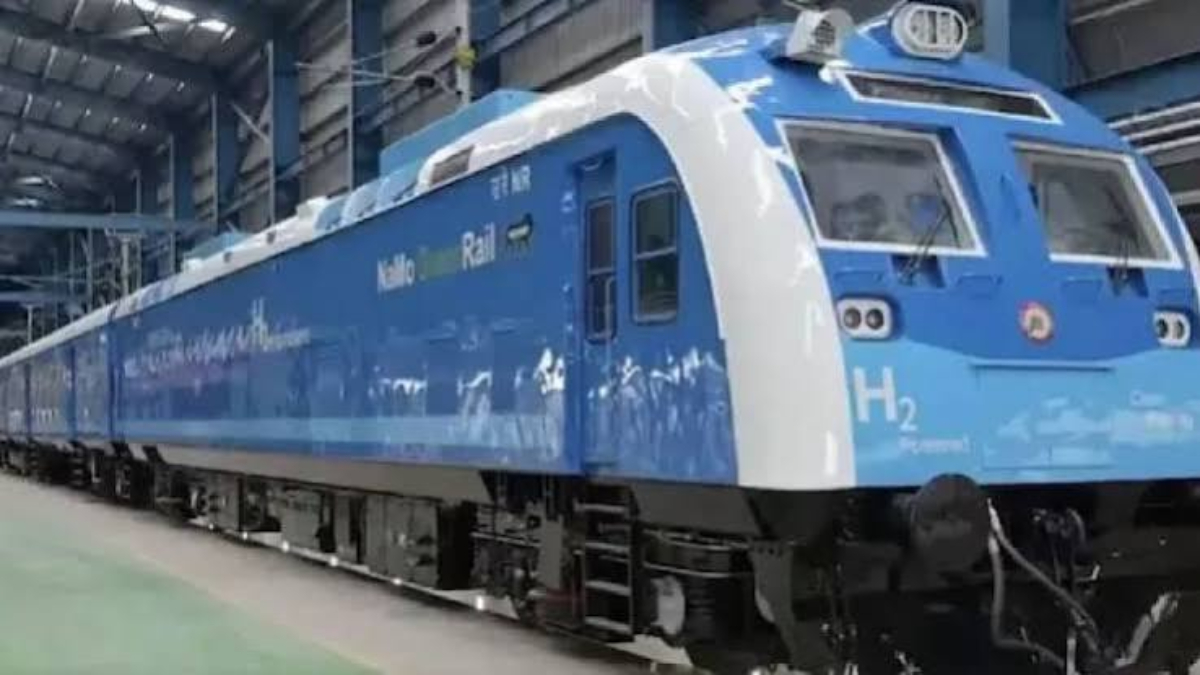
Hydrogen train operations in India are set for a major speed upgrade after the country’s first hydrogen-powered passenger service completed trials at 120 kmph. Indian Railways is now working to operate the train at speeds of up to 110 kmph, Railway Board Chairman and CEO Satish Kumar said on Sunday. The move could mark an important step in expanding clean-energy rail transport beyond its current operating speed.
120 kmph trial marks key milestone
The final high-speed trial was conducted on the Jind-Sonipat section in Haryana on June 26. During the test, the train reached 120 kmph as railway officials assessed its speed, braking performance, stability and other technical parameters. The successful trial cleared an important stage in preparations for wider operations.
The train was subsequently launched for commercial service on the Jind-Sonipat route in July. The 89-km section currently remains the first operational route for India’s indigenous hydrogen-powered passenger train.
Although the train has demonstrated that it can run at 120 kmph during testing, its operational speed has so far been kept at 75 kmph. Railway authorities are now examining the technical requirements needed to raise the maximum regular speed to 110 kmph.
Hydrogen train technology developed in India
The train is a 10-coach fuel-cell-powered set developed with indigenous technology. It consists of two driving power cars and eight trailer coaches. Each power car houses hydrogen fuel cells, lithium iron phosphate batteries and hydrogen storage systems.
According to the Ministry of Railways, the two power cars together provide enough power to take the train to its designed speed of 110 kmph. The fuel cells generate electricity through an electrochemical reaction involving hydrogen and oxygen. Water vapour is the direct by-product at the point of use, eliminating smoke and direct carbon emissions during operation.
The train also incorporates multiple safety systems designed to detect hydrogen leaks, heat, flames and smoke. A dedicated hydrogen production, storage and refuelling facility has been established at Jind to support the service.
What the 110 kmph plan means
The proposed speed increase would bring the train closer to its designed operating capability. It could also make hydrogen-powered services more practical on routes where faster passenger movement is required.
However, the Railways is not treating the speed upgrade as an automatic change. Satish Kumar said consultations are underway with stakeholders to determine suitable sections for the train. Technical considerations and arrangements for a reliable hydrogen fuel supply are also being examined.
Expansion plans for green rail transport
The latest development comes as Indian Railways looks to expand the use of hydrogen beyond the pilot service. The national transporter has an initial plan for 35 hydrogen-powered trains under its “Hydrogen for Heritage” programme, aimed particularly at heritage, hill and other routes where conventional electrification can be difficult or less practical.
The Jind facility is significant in this wider strategy because reliable hydrogen production, storage and refuelling infrastructure will be essential if more trains are introduced. Railways is also examining ways to increase the number of green hydrogen suppliers and reduce fuel procurement costs as the programme expands.
A step towards cleaner railway mobility
The development of India’s hydrogen rail programme reflects a broader effort to reduce fossil-fuel dependence and introduce cleaner transport technologies. Hydrogen-powered trains can be particularly relevant for non-electrified routes, although their wider adoption will depend on factors such as fuel availability, infrastructure, costs and operational safety.
For now, the successful 120 kmph trial and the plan to raise regular speeds to 110 kmph represent significant progress. If the required technical and fuel-supply arrangements are completed, the hydrogen train could become an important part of India’s efforts to build a cleaner and more flexible railway network.
Mizoram Universal Healthcare Scheme Expands Reach With 3.2 Lakh Families