


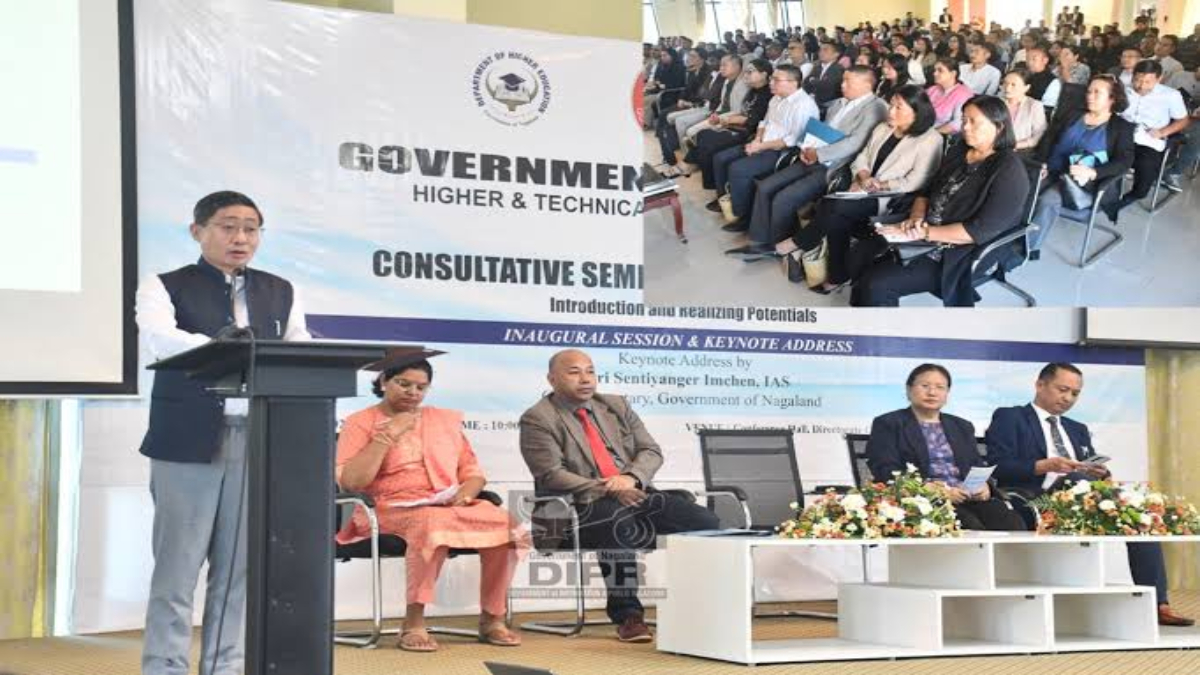
Industry-oriented courses are emerging as a key priority for Nagaland as Chief Secretary Sentiyanger Imchen has urged universities, colleges and technical institutions to reform their academic programmes to meet changing employment demands. Highlighting the widening gap between educational qualifications and practical workplace requirements, Imchen called for greater emphasis on emerging technologies, vocational training and industry-focused learning to improve job opportunities for the state’s youth.
He made the appeal while delivering the keynote address at a one-day consultative seminar titled “Emerging Trends: Introduction and Realising Potential” on October 30, 2026. The seminar was organised by the Department of Higher and Technical Education at the Conference Hall of the Department of Information Technology and Communication in Kohima.
According to a report from the Department of Information and Public Relations (DIPR), the Chief Secretary stressed that Nagaland’s education system must adapt to rapid technological developments and the changing requirements of the global economy.
Nagaland faces growing skills gap and unemployment
Addressing the gathering, Imchen observed that the education sector was experiencing one of its most significant transformations since the Industrial Revolution. Technological disruption, climate change, demographic changes and the transition towards a green economy are reshaping industries and creating new demands for skilled professionals.
He pointed out that many graduates possess academic qualifications and theoretical knowledge but struggle to secure employment because they lack the practical abilities required by employers.
This disconnect between education and employment, he said, represents a serious skills gap that Nagaland must address through changes in its higher education system.
Citing the Periodic Labour Force Survey (PLFS) report of March 2026, Imchen stated that unemployment among people aged 15 to 59 stood at 7.3 per cent in Nagaland, significantly higher than the national average of 3.5 per cent.
The situation was particularly concerning among younger people. Youth unemployment in the 15–29 age group reached 17.5 per cent in Nagaland, compared to 9.9 per cent nationally.
He also referred to the 2025 report Unemployment, Skill and Migration in Nagaland, which revealed that 92 per cent of the state’s residents lacked formal vocational or technical education. Additionally, 78 per cent of workers had no previous work experience.
According to Imchen, these figures underline the urgent need to strengthen practical education and introduce industry-oriented courses that prepare students for actual workplace responsibilities.
Government jobs no longer a reliable career option
The Chief Secretary also highlighted the limited availability of government employment in Nagaland.
He noted that government jobs had traditionally been considered a preferred career option, with many families investing heavily in their children’s education in the hope of securing public-sector employment.
However, recruitment opportunities have become increasingly limited.
According to the figures presented by Imchen, recruitment into state government services through the Nagaland Staff Selection Board (NSSB) and Nagaland Public Service Commission (NPSC) stood at 845 in 2024. The number declined to 589 in 2025.
He stressed that young people must increasingly explore opportunities beyond conventional government employment.
Developing practical abilities, pursuing specialised qualifications and building entrepreneurial skills could help graduates access opportunities in emerging industries and the private sector.
AI, cybersecurity and renewable energy among priority fields
Highlighting the changing employment landscape, Imchen identified technology-driven disciplines, sustainability-related fields and interdisciplinary professional programmes as important areas for future academic development.
He encouraged higher education institutions to introduce specialised programmes in Artificial Intelligence (AI), Machine Learning, Data Science, cybersecurity, digital forensics, FinTech and digital marketing.
He also highlighted the growing importance of renewable energy, energy science and sustainability-related studies as industries respond to environmental challenges and the transition towards greener economic models.
Referring to the World Economic Forum’s Future of Jobs Report 2025, he noted that demand for professionals in artificial intelligence, machine learning, data analytics, big data and information security is expected to increase significantly by 2030.
These developments, he suggested, make it essential for Nagaland’s educational institutions to prepare students for emerging employment opportunities rather than relying entirely on traditional academic programmes.
Nagaland University plans AI integration
Welcoming an important development in the state’s higher education sector, Imchen appreciated Nagaland University’s initiative to incorporate AI components into postgraduate and PhD programmes across several departments.
The initiative is proposed for implementation from the 2026–2027 academic session.
He urged private universities, colleges and technical institutions to introduce similar measures and expand their academic offerings to include emerging disciplines.
The Chief Secretary also suggested establishing specialised departments and strengthening institutional partnerships to support the introduction of industry-oriented courses.
He maintained that shortages of qualified faculty members and infrastructure limitations should not prevent institutions from adopting necessary reforms.
Faculty-sharing arrangements, academic collaborations, partnerships with industries and hybrid learning models could help institutions overcome these challenges.
Universities urged to strengthen practical learning
Delivering the special address, Nagaland University Pro Vice-Chancellor of Medziphema Campus, Professor Dipak Sinha, said emerging courses did not always require universities to establish entirely new academic programmes.
Instead, existing curricula could be updated to incorporate technological developments and changing market requirements.
He emphasised that artificial intelligence should be integrated across different academic disciplines rather than being restricted to computer science.
Sinha also highlighted short-term certificate programmes as a practical way to introduce emerging subjects. He encouraged institutions to use the SWAYAM online learning platform, noting that around 70 undergraduate and 30 to 35 postgraduate students at the university had completed courses through the platform and transferred the credits to their academic records.
He further informed that Nagaland University had approved five agriculture-related skill enhancement courses.
The seminar featured technical sessions on renewable energy, agriculture, veterinary sciences, AI, machine learning, cybersecurity, semiconductors, data science, medical technologies and emerging teaching methods in arts and commerce.
Education reforms expected to create better opportunities
Secretary of Higher and Technical Education Sarita Yadav also stressed the importance of keeping educational institutions aligned with technological advancements and evolving career opportunities.
She encouraged greater awareness among students about emerging professional fields and the importance of making informed academic choices.
The discussions highlighted the need for stronger cooperation between universities, colleges, technical institutions and industries.
For Nagaland, improving employability will require more than increasing access to conventional higher education. Students must also receive practical training, career guidance and opportunities to develop research, innovation and entrepreneurial capabilities.
Imchen expressed hope that the seminar would encourage institutions to translate discussions into concrete reforms. He urged universities, colleges and polytechnics to review their existing curricula and introduce programmes that reflect future employment requirements.
The proposed shift towards industry-oriented courses could become an important step in addressing Nagaland’s unemployment challenges. However, its success will depend on how effectively educational institutions implement curriculum changes, strengthen practical training and establish meaningful connections with employers.
Tripura Rubber Processing Hubs Aim to Strengthen Farmers’ Earnings