

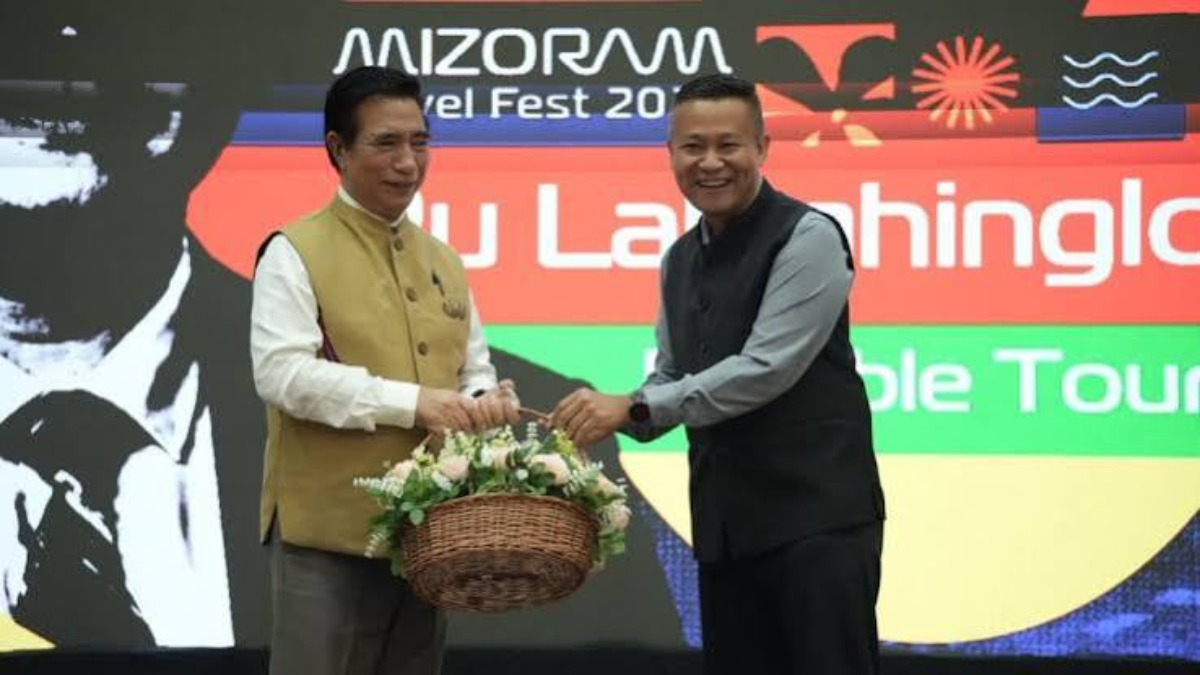
Mizoram tourism is set for a major expansion as the state government aims to increase the sector’s contribution to the Gross State Domestic Product (GSDP) from the current 2.3% to between 5% and 7% by 2047. The strategy combines public infrastructure development, private investment, improved connectivity and the promotion of the state’s natural beauty and cultural heritage.
Chief Minister Lalduhoma announced the vision while addressing the media at Mizoram Travel Fest 2026 on October 14. The government is also targeting at least 10 lakh visitors by December 31, 2026, as tourist arrivals rise and demand for accommodation, transport and organised travel experiences grows.
Mizoram Tourism Targets Higher Economic Growth by 2047
The long-term target reflects the state government’s ambition to make tourism a stronger contributor to economic development. Raising tourism’s share of GSDP to 5–7% would require sustained investment in visitor facilities, destination management, transport and services over the coming two decades.
The government is encouraging private businesses to participate in this expansion, particularly in areas where existing facilities are unable to meet growing demand. The approach is intended to create opportunities for entrepreneurs while generating employment and supporting local communities.
Lalduhoma said the government was laying the foundation through infrastructure development and inviting the private sector to build on these efforts. The state believes its peaceful environment, clean surroundings and distinctive cultural identity offer advantages that cannot be created through financial investment alone.
Tourism Projects Worth Rs 681 Crore Underway
Infrastructure development is central to Mizoram’s tourism plans. Projects worth more than Rs 681.16 crore are currently under execution with support from the Central government and external partners.
The projects cover several categories, including eco-resorts, ropeways, heritage centres, pilgrimage circuits and convention facilities. These developments are expected to strengthen the tourism ecosystem and encourage visitors to explore more destinations across the state.
Better accommodation, improved transport facilities and organised visitor experiences could also help tourists stay longer and spend more locally. For private investors, the ongoing public investment provides a foundation for developing hotels, homestays, restaurants, travel services and other tourism-related businesses.
The government is looking at different investment models, including community enterprises, private tourism ventures and public-private partnerships, to widen participation in the sector.
Tourist Arrivals Rise 51% as Connectivity Improves
Mizoram recorded more than 6.7 lakh visitors between January and August 2026, representing a 51% increase compared with the corresponding period last year. The figures indicate growing interest in the state as a destination for nature-based travel, cultural experiences and regional tourism.
A major development supporting this growth has been the opening of the Bairabi–Sairang railway line in September 2025. The railway connection has made travel to Mizoram more accessible and dependable, improving prospects for visitors arriving from other parts of India.
However, rising arrivals have also highlighted gaps in the availability of tourism facilities. The government sees this mismatch between demand and existing capacity as an opportunity for investors to develop new services and improve the overall visitor experience.
The target of 10 lakh visitors by the end of 2026 is an important near-term milestone. Tourism Minister Lalnghinglova Hmar has stressed that the sector’s success should be assessed not only through visitor numbers but also through the economic benefits reaching local businesses and communities.
Natural Landscapes and Mizo Culture Offer Strong Potential
Mizoram’s tourism appeal rests on its forested hills, waterfalls, biodiversity, scenic landscapes and living Mizo traditions. According to the Tourism Department presentation at the travel festival, forests cover approximately 85.34% of the state.
These natural and cultural assets create opportunities for eco-tourism, village-based experiences, adventure activities and cultural tourism. Developing these segments could help distribute tourist spending beyond Aizawl and encourage visitors to explore smaller towns and rural destinations.
The state’s tourism calendar also provides opportunities to attract visitors throughout the year. Upcoming events include the Hnahsin Kut, or Cosmos Festival, in Champhai until October 16, the Leitlangpui Music Festival in Lunglei from November 11 to 13, and the Winter Festival in Aizawl from December 15 to 23.
Such events can support hotels, restaurants, transport operators, artisans and local vendors while introducing visitors to the state’s traditions. Better coordination between festivals, accommodation providers and tour operators could further strengthen tourism-related business activity.
Sustainable Investment and Community Benefits Remain Priorities
The state government has emphasised that tourism expansion must protect the environment and preserve the cultural values that make Mizoram distinctive. Rapid construction and unmanaged visitor activity could undermine the natural assets on which the industry depends.
To encourage responsible travel, the Tourism Department has signed a memorandum of understanding with the Central Young Mizo Association (CYMA) to familiarise visitors with local customs, traditions and appropriate conduct. The government is also promoting greener festivals, reduced plastic waste and plastic-free events.
Authorities are planning better regulation and monitoring of accommodation units in collaboration with CYMA and the Aizawl Municipal Corporation. These measures aim to improve service standards while maintaining the state’s clean and peaceful environment.
Regional cooperation could provide another avenue for growth. Lalduhoma has highlighted Mizoram’s international borders with Myanmar and Bangladesh and its position under the Centre’s Act East Policy. Tourism initiatives, including the Assam–Mizoram Border Festival, could help strengthen cross-border goodwill and encourage regional travel.
Private Sector Participation Could Shape the Next Phase
The government is seeking investors who can help convert growing interest in Mizoram into sustainable economic opportunities. Hotels, eco-resorts, homestays, transport services, adventure tourism operators and event-related businesses are among the areas that could benefit from improved infrastructure and visitor demand.
For Mizoram tourism to reach its 2047 target, investment will need to translate into better facilities, stronger local supply chains and reliable employment opportunities. Training residents for hospitality and tourism-related work will also be important to ensure that communities can participate directly in the industry’s expansion.
The challenge will be to balance commercial growth with environmental protection and cultural preservation. If public investment, private enterprise and community participation develop together, tourism could become a more significant pillar of Mizoram’s economy.
With visitor numbers rising and major infrastructure projects underway, the state is positioning itself for long-term growth. Achieving a 5–7% contribution to GSDP by 2047 will depend on consistent implementation, responsible investment and ensuring that the benefits of tourism reach people across Mizoram.
Powerful Manipuri Film Fireflies in the Dark Premieres at Vancouver Festival