

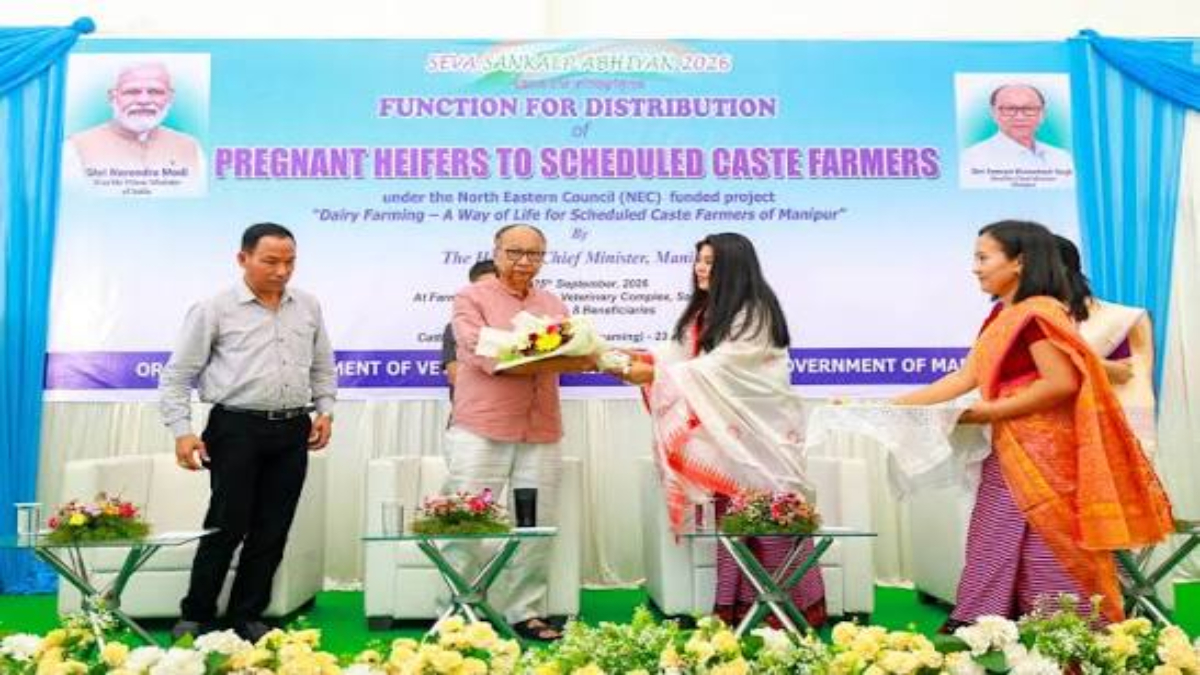
Pregnant heifers have become part of a targeted dairy support initiative in Manipur, where Chief Minister Yumnam Khemchand Singh distributed 31 high-yielding animals to Scheduled Caste farmers. The initiative aims to strengthen household livelihoods through dairy farming while expanding access to productive livestock among beneficiaries from the Scheduled Caste community.
The distribution forms part of the broader dairy development programme being implemented in Manipur with support from the North Eastern Council (NEC). The project, titled “Dairy Farming – A Way of Life for Scheduled Caste Farmers of Manipur”, focuses on creating sustainable income opportunities through livestock-based activities.
Pregnant heifers support dairy livelihoods
The 31 animals distributed by the Chief Minister are intended to give beneficiary farmers a productive asset that can contribute to future milk production and household income.
Unlike ordinary cattle assistance, the provision of high-yielding animals allows farmers to begin with livestock that is already at an advanced stage of reproduction. The animals can therefore form the foundation of small dairy units, provided farmers have adequate fodder, veterinary care, housing and other support.
The wider NEC-backed project includes several components beyond livestock distribution. According to project details reported from the Department of Veterinary and Animal Husbandry, these include animal insurance, concentrate feed, skill-development training, cattle sheds, equipment and utensils, as well as technology support.
A wider dairy project for SC farmers
The NEC project was sanctioned with an estimated outlay of about Rs 14.26 crore. Government project records list it as an ongoing Agriculture and Allied sector initiative in Manipur.
The programme is designed to cover 612 beneficiaries across the state. Thoubal and Kakching districts account for 178 and 179 selected beneficiaries respectively, according to recent information from the district veterinary authorities.
The scale of the project shows that the latest distribution is one phase of a larger effort rather than a standalone livestock handout. The government is using the programme to build a broader dairy ecosystem around beneficiary farmers.
Lottery system guides the next phase
The implementation has also involved a beneficiary-selection process for the phased distribution of pregnant heifers.
On September 23, the District Veterinary Offices of Thoubal and Kakching conducted a lottery at the District Veterinary Hospital in Thoubal. The exercise covered around 178 selected beneficiaries from Thoubal and 179 from Kakching. Officials said the lottery would help prepare a transparent list for phased distribution.
The selected animals are described as five to six months pregnant. Their distribution is to follow the outcome of the lottery, according to the district veterinary authorities. The process involves officials, farmers and beneficiaries from the two districts.
This phase-wise approach is important because the project involves hundreds of beneficiaries and requires the livestock to be distributed over time rather than in a single operation.
Focus on productivity and farmer income
The dairy programme also reflects a broader emphasis on livestock-based livelihood generation in Manipur. The state’s Animal Husbandry and Veterinary budget documents include dedicated Scheduled Caste Sub-Plan components under livestock health and disease-control programmes and the National Livestock Mission.
For farmers receiving pregnant heifers, long-term benefits will depend on proper animal nutrition, veterinary services, disease prevention and access to markets for milk and other dairy products. Insurance and training included in the wider project are intended to address some of these practical requirements.
The programme also comes amid continuing efforts to strengthen agricultural and allied livelihoods in Manipur. Other initiatives have focused on climate-resilient farming and the distribution of improved agricultural and livestock inputs to Scheduled Caste communities.
Building a stronger dairy base
The distribution of 31 animals gives the current phase of the project a clear livelihood focus. For beneficiary families, the livestock can potentially provide milk, calves and a recurring source of farm income, while the wider programme seeks to provide the infrastructure and training needed to maintain productive dairy units.
With hundreds of beneficiaries identified across districts, the next stages of the project will determine how effectively the support translates into sustained dairy activity. Continued veterinary assistance, timely feed supply, insurance coverage and market access will remain important as Manipur expands this livestock-based livelihood programme for Scheduled Caste farmers.
Tripura’s Neermahal Water Festival Returns to Melaghar From October 7