

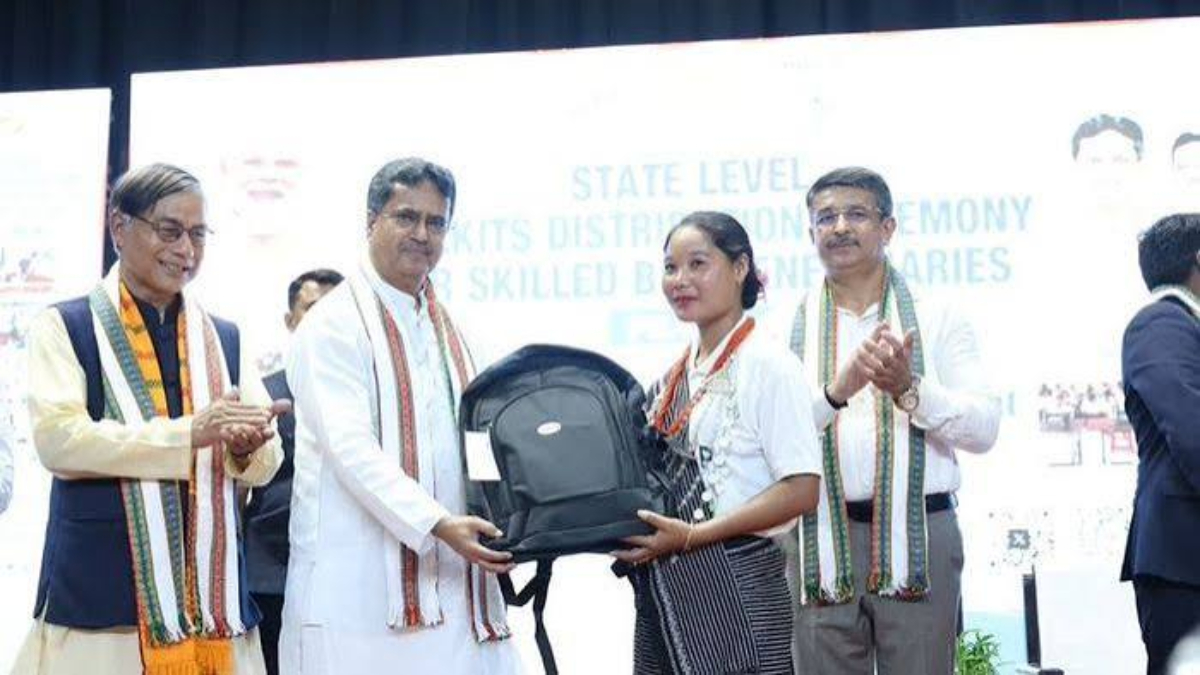
Tripura Bru community members trained under government skill-development programmes are being provided toolkits to help them start income-generating activities and move towards greater economic independence. Tripura Chief Minister Manik Saha distributed the toolkits at a programme in Amarpur in Gomati district on Sunday, August 23, highlighting the state government’s focus on sustainable livelihoods for resettled Bru families.
The initiative is part of a wider effort to ensure that the rehabilitation of Bru families goes beyond housing and financial assistance. The government is seeking to equip trained beneficiaries with practical skills, tools and opportunities that can help them establish their own livelihoods.
Tripura Bru community receives livelihood support
Addressing the programme, Saha said the government was working to create sustainable livelihood opportunities for Bru families who were resettled in Tripura after spending years in relief camps.
The Chief Minister said monetary assistance and stipends alone cannot ensure a stable income in the long term. He stressed that skill development and self-employment are important for enabling families to become economically self-reliant.
According to Saha, the Skill Development Department has been conducting training for Bru beneficiaries under government programmes and distributing toolkits to candidates who successfully complete their courses. The training covers 16 different trades, giving beneficiaries opportunities to pursue various forms of income-generating work.
The latest figures shared by the Chief Minister show the scale of the programme. Around 5,100 members from 4,318 Bru families have already received skill training and toolkits to undertake sustainable economic activities.
Skill training aims to build self-reliance
The focus on skills is intended to give beneficiaries practical alternatives to dependence on government assistance. Training can help members of the community use their skills directly for self-employment or seek opportunities in the private sector.
The state has previously conducted specialised training programmes for resettled Bru families in areas such as pig farming, goat farming, poultry, woodworking and candle making. Such programmes are designed around livelihood opportunities that can be pursued locally and expanded at the household level.
The government has also identified several potential job roles for members of the Bru community, including small poultry farming, piggery, bamboo utility handicrafts, mushroom cultivation, beekeeping and handloom weaving. A skills and capacity development report prepared for Tripura also identified opportunities for rubber-related work and other livelihood activities in Dhalai district.
A wider push for the Tripura Bru community
The latest toolkit distribution forms part of the broader rehabilitation process following the agreement reached in January 2020 between the Centre and the governments of Tripura and Mizoram for the permanent resettlement of displaced Bru families.
More than 8,000 internally displaced Bru families were covered under the resettlement agreement. The Centre has sanctioned Rs 600 crore for the rehabilitation of these families, according to the Chief Minister.
The rehabilitation programme has focused on providing essential infrastructure and basic facilities while gradually integrating families into their new communities. Livelihood support has emerged as an important component because permanent resettlement requires opportunities for families to earn regular incomes.
Government stresses entrepreneurship over dependence
Saha also urged young people to consider self-employment and entrepreneurship rather than relying exclusively on government jobs. He pointed out that public-sector employment cannot be the only solution to unemployment and encouraged skill-based livelihood opportunities.
The Chief Minister said the state would also need to expand training in emerging areas such as artificial intelligence, machine learning and digital marketing. Such courses could help young people access new employment opportunities and build businesses in sectors beyond traditional occupations.
Tripura has been expanding skill-development initiatives under the Mukhyamantri Dakshata Unnayan Prakalpa, with training programmes intended to improve employability and encourage self-reliance.
The approach is also consistent with the state’s broader emphasis on livelihood generation through skills. Recent programmes have included the distribution of sewing machines to trained women, allowing beneficiaries to use their training and equipment to pursue self-employment.
From resettlement to sustainable livelihoods
For the Tripura Bru community, access to tools after completing training can bridge an important gap between learning a skill and actually using it to earn an income. Toolkits can provide beneficiaries with the basic equipment required to begin work without having to make a large initial investment.
The effectiveness of the initiative, however, will depend on continued support, market access, financial assistance and opportunities to sell products or services. Linking trained beneficiaries with local markets and entrepreneurship schemes could help turn skill training into reliable household incomes.
The latest distribution therefore represents another step in Tripura’s effort to make Bru rehabilitation economically sustainable. By combining resettlement, training and livelihood assistance, the government is seeking to help families move from long-term dependence towards self-reliance and stable employment.
NorthEast United FC Seal Powerful 4-1 Durand Cup Win Over Karbi Anglong