

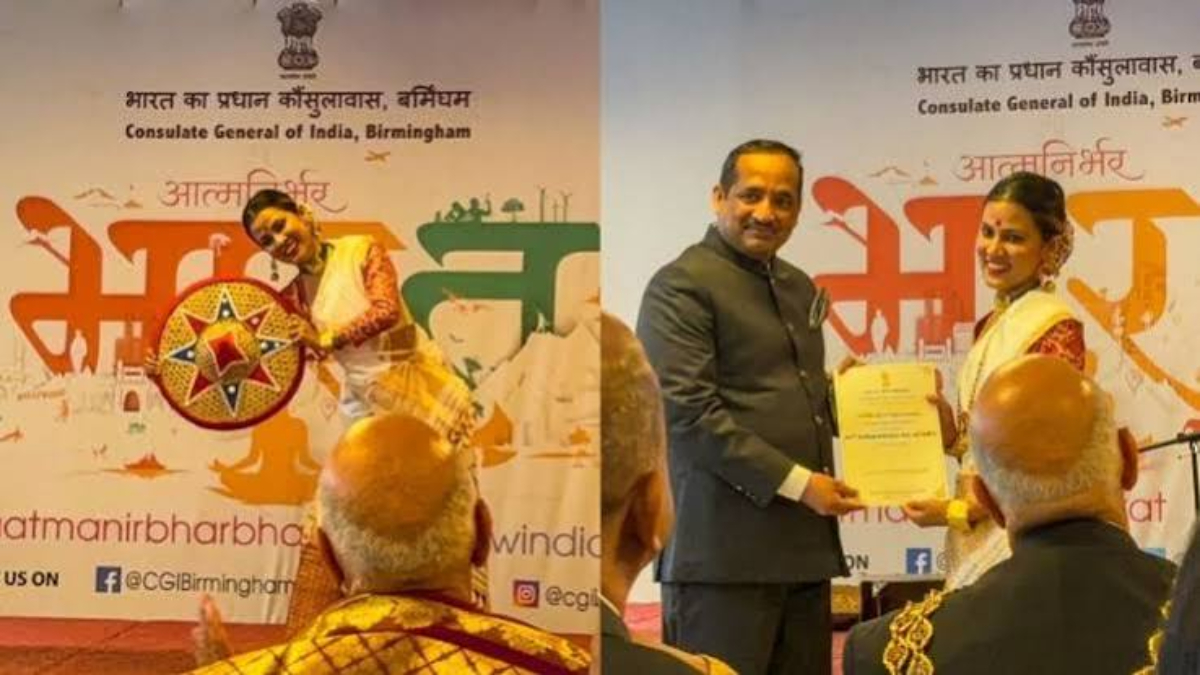
Assamese culture in Birmingham took the spotlight as Sattriya and Bihu featured prominently at India’s 80th Independence Day celebrations organised by the Consulate General of India in Birmingham on August 15. Guwahati-born, London-based dancer Anannya Mahanta presented a solo performance that brought two distinctive Assamese dance traditions to an audience of dignitaries, members of the Indian diaspora, students and friends of India.
A powerful showcase of Assamese culture in Birmingham
Mahanta was invited by the Consulate to showcase Assam’s cultural heritage during the Independence Day programme. Her performance moved between the classical discipline of Sattriya and the energetic folk tradition of Bihu, showing the variety of Assam’s performing arts.
The presentation began with Sattriya, the classical dance tradition associated with Assam’s satra institutions. Mahanta explored different talas and rhythmic patterns, combining structured movements with a brief abhinaya segment.
Sattriya brings Assam’s classical tradition to Birmingham
The Sattriya segment highlighted the spiritual and refined character of Assamese performance culture.
Mahanta is a member of the International Dance Council, UNESCO, Paris, and a certified artist under the Ministry of Culture, Government of India. She is also a double diploma holder in Sattriya, a Prasar Bharati graded artist and an empanelled artist with SPIC MACAY.
The performance served not only as entertainment but also as cultural representation. For Assamese communities living away from the state, such events provide an opportunity to reconnect with familiar traditions and strengthen Assamese culture in Birmingham.
Bihu adds vibrant energy to Assamese culture in Birmingham
After Sattriya, Mahanta shifted to Bihu, creating a contrast in rhythm, movement and mood. The performance drew on recognisable Assamese elements such as the jaapi and toka, combining energetic movements with music and festive imagery associated with Bihu.
The transition from the controlled movements of Sattriya to the exuberance of Bihu showcased the diversity within Assam’s performing arts. The audience responded with cheers and applause, adding to the celebratory atmosphere.
Presenting Bihu in Birmingham allowed a familiar cultural expression from Assam to become part of a broader Indian national celebration. It also gave audiences a glimpse of the traditions that remain closely connected with Assamese identity.
Independence Day programme brings communities together
The cultural performance was part of a wider Independence Day programme at the Consulate General of India in Birmingham. The celebrations began with the singing of Vande Mataram, followed by the hoisting of the national flag by Consul General Dr Venkatachalam Murugan.
West Midlands Lord-Lieutenant Derrick Anderson CBE and Birmingham Lord Mayor Councillor Zaker Choudhry MBE extended Independence Day greetings. Other dignitaries included Mayor of Royal Sutton Coldfield Councillor Dr Nitish Raut, High Sheriff of the West Midlands Carmen Watson and Consul General of Romania Mihaela Savu.
More than 150 participants from across the country attended. The gathering highlighted India’s cultural diversity and links with the Indian diaspora in the United Kingdom.
For Assamese culture in Birmingham, the event was significant because it placed Sattriya and Bihu within a national celebration before a diverse audience. It showed how regional traditions can strengthen diaspora connections.
A wider platform for Assam’s traditions
The Birmingham performance follows a broader pattern of Assamese artists presenting Sattriya and Bihu internationally. In April, Assam artiste Rodali Bora showcased the two dance forms at an Indian Council for Cultural Relations Foundation Day event at the Consulate General of India in Birmingham, highlighting Assam’s heritage abroad.
Such programmes help younger diaspora members encounter Assamese traditions while showing international audiences India’s regional cultural diversity.
For Mahanta, the Independence Day appearance carried a personal dimension. The Birmingham event also showed the value of presenting regional art in a setting that brings together diplomats, community leaders and diaspora families. For audiences unfamiliar with Assam, the pairing of Sattriya and Bihu offered a clear introduction to both the state’s classical heritage and its popular festive traditions, while reinforcing Assamese culture in Birmingham.
Bringing traditions she grew up with in Guwahati to Birmingham allowed Mahanta to represent her home state while connecting its artistic heritage with a global audience.
The presentation underlined the continuing relevance of Assamese culture in Birmingham and the wider UK. By bringing together Sattriya’s classical precision and Bihu’s festive energy, the celebration offered a powerful picture of Assam’s cultural richness. It showed how regional art can become a meaningful part of India’s national story, even thousands of kilometres from home.
Tura Youth Delegate: Meghalaya Student Arrives in Australia for Commonwealth Youth Parliament