

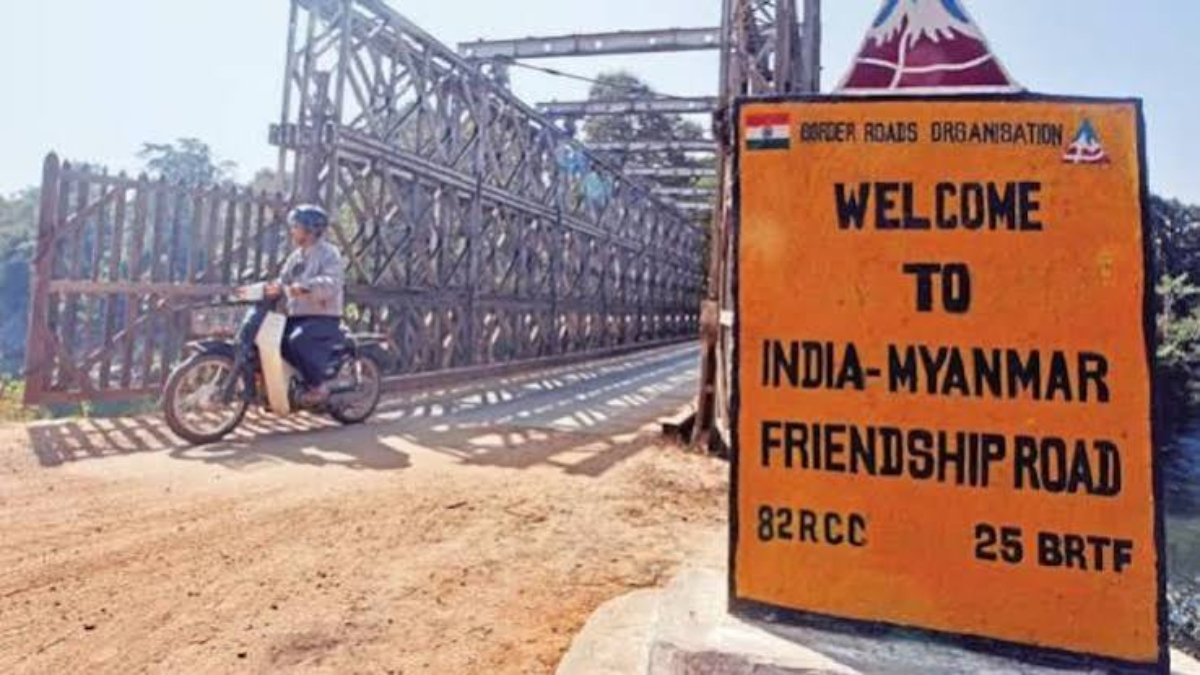
India Myanmar Manipur border discussions have gained fresh momentum as India and Myanmar are working together to resolve the long-pending issue of an undemarcated stretch along the Manipur border. The Ministry of External Affairs (MEA) confirmed that both countries remain engaged in dialogue to address the sensitive boundary issue through mutual understanding and established diplomatic mechanisms. The development comes as India continues to strengthen border security while maintaining close cooperation with its eastern neighbour.
MEA confirms ongoing diplomatic engagement
The India Myanmar Manipur border issue was highlighted during the weekly media briefing by the Ministry of External Affairs, where officials stated that discussions with Myanmar are continuing to resolve the remaining undemarcated portion of the international boundary.
According to the MEA, India and Myanmar share a border of over 1,600 kilometres, most of which has already been demarcated. However, a small stretch in Manipur remains undemarcated due to historical and technical reasons. Officials stressed that both countries are addressing the matter through bilateral consultations and peaceful negotiations.
The ministry reiterated that India remains committed to maintaining peaceful relations with Myanmar while ensuring that the integrity and security of its international borders are protected.
Why the India Myanmar Manipur border matters
The undemarcated section has remained a matter of concern because of its strategic location. Manipur shares a significant portion of India’s international border with Myanmar, making it crucial for regional security, cross-border trade, and people-to-people ties.
The border region is also important because several communities live on both sides and have traditionally maintained cultural and family connections. At the same time, the area has witnessed challenges related to illegal crossings, smuggling, and the movement of insurgent groups over the years.
Resolving the remaining boundary issue is expected to provide greater clarity for border management while reducing the possibility of misunderstandings between local communities and security agencies.
Border security remains a priority
India has intensified border management measures along the Myanmar frontier over the past year. The government has announced plans to strengthen fencing in selected vulnerable areas and improve surveillance infrastructure.
Officials have repeatedly stated that these measures are aimed at preventing illegal immigration, curbing cross-border crime, and enhancing national security. The review of the Free Movement Regime (FMR), which earlier allowed residents near the border to travel across with limited restrictions, also reflects India’s broader efforts to regulate movement more effectively.
Despite these security initiatives, the government has maintained that all outstanding border-related matters with Myanmar will continue to be handled through dialogue and diplomatic channels.
Historical background of the boundary
The India-Myanmar international boundary was established during the colonial period and has largely remained peaceful. Joint survey teams from both countries have, over the years, worked to identify and demarcate most sections of the border.
However, a limited portion in Manipur has remained unresolved because of differences in interpretation of historical records and geographical features. Successive governments have continued discussions to find a mutually acceptable solution without escalating tensions.
The latest statement from the MEA indicates that communication between the two neighbours remains active despite Myanmar’s internal political situation.
Bilateral cooperation extends beyond border issues
The India Myanmar Manipur border talks are taking place alongside broader cooperation between New Delhi and Naypyidaw. India considers Myanmar a key partner under its Act East Policy and the Neighbourhood First approach.
Both countries are working together on connectivity projects, trade, infrastructure development, and security cooperation. Projects such as the India-Myanmar-Thailand Trilateral Highway and the Kaladan Multi-Modal Transit Transport Project are expected to improve regional connectivity and economic integration.
Security cooperation has also strengthened over the years, with both governments coordinating efforts against insurgent groups operating along the border.
Impact on Manipur and the Northeast
For Manipur and the wider Northeast, progress on the India Myanmar Manipur border issue could contribute to improved stability and development. A clearly defined international boundary can help streamline security operations, facilitate legal trade, and support infrastructure projects in border districts.
The development also comes at a time when the central government is focusing on improving connectivity and promoting economic growth across the Northeast. Stable international borders are considered essential for attracting investment and expanding cross-border commerce.
Experts believe that a mutually agreed resolution will benefit both countries while reinforcing long-term peace and cooperation in the region.
The MEA’s latest remarks underline India’s preference for resolving sensitive international boundary issues through sustained dialogue and diplomatic engagement. While no timeline has been announced for finalising the remaining undemarcated stretch, the confirmation that talks are continuing signals positive momentum. As India and Myanmar deepen bilateral cooperation, resolving the remaining Manipur border issue could become another important step towards stronger regional security, stability, and neighbourly relations.
Inspiring Triumph: Arunachal women scale Mt Kun, Create History in Ladakh