

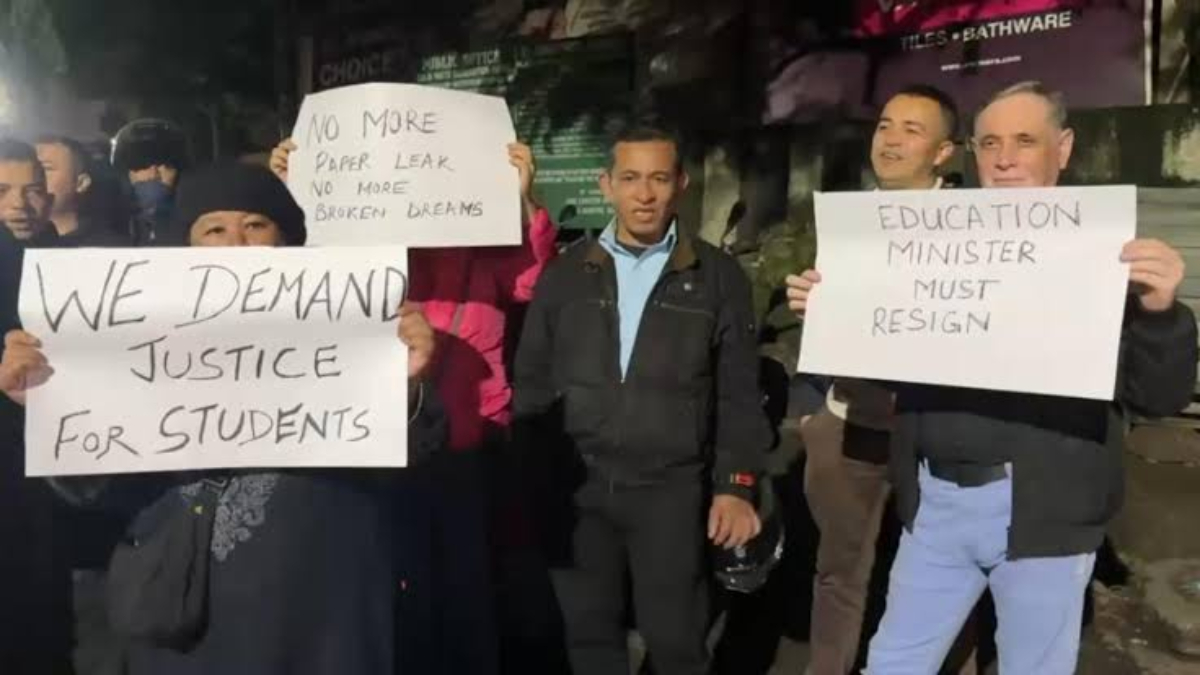
Meghalaya NEET protest has gained significant attention after the Voice of the People Party (VPP) and students from North-Eastern Hill University (NEHU) extended their support to the Cockroach Janta Party (CJP)-led nationwide agitation over the NEET paper leak controversy. The growing movement has strengthened calls for the resignation of Union Education Minister Dharmendra Pradhan, with student groups and opposition leaders demanding accountability, transparent reforms, and justice for affected aspirants.
Meghalaya Joins Nationwide NEET Protest
The Meghalaya NEET protest gathered pace as the opposition VPP and NEHU student representatives expressed solidarity with the CJP movement that has emerged as the face of nationwide demonstrations against alleged irregularities in the NEET examination process.
During the protest, participants raised concerns over repeated examination paper leaks, the credibility of national entrance examinations, and the future of millions of students preparing for competitive tests. Protesters argued that repeated controversies have weakened public confidence in India’s examination system and called for immediate institutional reforms.
Student leaders in Meghalaya said the issue goes beyond a single examination and reflects the need for greater transparency, fairness, and accountability in conducting national-level entrance tests.
Meghalaya NEET Protest Echoes Demand for Minister’s Resignation
One of the central demands during the demonstrations was the resignation of Union Education Minister Dharmendra Pradhan. The protesters alleged that the ministry must accept responsibility for repeated examination irregularities and restore public trust through decisive action.
The CJP has consistently maintained that the minister’s resignation remains a non-negotiable demand while also seeking comprehensive examination reforms and accountability for those responsible for paper leaks. The movement has also called for justice for students allegedly affected by the examination controversy.
The VPP’s support has added political weight to the movement in Meghalaya, while NEHU students emphasized that educational integrity should remain above political considerations.
Swift Assam Communal Tension Arrests: Five Held for Alleged Bid to Disturb Peace
Growing National Support for the CJP Movement
The Meghalaya demonstrations are part of a much larger nationwide campaign that has witnessed participation from students, youth groups, civil society organisations, and several opposition parties.
In recent days, protests have spread across multiple states, with thousands participating in rallies, marches, and peaceful demonstrations. The CJP has announced nationwide district-level protests under the slogan “Every District. One Day. One Demand,” urging citizens to peacefully support students demanding accountability.
Several opposition leaders have also backed the agitation, arguing that recurring examination controversies require urgent policy intervention rather than temporary administrative measures. Parliament has witnessed repeated disruptions as opposition parties demanded the Education Minister’s resignation before discussions on the NEET issue could proceed.
Students Demand Long-Term Examination Reforms
Apart from political accountability, student organisations have stressed the need for structural reforms in India’s examination system.
Among the key issues highlighted are stronger safeguards against paper leaks, enhanced digital security, transparent investigations into examination irregularities, faster legal action against offenders, and improved mechanisms to protect students’ interests.
Many students believe that restoring confidence in national entrance examinations is essential because lakhs of aspirants dedicate years of preparation and substantial financial resources for these highly competitive tests. The protesters argue that repeated controversies undermine merit and create uncertainty for deserving candidates.
Political Pressure Continues to Build
The support from Meghalaya’s VPP and NEHU students comes at a time when political pressure on the Centre continues to intensify.
While the Union government has indicated its willingness to discuss examination reforms and strengthen safeguards against future irregularities, it has not accepted the demand for the Education Minister’s resignation. Government representatives have maintained that reforms are being considered, even as protests continue in several parts of the country.
Meanwhile, student organisations insist that accountability and meaningful reforms must accompany any future policy announcements.
The expanding support from Meghalaya reflects how the NEET controversy has evolved into a broader national debate about examination integrity, educational governance, and student welfare. As demonstrations continue across India, the coming days are expected to be crucial in determining whether dialogue between protesters and the government can lead to a resolution. Until then, the movement remains focused on securing transparent reforms and ensuring that students’ concerns remain at the centre of the national conversation.