

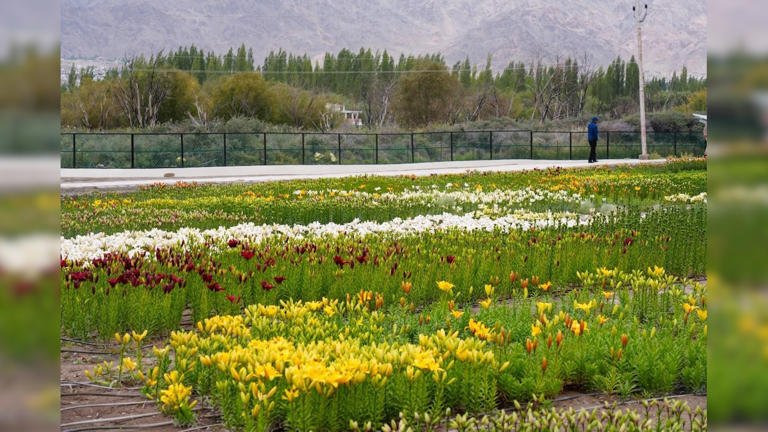
Ladakh has opened its twin flower fields at Choglamsar and Stakna in Leh to the public from September 18.
The gardens sit at an altitude of around 10,600 feet and cover 40 acres. Together, they feature more than 25 lakh high-value flowers.
The Ladakh Administration has described them as the world’s highest-altitude twin flower fields. The project also aims to promote commercial floriculture and create new livelihood opportunities for local farmers.
Visitors can enter the gardens for ₹25 for adults and ₹10 for children. The administration will use the ticket revenue for the maintenance and upkeep of the gardens.
More Than 25 Lakh Flowers at 10,600 Feet
The two fields contain more than 25 lakh flowers. Around 24 lakh are Lilium, while another one lakh are Gladiolus.
The colourful flowers create a sharp contrast with Ladakh’s rugged mountain landscape. The fields display shades of yellow, white, orange and red.
The project represents a large-scale experiment in high-altitude floriculture. Officials say its successful development could help replicate similar models in other parts of Ladakh.
The project also seeks to demonstrate that farmers can explore high-value crops beyond traditional agricultural activities.
Choglamsar Field Developed in Two Months
The Choglamsar flower field has developed rapidly.
Plantation began there on July 16, 2026. The first flowers started blooming during the first week of September.
The administration completed the field in about two months. Officials have highlighted this as an important achievement because of the region’s high altitude and challenging climatic conditions.
The Stakna field followed a different timeline. Nearly 14 lakh Lilium plants went into the ground from August. Officials expect the first major bloom there around the end of October.
Ladakh Promotes Commercial Floriculture
The project has a larger purpose beyond creating a tourist attraction.
The Ladakh Administration wants to use floriculture to diversify agriculture and create additional income opportunities for farmers. High-value flowers can offer an alternative source of revenue in the region.
According to the administration, Lilium flowers can fetch around ₹60 to ₹70 per stick in wholesale markets.
The project will also provide training in scientific floriculture, modern cultivation methods and post-harvest management. These skills can help farmers explore commercial flower production.
Flower Garden to Become Training Centre
The Choglamsar site will also function as a demonstration and training centre.
Farmers and young people will receive exposure to modern cultivation techniques and scientific farming practices. The centre will also demonstrate the cultivation of Lilium, Gladiolus, Tulips and other ornamental flowers.
The administration hopes this training will encourage more people to consider floriculture as a commercial activity.
The facility can therefore serve both visitors and the local farming community. It combines recreation with agricultural education and skill development.
Self-Help Groups and Cooperatives to Take Over
The Agriculture Department will manage the fields during the first year and support the transition towards community-based commercial cultivation.
According to the administration, officials will hand over the fields at the time of bloom to selected self-help groups and cooperatives. The department will also support them with marketing.
From the second year, the cooperatives are expected to manage cultivation, harvesting and value addition themselves.
This approach aims to create a sustainable local floriculture system rather than keeping the project entirely under government management.
LG VK Saxena Inaugurates the Fields
Ladakh Lieutenant Governor Vinai Kumar Saxena inaugurated the twin flower fields on September 17.
The inauguration took place on the occasion of Prime Minister Narendra Modi’s 76th birthday and formed part of the day’s events in Ladakh.
Saxena said the initiative seeks to create new livelihoods, skills and opportunities for the people of Ladakh. He also highlighted floriculture as an activity that could complement traditional farming and provide additional income.
The project also aligns with the administration’s focus on agricultural diversification and local economic development.
Tourism Gets a New Attraction
The flower fields also add a new attraction to Leh’s tourism landscape.
Ladakh is known for its mountains, monasteries, lakes and high-altitude landscapes. The flower fields introduce a different visual experience against this natural backdrop.
Opening the gardens to visitors allows tourists and residents to experience the project while also generating revenue for maintenance.
The gardens could also create opportunities for local businesses linked to tourism, transportation and other visitor services.
A New Experiment for High-Altitude Farming
Growing millions of flowers at 10,600 feet represents a significant agricultural experiment for Ladakh.
The region has a cold and dry climate, which creates challenges for conventional farming. The administration has therefore focused on crops and cultivation methods that can offer new economic opportunities.
The success of the twin flower fields could provide useful experience for future floriculture projects in other parts of the Union Territory.
Officials have already indicated that the model could be replicated elsewhere in Ladakh if the experiment continues to perform well.
Visitors Can Explore the Gardens From Today
The twin flower fields at Choglamsar and Stakna are now open to visitors.
With more than 25 lakh flowers spread across 40 acres, the gardens offer a striking contrast to Ladakh’s barren mountain surroundings.
At the same time, the project has a wider objective. It aims to train farmers, diversify agriculture, strengthen local livelihoods and develop commercial floriculture in the high-altitude region.
With an entry fee of ₹25 for adults and ₹10 for children, the gardens will remain accessible to visitors while using the proceeds for maintenance. The initiative now enters its public phase as Ladakh seeks to turn high-altitude floriculture into a new avenue for tourism, skills and rural economic opportunities.