

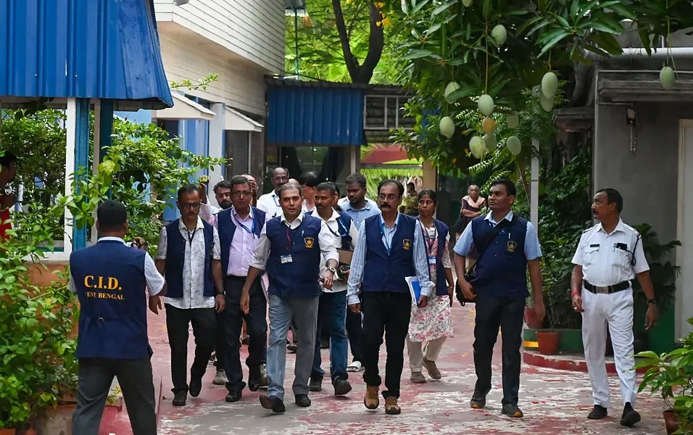
Trinamool Congress (TMC) national general secretary Abhishek Banerjee has come under renewed legal and political scrutiny after being questioned by the Criminal Investigation Department (CID) in connection with an ongoing investigation while also facing a summons issued by a court in Tripura.
The developments have triggered fresh political reactions, with the ruling and opposition parties exchanging allegations over the timing and nature of the legal proceedings. While investigating agencies maintain that they are carrying out their duties in accordance with the law, TMC leaders have alleged that the actions are politically motivated.
The twin developments have once again placed Abhishek Banerjee at the center of a high-profile political and legal controversy.
CID Questions Abhishek Banerjee
Abhishek Banerjee appeared before the CID as part of an ongoing investigation into a case being probed by the agency. Officials questioned him regarding matters linked to the inquiry and sought clarifications on several issues connected to the investigation.
Sources indicated that the questioning session lasted several hours, during which investigators examined documents, statements, and other materials relevant to the case. Officials, however, have not publicly disclosed specific details regarding the contents of the interrogation.
The CID has maintained that the questioning forms part of standard investigative procedures and that all individuals connected to a case may be called upon to cooperate with investigators whenever required.
Abhishek Banerjee reportedly cooperated with the investigation and responded to questions posed by officials during the session.
Tripura Court Issues Summons
In a separate development, a court in Tripura has issued a summons to the TMC leader in connection with a legal matter pending before it.
According to legal sources, the summons requires Banerjee to appear before the court in relation to proceedings arising from a case registered in the state. The exact nature of the allegations and legal issues involved will be addressed during the judicial process.
Court officials stated that the summons was issued in accordance with legal procedures. The matter is expected to come up for further hearings as the case progresses through the judicial system.
Legal experts noted that a summons does not imply guilt and is part of the due process that allows individuals to present their side before the court.
The development has attracted considerable attention due to Banerjee’s prominent position within the TMC and his role in national politics.
Political Reactions Intensify
The legal developments have sparked sharp political reactions from both the ruling establishment and opposition parties.
TMC leaders have alleged that investigative agencies are being used to target opposition politicians. Party representatives claimed that repeated legal actions against opposition leaders raise questions about political intent.
According to TMC officials, Abhishek Banerjee has consistently cooperated with investigations and remains committed to pursuing legal remedies wherever necessary.
On the other hand, political opponents have argued that investigative agencies and courts are functioning within the framework of the law and that no individual should be exempt from scrutiny.
The contrasting narratives have intensified political debate, particularly in West Bengal and Tripura, where the TMC remains an active political force.
TMC’s Growing Presence in Tripura
The court summons has also revived discussions about the TMC’s political activities in Tripura. Over the past few years, the party has sought to expand its organizational presence in the northeastern state and position itself as an alternative political force.
Abhishek Banerjee has played a significant role in the party’s expansion efforts, leading campaigns, organizational drives, and outreach programmes in Tripura. His frequent visits to the state have made him one of the most visible TMC leaders in the region.
Political analysts believe that legal developments involving senior leaders often acquire additional significance in states where political competition remains intense.
The latest summons is therefore likely to remain a subject of discussion in Tripura’s political landscape in the coming weeks.
Legal Process Takes Centre Stage
Legal experts have emphasized that the matters involving the CID investigation and the Tripura court proceedings are distinct and will follow their respective legal pathways.
The questioning by investigators forms part of an inquiry process, while the court summons relates to judicial proceedings that will be addressed through established legal mechanisms.
Observers note that high-profile political cases often attract public attention due to the prominence of the individuals involved. However, they stress that legal outcomes ultimately depend on evidence, arguments, and judicial determination.
Abhishek Banerjee and his legal team are expected to respond to the summons and pursue appropriate legal options as the cases move forward.
Impact on Political Discourse
The developments have once again highlighted the growing intersection between law and politics in India. Investigations involving senior political leaders frequently become subjects of intense public and media scrutiny.
Supporters of the TMC argue that the party’s leadership is being subjected to excessive legal pressure, while critics insist that accountability and legal scrutiny are essential components of democratic governance.
Political commentators believe that such cases often influence public discourse and become important talking points during elections and political campaigns.
The latest developments involving Abhishek Banerjee are therefore expected to remain politically significant beyond their immediate legal implications.
TMC Maintains Defensive Stand
Following the CID questioning and court summons, TMC leaders reiterated their support for Abhishek Banerjee and expressed confidence that he would emerge from the proceedings without any adverse consequences.
Party representatives argued that legal challenges would not affect the organization’s political activities or its commitment to addressing public issues. They emphasized that the party would continue focusing on governance, development, and organizational expansion.
Officials also maintained that all legal matters should be resolved through due process and within the framework of the Constitution.
The TMC leadership has consistently projected the developments as part of a broader political confrontation involving opposition parties and investigative agencies.
Looking Ahead
The questioning of Abhishek Banerjee by the CID and the issuance of a court summons by a Tripura court have added a new dimension to the legal and political challenges facing the senior TMC leader.
As investigations continue and court proceedings move forward, attention will remain focused on the responses of both legal authorities and political stakeholders. The developments are likely to generate continued debate in political circles, particularly in West Bengal and Tripura.
For now, the matter remains firmly within the legal domain, with investigators pursuing their inquiry and the judiciary expected to examine the issues before it. The coming weeks will be crucial in determining how the proceedings unfold and what implications they may have for Abhishek Banerjee and the broader political landscape.