

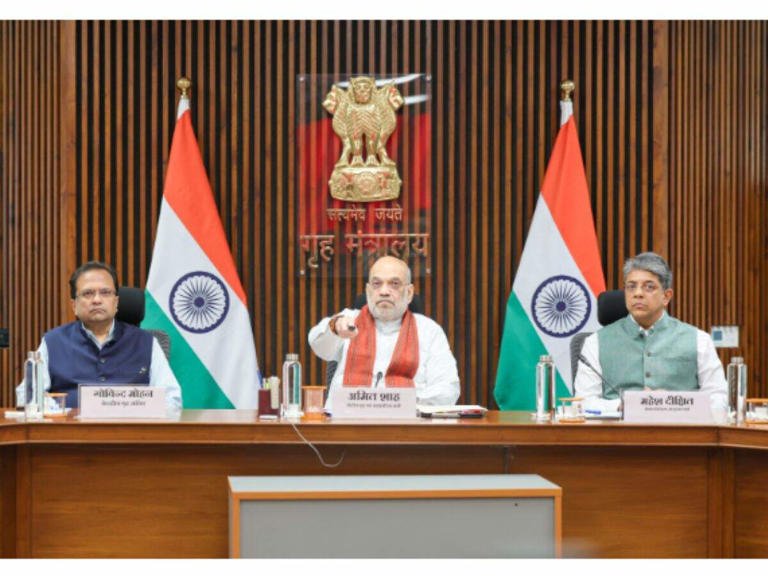
Union Home Minister Amit Shah on Tuesday launched the Foreign Contribution (Regulation) Act (FCRA) 2.0 portal and the electronic Overseas Citizen of India (e-OCI) card, marking a significant step towards enhancing transparency, efficiency, and digital governance in the delivery of citizen-centric services. The initiatives are aimed at modernising administrative processes, improving ease of access for applicants, and strengthening the government’s commitment to technology-driven public service delivery.
The launch reflects the Ministry of Home Affairs’ continued focus on digital transformation by leveraging technology to simplify regulatory procedures and improve service accessibility. The upgraded FCRA 2.0 portal is expected to streamline the management of foreign contribution-related services, while the e-OCI card introduces a secure digital platform for Overseas Citizen of India cardholders.
Speaking on the occasion, Amit Shah said the government remains committed to building a transparent, efficient, and technology-enabled governance system that serves citizens more effectively while reducing procedural complexities.
FCRA 2.0 portal to enhance transparency and efficiency
The newly launched FCRA 2.0 portal has been designed to modernise the administration of services related to the Foreign Contribution (Regulation) Act by introducing improved digital features, faster processing mechanisms, and enhanced transparency.
Officials stated that the upgraded platform will facilitate online submission of applications, renewals, compliance filings, and various regulatory services under a more user-friendly interface. The system is expected to reduce processing time while enabling applicants to track the status of their applications more efficiently.
The portal also incorporates improved digital monitoring and management capabilities, allowing authorities to process applications with greater accuracy and operational efficiency.
According to the Ministry of Home Affairs, the platform aims to promote ease of compliance while strengthening regulatory oversight in accordance with the provisions of the FCRA.
e-OCI card introduces digital convenience
Alongside the FCRA 2.0 portal, Amit Shah launched the e-OCI card, which is expected to provide Overseas Citizen of India cardholders with a secure digital version of their OCI documentation.
Officials explained that the electronic OCI card has been introduced to improve convenience, accessibility, and digital verification while reducing dependence on physical documentation.
The initiative aligns with the government’s broader Digital India vision by expanding the use of secure digital identity systems across various public services.
Cardholders are expected to benefit from quicker access to their OCI credentials and simplified verification processes whenever required.
Authorities stated that the digital platform has been developed with robust security features to ensure authenticity and data protection.
Strengthening Digital India initiatives
The launch of the FCRA 2.0 portal and e-OCI card represents another milestone in the government’s ongoing Digital India programme, which seeks to transform governance through technology.
Over the past decade, numerous government services have been digitised to improve accessibility, reduce paperwork, enhance transparency, and promote efficient public administration.
Amit Shah observed that technology has become an important tool for improving governance by enabling faster service delivery and strengthening accountability across government institutions.
The latest initiatives are expected to further simplify administrative procedures while making government services more accessible to citizens and stakeholders.
Focus on citizen-centric governance
The Union Home Minister emphasised that digital transformation should ultimately improve the experience of citizens interacting with government institutions.
By reducing manual processes, introducing online platforms, and improving transparency, the government aims to create a more responsive and efficient administrative system.
Officials noted that the upgraded digital platforms have been developed with user-friendly interfaces to minimise procedural difficulties and encourage greater utilisation of online services.
The government continues to prioritise citizen-centric governance through the adoption of modern technologies that simplify service delivery while maintaining security and regulatory compliance.
Improved regulatory management under FCRA
The FCRA 2.0 portal is also expected to strengthen regulatory administration through enhanced digital monitoring and integrated data management systems.
Officials stated that the platform enables better record management, automated workflows, and more efficient processing of applications submitted by eligible organisations seeking permissions under the Foreign Contribution (Regulation) Act.
Improved digital capabilities are expected to facilitate timely decision-making while supporting greater transparency throughout the regulatory process.
Authorities believe that technological integration will contribute to improved governance and more effective implementation of statutory provisions.
Secure digital identity for OCI cardholders
The introduction of the e-OCI card reflects the government’s broader efforts to promote secure digital documentation across public services.
Digital credentials reduce dependence on physical documents while improving portability, accessibility, and verification for users.
Officials stated that the electronic OCI card has been designed using modern digital security standards to safeguard personal information while enabling convenient access for cardholders.
The initiative also supports the government’s vision of expanding digital identity solutions to improve service delivery and administrative efficiency.
Technology-driven reforms continue
The Ministry of Home Affairs has undertaken several initiatives in recent years to modernise administrative systems through digital technologies.
Officials observed that technology-driven reforms improve operational efficiency, reduce administrative delays, minimise paperwork, and strengthen transparency in government functioning.
The FCRA 2.0 portal and e-OCI card form part of this broader transformation aimed at creating more effective governance systems capable of meeting the evolving needs of citizens and institutions.
The government intends to continue introducing technological innovations that improve public service delivery while ensuring robust data security and regulatory compliance.
Supporting ease of access and administrative efficiency
The latest digital platforms are expected to benefit a wide range of stakeholders, including organisations regulated under the FCRA framework and Overseas Citizen of India cardholders.
Online services, digital documentation, automated workflows, and enhanced tracking mechanisms are expected to improve overall user experience while reducing administrative burdens.
Officials believe that greater digitisation of public services contributes to more efficient governance and strengthens public confidence in government institutions.
The initiatives also reinforce India’s growing emphasis on digital governance as an important driver of administrative reforms.
Digital governance receives another major boost
The launch of the FCRA 2.0 portal and the e-OCI card by Union Home Minister Amit Shah marks another important step in India’s journey towards technology-enabled governance. By introducing upgraded digital platforms that simplify regulatory compliance and improve citizen services, the government aims to strengthen transparency, operational efficiency, and ease of access across key administrative functions.
As Digital India continues to expand its reach, initiatives such as the FCRA 2.0 portal and e-OCI card demonstrate the government’s commitment to modernising public administration through innovation and secure digital technologies. The reforms are expected to benefit both institutions and individuals by making government services faster, more transparent, and increasingly accessible in the digital era.