

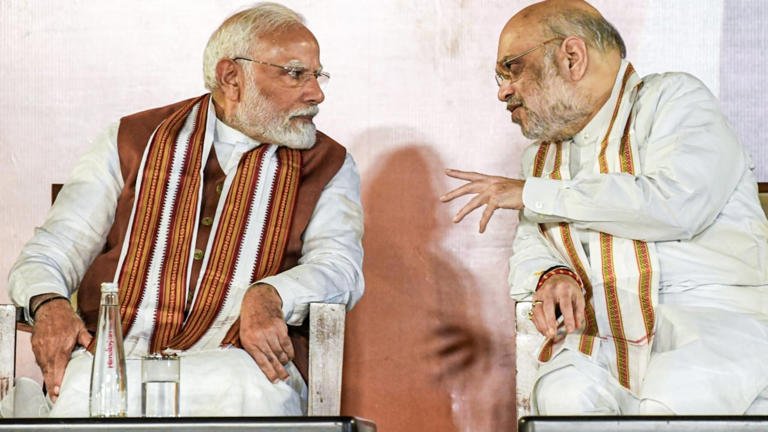
Union Home Minister Amit Shah met Prime Minister Narendra Modi on Saturday shortly after Union Education Minister Dharmendra Pradhan resigned from the Union Cabinet amid sustained nationwide protests over alleged examination irregularities. The high-level meeting came at a crucial time as the Centre worked to manage the political fallout and chart its next course of action following one of the most significant Cabinet resignations in recent years.
Pradhan’s resignation followed weeks of protests led by the Cockroach Janta Party (CJP) and supported by students, youth groups, and opposition parties. Demonstrators had demanded accountability over alleged paper leaks in competitive examinations, with Pradhan’s resignation emerging as one of their principal demands.
The meeting between Shah and Modi has sparked political discussions over the government’s strategy to address the crisis, reassure students, and maintain stability following the minister’s departure.
Amit Shah Holds Key Meeting With Prime Minister
According to reports, Amit Shah met Prime Minister Narendra Modi soon after Dharmendra Pradhan submitted his resignation. The meeting came as the government evaluated the rapidly changing political situation following the resignation and the subsequent announcement by the protesters to end their agitation.
Government sources indicated that senior ministers have been closely coordinating efforts to ensure a smooth transition within the Education Ministry while also addressing the concerns raised by protesting students.
Union Ministers J.P. Nadda and Jitendra Singh, who had held multiple rounds of discussions with protest representatives over the past week, were also expected to brief Amit Shah on the outcome of the negotiations and the commitments made by the government.
Dharmendra Pradhan Steps Down Amid Mounting Pressure
Dharmendra Pradhan announced his resignation after weeks of mounting pressure from student groups protesting alleged irregularities in competitive examinations, including concerns surrounding paper leaks.
In his public statement, Pradhan said he had taken moral responsibility for the situation and emphasized that he wanted to ensure students’ futures were protected. He also said his resignation was intended to prevent further unrest and to ensure that students could return their focus to education rather than prolonged protests.
His resignation marked a rare instance of a Union minister stepping down amid sustained public protests, making it one of the most closely watched political developments of the year.
Student Protests Lead to Major Political Development
The protests, centered at Delhi’s Jantar Mantar, drew thousands of students from across the country. Demonstrators accused the government of failing to prevent examination irregularities and demanded sweeping reforms in the education system.
Along with Pradhan’s resignation, protesters sought assurances regarding reforms in examination processes, compensation for families affected by alleged exam-related tragedies, protection from legal action against protesters, and greater transparency in recruitment and entrance examinations.
As public pressure intensified, the government initiated multiple rounds of dialogue with protest leaders, eventually leading to an agreement that paved the way for ending the demonstrations.
Centre Engages With Protest Leaders
Before the resignation, senior government representatives held extensive discussions with the protesters in an effort to resolve the deadlock peacefully.
Union Health Minister J.P. Nadda met representatives of the movement and assured them that the government would consider their five-point charter of demands. Following these assurances and Pradhan’s resignation, the protest leadership announced that the agitation would be withdrawn.
The government’s approach was widely viewed as an attempt to restore normalcy while demonstrating its willingness to engage through dialogue.
Political Reactions Intensify
Pradhan’s resignation triggered strong reactions across the political spectrum.
Opposition parties described the development as a victory for student activism and accountability, arguing that sustained public pressure had compelled the government to respond. Several leaders praised the protesters for maintaining their movement despite weeks of demonstrations.
Meanwhile, leaders from the ruling BJP maintained that the government’s priority remained protecting students’ interests and ensuring that examination reforms would continue.
Political analysts noted that the episode represents one of the most significant public pressure campaigns faced by the Modi government in recent years.
Focus Shifts to Education Reforms
With the resignation accepted and protests ending, attention has shifted toward the government’s promised reforms in the education sector.
Students and education experts have called for stronger safeguards against examination malpractice, enhanced transparency in recruitment processes, improved security for entrance examinations, and faster investigation of alleged irregularities.
Many believe that restoring confidence in India’s examination system will require both administrative reforms and technological improvements to ensure fairness for millions of students appearing in competitive examinations every year.
Government Seeks Stability After Crisis
The meeting between Amit Shah and Prime Minister Modi is being viewed as part of the government’s efforts to stabilize the political situation following the resignation.
Senior ministers are expected to oversee the transition in the Education Ministry while ensuring that commitments made during negotiations with protesters are implemented. The government also faces the challenge of rebuilding public trust in the country’s education system and preventing similar controversies in the future.
What Lies Ahead
The resignation of Dharmendra Pradhan and the subsequent meeting between Amit Shah and Prime Minister Narendra Modi mark a significant moment in Indian politics. While the immediate political crisis appears to have eased following the withdrawal of the protests, the larger challenge now lies in delivering meaningful reforms that address the concerns raised by students.
The Centre’s response in the coming weeks will be closely watched by students, educators, political observers, and opposition parties alike. The government’s ability to implement credible examination reforms and uphold its assurances will determine whether the episode becomes a turning point for India’s education system or remains a temporary political settlement.