

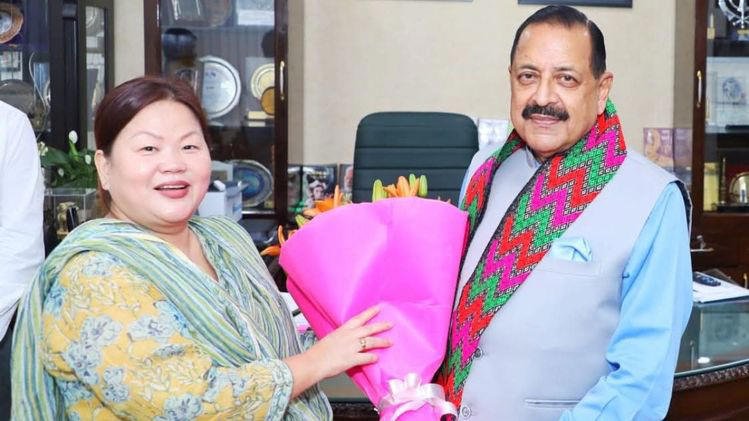
Arunachal Pradesh has put forward the Arunachal bioresource centre proposal during a high-level meeting with Union Minister for Environment, Forest and Climate Change, Bhupender Yadav. The proposal also includes setting up a germplasm bank to preserve genetic material of the region’s unique flora.
The high-level meeting, held in New Delhi, saw a delegation led by Arunachal Environment Minister Mama Natung presenting the state’s ambitious Arunachal bioresource centre proposal, aimed at harnessing the region’s rich biodiversity while ensuring scientific conservation.
Read More: Tripura Expands Organic Farming, Boosts Export Success
Why Arunachal Needs a Bioresource Hub
Arunachal Pradesh is home to more than 4,000 species of flowering plants, 600 species of orchids, and diverse medicinal herbs, many of which are endemic. However, the lack of structured documentation, storage, and research infrastructure hampers the sustainable use of these resources.
To address this gap, the state’s proposal calls for a dedicated bioresource centre that would facilitate advanced research, documentation, value addition, and policy formulation for bioeconomy-based development.
Minister Natung said, “We are nature-rich but technology-poor. A bioresource centre will help bridge this gap and unlock Arunachal’s green potential.”
Germplasm Bank to Conserve Local Species
A major highlight of the proposal includes setting up a germplasm bank, which would store and protect genetic material of rare and endangered species. The initiative will support biodiversity conservation, forest resilience, and local agri-based industries.
Experts from the Department of Science and Technology, who were also present, noted that germplasm banks are vital in an era of climate change, especially in biodiversity hotspots like Arunachal.
The bank would collect seeds, tissues, and DNA of important local species—particularly those under threat from urban expansion or invasive species. These samples would be stored under controlled conditions for future research and restoration.
Centre Responds Positively
Union Minister Bhupender Yadav responded positively to the Arunachal bioresource centre proposal, appreciating the state’s proactive approach. He assured that the Centre would examine the proposal thoroughly and consider integrating it into the National Mission on Bioresources and Sustainable Development.
He also encouraged the state to prepare a detailed project report (DPR), outlining costs, scientific collaborations, local partnerships, and long-term benefits.
The Centre’s support is expected to be channeled through institutions like the National Biodiversity Authority (NBA) and the Indian Council of Forestry Research and Education (ICFRE).
Boost for Local Economies and Indigenous Communities
The bioresource centre is not just about conservation—it also promises economic benefits for tribal communities in Arunachal. The facility would offer training and support in processing medicinal plants, bamboo, and forest produce for commercial use, with a focus on fair-trade practices.
Minister Natung highlighted how such centres can empower local youth and traditional knowledge holders. “Our tribal communities have preserved biodiversity for centuries. Now, science must partner with tradition to create jobs and income,” he said.
Additionally, the proposed germplasm bank could support community seed banks and promote indigenous farming systems that are climate-resilient and sustainable.
Collaboration with Research Bodies and Universities
During the meeting, the delegation also proposed linkages between the bioresource centre and national research institutions like the GB Pant Institute of Himalayan Environment and Sustainable Development, DBT-NEHU, and Arunachal University.
These collaborations aim to create a long-term knowledge network for the Eastern Himalayan region. Students, researchers, and policymakers would benefit from data access, training modules, and shared innovations.
Environmentalists Welcome the Move
Environmentalists and scientists in the Northeast have welcomed the Arunachal bioresource centre proposal, calling it a crucial step toward integrated conservation. Many have argued that India’s biodiversity policy must go beyond protected areas and include local-led initiatives.
Dr. Kimi Dolo, an ecologist based in Itanagar, noted, “Arunachal’s ecosystem is fragile yet powerful. A bioresource centre would turn this strength into a strategic advantage—scientifically and socially.”
She also emphasized that germplasm banks would future-proof local ecosystems against environmental shocks like floods, droughts, and forest loss.
What’s Next?
The state government has already begun drafting the DPR, which is expected to be submitted within the next two months. The plan includes timelines for infrastructure, staffing, equipment procurement, and training modules.
If approved, Arunachal’s facility would become the Northeast’s first integrated bioresource and germplasm hub. It would also align with India’s commitment to the UN Convention on Biological Diversity and Sustainable Development Goals (SDGs).
In the coming weeks, officials from the Ministry of Environment, Forest and Climate Change are expected to visit potential sites in East Kameng and Papum Pare districts for feasibility checks.
Read More: Tripura Allocates Three Departments to Cabinet Minister Kishor Barman