

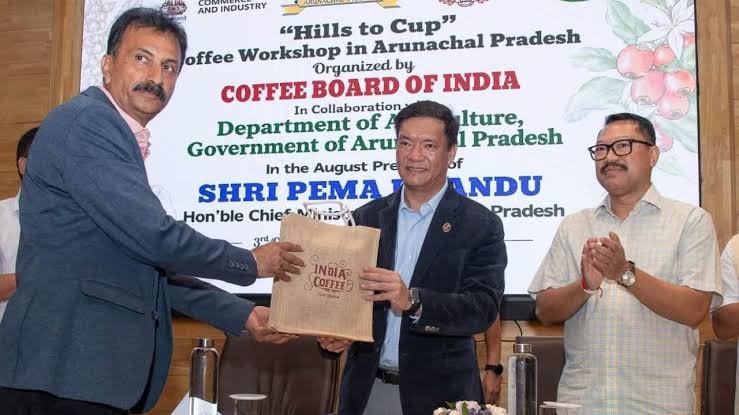
The Arunachal coffee workshop potential has come into focus after the state hosted its first official coffee workshop in Itanagar. The event brought coffee growers, technical experts, entrepreneurs and government officials together to discuss the future of the crop.
The Coffee Board of India organised the “Hills to Cup” workshop with the Arunachal Pradesh Agriculture Department. The initiative aims to identify technical gaps, assess challenges and develop recommendations for expanding coffee cultivation.
Chief Minister Pema Khandu said Arunachal Pradesh currently has around 600 hectares under coffee cultivation. He also called for stronger productivity, better bean quality and a complete value chain to increase growers’ incomes.
Major Breakthrough: Chakhesang Youth Agitation Ends After Nagaland Forest Department Settlement
Arunachal Coffee Workshop Potential Gains Official Focus
The Arunachal coffee workshop potential reflects a renewed effort to develop coffee as a commercial crop. Although coffee cultivation has existed in Arunachal Pradesh for nearly five decades, the sector has not received sustained policy attention, according to Chief Minister Pema Khandu.
The October 3 workshop marked the first official platform where growers from across the state could collectively discuss the sector with Coffee Board representatives and state officials. The meeting therefore created a structured opportunity to identify problems affecting cultivation and processing.
Khandu said the government would follow up on the workshop’s recommendations. He also indicated that the state would explore suitable policy interventions to provide greater support to coffee growers and entrepreneurs.
Earlier, the state government had constituted a three-member delegation to study coffee cultivation models in Andhra Pradesh and other states. The delegation included Agriculture Department officials, a retired Principal Chief Conservator of Forests and the chairman of the Arunachal Pradesh Forest Corporation.
Following the delegation’s report, the government invited the Coffee Board’s chairman and director to Arunachal Pradesh. Their visit subsequently contributed to the decision to organise the “Hills to Cup” workshop.
Consequently, the event forms part of a broader effort rather than an isolated agricultural meeting. The government now intends to use technical recommendations to determine how it can support the sector more systematically.
Coffee Cultivation Covers Around 600 Hectares
The Arunachal coffee workshop potential becomes clearer when compared with the state’s current cultivation area. Agriculture Department data cited by the Chief Minister puts the area under coffee at only around 600 hectares.
A substantial portion of the existing plantations lies under the Arunachal Pradesh Forest Corporation in eastern Arunachal Pradesh. At the same time, individual growers in different parts of the state have developed pilot and model plantations.
Khandu said Arunachal’s diverse agro-climatic conditions, fertile land and multiple climatic zones provide a favourable foundation for expanding coffee cultivation. However, he stressed that increasing plantation area alone should not become the main objective.
Instead, the state wants to improve productivity per hectare, bean quality and farmer incomes. This approach places greater emphasis on the economics of coffee production rather than simply increasing the amount of land under the crop.
Coffee growers had already begun building networks before the latest workshop. In February 2026, growers from Kamle, Upper Subansiri, West Siang, Leparada, Papum Pare, Lower Siang, Keyi Panyor and Tirap participated in a growers’ meeting at Sengri village in Papum Pare.
That meeting, organised under the aegis of the Coffee Board, highlighted the need for better coordination between growers and government agencies. Participants also discussed cultivation practices, nursery development and the broader coffee value chain.
The earlier meeting shows that interest in coffee development existed before the state-level workshop. However, growers had also pointed to the absence of a dedicated state coffee development programme as one factor behind relatively slow progress.
Value Chain and Technical Support Become Priorities
The Arunachal coffee workshop potential extends beyond cultivation because the state wants to establish a complete value chain. Such a chain can include planting, harvesting, processing, quality improvement, marketing and related entrepreneurial activities.
Khandu specifically urged growers to focus on value addition and stronger market connections. He said the state should improve productivity and bean quality while ensuring that farmers receive greater economic benefits from coffee.
Technical knowledge remains another priority. The Coffee Board’s experts are expected to study the gaps and challenges raised during the workshop and prepare recommendations for the state government.
Those recommendations could help identify the support growers require at different stages of production. Moreover, technical guidance can help growers improve cultivation practices and understand quality requirements before expanding plantations.
The February growers’ meeting also included practical demonstrations on plantation management and nursery-raising techniques. Such activities indicate the importance of field-level knowledge as the sector develops.
At the same time, the state needs to consider processing and market access. Increasing production without sufficient processing or reliable buyers could limit the economic benefits for growers.
Therefore, the workshop’s focus on a complete value chain is significant. A coordinated approach could connect farmers with technical institutions, processors, traders and potential markets.
The Coffee Board has also expressed interest in supporting coffee development in the Northeast. At the February growers’ meeting, Coffee Board officials said the region could contribute more significantly to India’s overall coffee production.
Tourism and Youth Entrepreneurship Add New Opportunities
The Arunachal coffee workshop potential also connects agriculture with the state’s growing tourism economy. Khandu said tourism could create additional opportunities for coffee growers and businesses.
Arunachal Pradesh attracts visitors to its mountainous landscapes, cultural destinations and remote communities. Consequently, locally produced coffee could potentially find markets through cafes, hospitality businesses and tourism-related enterprises.
Khandu specifically encouraged young people to explore coffee cultivation, processing and related businesses. He described the sector as an opportunity for employment and entrepreneurship, particularly as the state seeks to diversify its agricultural economy.
However, the expansion of coffee will require sustained investment. Coffee cultivation can take time to become commercially productive, while farmers also need access to suitable planting material, technical advice and post-harvest facilities.
Historical documents on coffee development in the Northeast have identified long gestation periods and inadequate post-harvest infrastructure among challenges facing the sector. Those issues underline why cultivation expansion needs to occur alongside processing and market development.
The state will therefore need to balance ambition with practical implementation. Increasing plantation acreage can create opportunities, but growers also need reliable systems that help them convert harvested beans into quality products with better market value.
Additionally, stronger coordination between government agencies and growers could help reduce information gaps. A dedicated policy framework could also provide clearer direction for investments and technical support.
The workshop has now created a platform for those discussions. Its longer-term significance will depend on the recommendations prepared by the Coffee Board and the policy measures adopted by the state government.
Conclusion
The Arunachal coffee workshop potential has gained fresh attention after the Coffee Board of India and the Arunachal Pradesh Agriculture Department organised the state’s first official coffee workshop in Itanagar.
Arunachal Pradesh currently has around 600 hectares under coffee cultivation. Although coffee has been grown in the state for nearly five decades, Chief Minister Pema Khandu said its potential has not received adequate promotion or dedicated policy attention.
The state now wants to move beyond simply expanding cultivation. Productivity, bean quality, value addition, processing, market access and farmer incomes have emerged as key priorities.
Moreover, tourism and youth entrepreneurship could create additional opportunities around the crop. The Coffee Board’s technical recommendations will be important in determining the next stage of development.
The workshop therefore represents an initial step toward creating a more organised coffee ecosystem in Arunachal Pradesh. Its success will ultimately depend on how effectively the state converts the technical discussions into long-term support for growers.
FAQs
What was the Arunachal coffee workshop about?
The Arunachal coffee workshop potential was discussed at the “Hills to Cup” workshop, which brought growers, Coffee Board experts, entrepreneurs and government officials together to explore the development of coffee cultivation and its value chain.
How much land is currently under coffee cultivation in Arunachal Pradesh?
According to Agriculture Department data cited by Chief Minister Pema Khandu, around 600 hectares of land is currently under coffee cultivation in Arunachal Pradesh.
Is coffee cultivation new to Arunachal Pradesh?
No. Coffee cultivation has existed in Arunachal Pradesh for nearly five decades. However, the state government says the crop has not received adequate promotion or dedicated policy intervention over the years.
What does Arunachal Pradesh want to achieve through coffee development?
The state wants to improve productivity, bean quality and farmer incomes while developing a stronger value chain covering cultivation, processing and marketing.
Can tourism support Arunachal’s coffee sector?
The state government sees tourism as a potential opportunity for coffee-related businesses. Chief Minister Pema Khandu has encouraged young people to explore coffee cultivation, processing and related enterprises as tourism expands.
[…] Arunachal Hosts First-Ever Official Coffee Workshop to Map Cash Crop Potential […]
[…] Arunachal Hosts First-Ever Official Coffee Workshop to Map Cash Crop Potential […]
[…] Arunachal Hosts First-Ever Official Coffee Workshop to Map Cash Crop Potential […]
[…] Arunachal Hosts First-Ever Official Coffee Workshop to Map Cash Crop Potential […]
[…] Arunachal Hosts First-Ever Official Coffee Workshop to Map Cash Crop Potential […]