

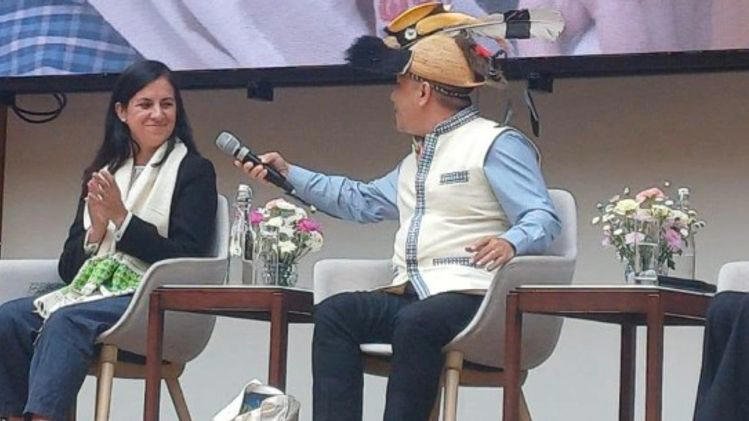
Arunachal Pradesh MLA Toko Tatung has presented the long-term development vision for Keyi Panyor district at the inaugural plenary of the Global Conscious Food Systems Summit 2026 in Paro, Bhutan, highlighting the importance of Indigenous knowledge, biodiversity, sustainable food systems and human well-being.
Representing the 16-Yachuli Assembly Constituency, Tatung became the first legislator from Arunachal Pradesh to participate in the international summit, according to an official statement. The summit brought together leaders, Indigenous representatives, scientists and development practitioners from 65 countries to discuss the future of sustainable and conscious food systems.
Toko Tatung Presents Keyi Panyor Mission Plan 2040
During the high-level panel discussion titled “Rising to the Moment: Igniting Consciousness to Address the Polycrisis,” Tatung presented the Keyi Panyor Mission Plan 2040 (KPMP 2040), a long-term framework designed to guide the development of one of India’s youngest districts.
The mission plan was formally launched on August 15, 2026, and seeks to move beyond conventional annual schemes and five-year electoral cycles. Instead, the framework envisions a long-term and community-centred approach to development, with an eye on what future generations will inherit.
KPMP 2040 covers 20 priority areas, including education, healthcare, agriculture, agroecology, biodiversity, forests, water, livelihoods, women and youth, culture, renewable energy, tourism, infrastructure and local institutions. The comprehensive approach seeks to ensure that economic development and environmental conservation progress together rather than being treated as competing priorities.
Indigenous Knowledge at the Centre of Development
Speaking as a member of the Nyishi community, Tatung placed Indigenous knowledge and traditional ecological wisdom at the centre of his vision for Keyi Panyor.
He emphasised that development planning should not rely exclusively on modern institutions and scientific expertise but should also recognise the knowledge preserved by local communities over generations.
According to Tatung, farmers, scientists, universities and Indigenous communities all possess valuable forms of knowledge that must be brought together to build a sustainable future.
The MLA highlighted the importance of combining traditional ecological knowledge with modern science, particularly when addressing interconnected challenges such as climate change, biodiversity loss, food security and rural livelihoods.
His intervention reflected a broader argument that communities which have lived closely with forests, rivers and agricultural landscapes for generations can play a significant role in designing solutions suited to their local ecological realities.
Linking Food Systems With Climate and Biodiversity
Tatung also highlighted the deep relationship between food systems and natural ecosystems.
He noted that food production depends on healthy soil, adequate water, forests and biodiversity while also influencing nutrition, livelihoods and cultural traditions. This connection, he argued, makes food systems central to discussions on climate resilience and sustainable development.
The MLA also drew attention to the real-life impact of climate change on rural communities. While climate change is often discussed at international forums and through global policy negotiations, its consequences are directly experienced by families whose farms, homes, livestock and livelihoods are affected by floods and other extreme weather events.
The Keyi Panyor development vision therefore seeks to connect environmental protection with the everyday needs of local communities.
The approach recognises that sustainable development cannot be achieved through conservation policies that overlook the people living in and around ecologically important landscapes.
Keyi Panyor to Become India’s First Bio-Happy District
One of the most significant aspects of Tatung’s presentation was the development of Keyi Panyor as India’s first “Bio-Happy District.”
The initiative draws inspiration from the concept of biohappiness associated with the vision of renowned agricultural scientist Dr M.S. Swaminathan. Keyi Panyor is working with the M.S. Swaminathan Research Foundation (MSSRF) and other partners to link biodiversity conservation directly with nutrition, livelihoods and human well-being.
The idea behind the initiative is that protecting biodiversity should also contribute to improving the lives of communities.
The development model seeks to ensure that forests remain protected while communities responsible for conserving them are also able to prosper. Similarly, agroecology is expected to support both environmental sustainability and rural livelihoods, while local food systems can contribute to better nutrition.
This approach places people at the centre of conservation and seeks to create a balance between ecological protection and economic dignity.
Education and Agroecology Initiatives Underway
Tatung said the Keyi Panyor Mission Plan 2040 is already being translated into grassroots programmes.
Under the Comprehensive Action Plan for Education (CAPE), more than 90 per cent of government school teachers have participated in district-wide cluster workshops. The initiative also includes engagement with Anganwadi workers on early childhood education and nutrition.
In agriculture and ecology, the district is working with organisations including the MSSRF and the Participatory Action Research Coalition of India (PARCI).
The partnerships focus on natural agriculture, agro-biodiversity conservation, ecological livelihoods and community-based planning. These initiatives are intended to create development models that are adapted to the district’s local environment and social realities.
The emphasis on community participation reflects the larger philosophy behind KPMP 2040—that sustainable development must be built with local communities rather than imposed through a top-down model.
Development Beyond Five-Year Political Cycles
A central message of Tatung’s address was the need to think beyond the five-year time frame commonly associated with electoral politics.
He argued that while elected representatives serve for limited terms, the consequences of development decisions can affect generations. A child born today may live for several decades, while forests and ecosystems can take centuries to develop.
For this reason, the Keyi Panyor Mission Plan 2040 seeks to establish a development vision that continues beyond individual political careers.
Tatung stressed that the mission should ultimately belong to the people of Keyi Panyor rather than to any individual leader.
This long-term approach could help create continuity in development planning and encourage local communities to take greater ownership of the district’s future.
A Vision Rooted in Local Identity
Concluding his address, Tatung made it clear that his vision was not to transform Keyi Panyor into an imitation of a major global city.
Instead, he emphasised that the district should pursue development while preserving its own ecological identity, culture and strengths.
The presentation at the Global Conscious Food Systems Summit provided an international platform for Arunachal Pradesh’s locally rooted development ideas and Indigenous knowledge systems.
By presenting KPMP 2040 before a global gathering of policymakers, scientists and Indigenous representatives, Tatung highlighted how districts such as Keyi Panyor can develop models that combine modern science with traditional wisdom.
The Keyi Panyor development vision ultimately presents a long-term approach centred on biodiversity, sustainable food systems, education, ecological livelihoods and community well-being—while seeking to ensure that development remains rooted in the identity and aspirations of the people it is meant to serve.