

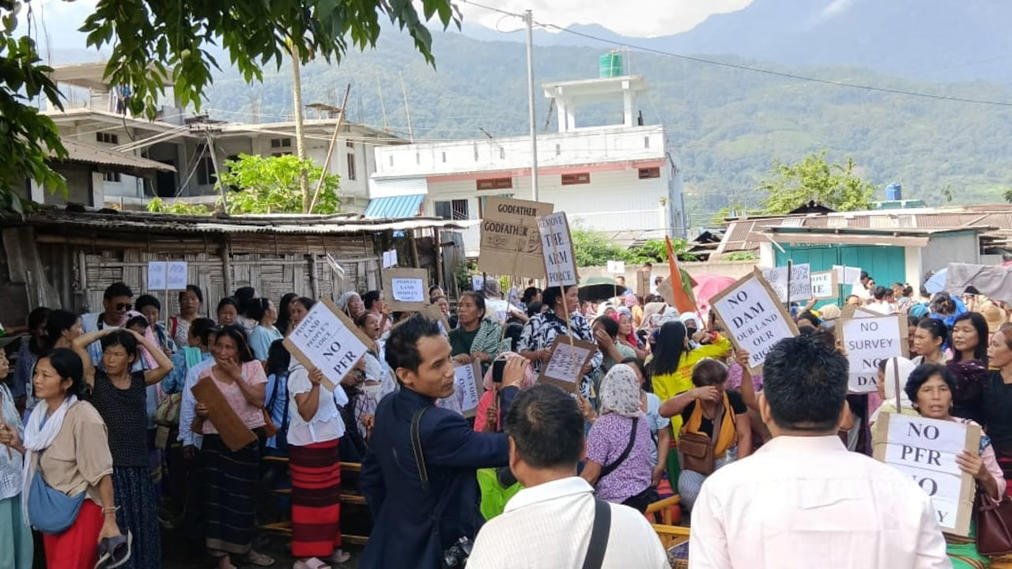
Protests against the proposed Siang Upper Multipurpose Project (SUMP) in Arunachal Pradesh’s Upper Siang district turned violent on September 30, with demonstrators blocking roads, clashing with security personnel and damaging government vehicles.
The unrest took place during Chief Minister Pema Khandu’s visit to Yingkiong, where opposition to the proposed mega hydropower project has intensified in recent weeks. Protesters have demanded an immediate halt to pre-feasibility studies and called for direct consultation with communities that could be affected by the project.
Government Vehicles Damaged, Police Vehicle Set on Fire
The demonstrations disrupted traffic on key routes, including the Yingkiong-Komkar-Geku stretch and roads towards Dite Dime. According to reports, government vehicles were damaged at several locations.
The situation escalated near the Dite Dime bridge, where a police vehicle was reportedly set on fire. Security personnel also clashed with protesters as authorities attempted to manage the demonstrations.
The latest violence followed clashes between villagers and security forces at Geku on September 28, when opposition to the deployment of security personnel for survey-related activities intensified.
MLA Alo Libang’s Residence Allegedly Vandalised
The protests also reached the residence of Tuting-Yingkiong MLA Alo Libang in Yingkiong. Hundreds of protesters allegedly entered the premises and vandalised the property.
Several ministers and legislators were reportedly staying at the residence during the Chief Minister’s visit. Security forces also intercepted a protest march in the town, leading to scuffles between demonstrators and personnel.
The incidents have highlighted the growing tension between sections of the local population and authorities over the proposed project and the ongoing survey process.
Villagers Oppose Pre-Feasibility Survey
A major point of contention is the government’s decision to proceed with a Pre-Feasibility Report (PFR) for the SUMP.
The proposed project has an estimated capacity of around 11,000 MW. Villagers and organisations representing sections of the indigenous Adi community have opposed the survey, saying they want affected communities to be consulted before such activities are carried out.
Protesters have also demanded the withdrawal of security forces deployed in areas where survey activities are planned.
Concerns Over Land, Livelihoods and Environment
Opposition groups have raised concerns about the possible impact of the proposed dam on land, livelihoods, ecosystems and the traditional way of life of communities in the Siang Valley.
The Adi Bané Kébang-United has said that villagers in Geku, Komkar and other affected areas oppose the project. The organisation has cited concerns about the region’s seismic vulnerability and potential effects on river ecosystems and downstream communities.
The concerns have also extended beyond Arunachal Pradesh, with groups highlighting possible implications for communities downstream in Assam.
Government Says Feasibility Study Is Not Project Approval
Chief Minister Pema Khandu has maintained that the present exercise is limited to assessing the project’s feasibility and does not amount to a final decision to construct the dam.
Khandu has said the PFR is intended to establish the technical viability of the proposed project. He has also offered to engage with protesters and said further stages would require additional assessments and consultations.
The Chief Minister has also linked the project to broader issues of energy and national security, particularly because of the Siang River’s location near the international border.
Debate Over Development and Local Concerns
The SUMP has generated a wider debate over Arunachal Pradesh’s hydropower potential and the environmental and social implications of large infrastructure projects.
The government has highlighted the potential importance of the project for power generation and regional infrastructure. Opposing groups, meanwhile, have focused on possible displacement, environmental changes and the impact on indigenous communities.
The disagreement has become increasingly contentious as authorities seek to proceed with preliminary studies while protesters demand that the process be stopped.
Calls for Dialogue Grow
With tensions rising, direct dialogue between authorities and affected communities remains a key issue. Protesters have sought consultation before surveys proceed, while the government has maintained that the feasibility stage is necessary before any further decision can be taken.
The recent violence has added urgency to the need for communication between the two sides. As authorities assess the situation in Upper Siang, the future of the Siang project remains closely tied to how concerns over development, environmental protection and community participation are addressed.