

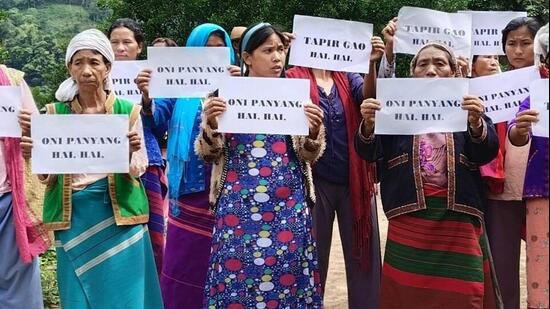
Protests against the proposed Siang Upper Multipurpose Project (SUMP) intensified in Arunachal Pradesh’s Upper Siang district on September 30, with demonstrators blocking roads, clashing with security personnel and allegedly vandalising the residence of local MLA Alo Libang.
The unrest occurred during Chief Minister Pema Khandu’s visit to Yingkiong. Protesters have been opposing the government’s decision to conduct a Pre-Feasibility Report (PFR) survey for the proposed mega dam on the Siang River.
Vehicles Set on Fire
The protests disrupted movement along the Yingkiong-Komkar-Geku road and towards Dite Dime after demonstrators erected blockades at several locations.
According to reports, several government vehicles were damaged during the demonstrations. A police vehicle was also reportedly set on fire near Dite Dime as security personnel attempted to manage the situation.
The latest escalation came two days after villagers and security forces clashed at Geku during protests over the deployment of Central Armed Police Forces for the proposed survey. Four people were detained following that incident and were subsequently released.
MLA Alo Libang’s Residence Vandalised
Tensions further escalated in Yingkiong when protesters allegedly entered the residence of Tuting-Yingkiong MLA Alo Libang and vandalised the premises.
The residence was reportedly being used by several ministers and legislators during the Chief Minister’s visit. Protesters raised slogans against the proposed project and demanded that the pre-feasibility process be stopped.
The incident has added to concerns over the growing tension between supporters of the proposed hydropower project and groups opposing it.
Opposition to the Siang Upper Multipurpose Project
The proposed SUMP is planned on the Siang River and has an estimated capacity of more than 10,000 MW, with some reports putting its potential at around 11,000 MW.
Sections of the indigenous Adi community and organisations opposing the project have raised concerns about possible displacement, loss of ancestral and customary land, disruption of livelihoods and environmental consequences.
The protesters have also objected to the deployment of security forces for the survey, arguing that local communities should be directly consulted before survey activities proceed.
Government Says Survey Does Not Mean Project Approval
Chief Minister Pema Khandu has maintained that the proposed Pre-Feasibility Report does not amount to approval for construction of the dam.
According to Khandu, the preliminary exercise is intended to establish whether the project is technically feasible and to identify possible locations and technical parameters. He has said that if experts conclude that the project cannot be built, there would be no further process.
The Chief Minister has also said that subsequent stages would involve further assessments, including social and environmental impact studies, a detailed project report and public consultations, depending on the findings of the feasibility exercise.
Chief Minister Meets Residents
Khandu, along with Deputy Chief Minister Chowna Mein and other state officials, was in the region to meet residents and explain the government’s position on the proposed project.
Reports differ on whether Khandu cut short his visit because of the protests. While some reports said the demonstrations affected his programme, Upper Siang Deputy Commissioner Ashok Tajo told Hindustan Times that the Chief Minister completed his scheduled official meeting in Yingkiong before leaving the district by helicopter.
Calls for Dialogue Continue
The Siang Indigenous Farmers’ Forum (SIFF), one of the organisations opposing the project, has sought direct dialogue with communities that could potentially be affected.
The government has maintained that people have the democratic right to oppose the project and question government decisions, while also stressing that protests should not result in damage to public or private property.
The state has also constituted an Empowered High-Level Committee headed by Rural Development and Panchayati Raj Minister Ojing Tasing to coordinate and oversee the PFR process.
Debate Over Development and Environment
The Siang project has generated debate over Arunachal Pradesh’s hydropower potential, environmental concerns and the rights of communities living along the river basin.
Supporters of the project have pointed to its potential importance for power generation and infrastructure, while opponents have highlighted concerns over land, displacement, livelihoods, cultural identity and ecological impact.
With protests now turning violent in parts of Upper Siang, the immediate focus remains on maintaining order and determining how the proposed feasibility study will proceed.
Situation Remains Tense
The latest incidents underline the depth of opposition to the Siang Upper Multipurpose Project among sections of the local population. The government, meanwhile, continues to maintain that the current exercise is only a feasibility assessment and not a final decision to construct the project.
As discussions over the dam continue, further engagement with affected communities and authorities is expected to remain central to the dispute.