

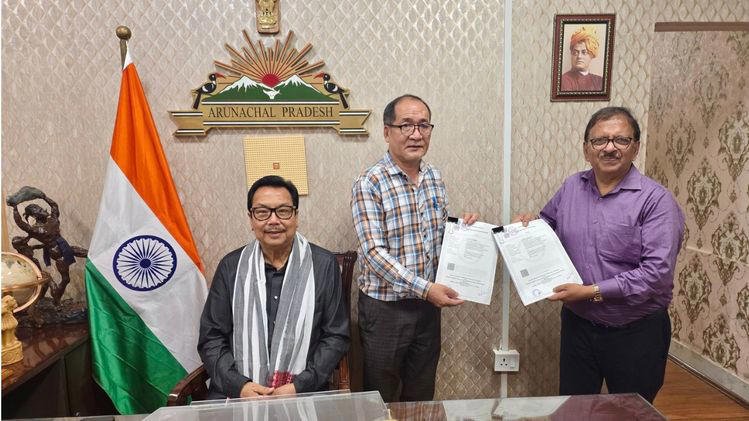
The Arunachal Pradesh government has signed a Memorandum of Agreement (MoA) for the development of the 1750 MW Demwe Lower Hydroelectric Project in Lohit district, marking a major step toward expanding the state’s hydropower infrastructure and energy generation capacity.
Officials said the project would play a significant role in strengthening renewable energy production, improving regional infrastructure, and supporting economic development in Arunachal Pradesh.
The agreement was signed in the presence of senior state government officials, representatives from the power sector, and project authorities. Leaders described the development as an important milestone in Arunachal Pradesh’s long-term energy and infrastructure strategy.
The Demwe Lower Hydroelectric Project is expected to become one of the major hydropower initiatives in the northeastern region because of its large electricity generation capacity.
Project to Boost Renewable Energy Capacity
Officials stated that the 1750 MW project would contribute significantly to renewable energy generation in the state and support India’s broader clean energy goals.
Arunachal Pradesh possesses vast hydropower potential due to its river systems and mountainous terrain. Therefore, the state government has increasingly focused on hydropower development in recent years.
Authorities believe the Demwe Lower project can strengthen power supply systems and reduce energy shortages in several regions.
The government also expects the project to contribute to national energy security by increasing electricity generation from renewable sources.
Officials said hydropower projects remain important for reducing dependence on fossil fuels while supporting sustainable development goals.
Infrastructure Development Expected in Lohit District
The project is expected to improve infrastructure and connectivity in Lohit district and nearby areas.
Officials said large hydropower projects often lead to the development of roads, bridges, communication systems, and transport facilities.
The state government believes such infrastructure improvements can support local economic growth and improve access to remote regions.
Authorities also expect the project to generate employment opportunities during construction and operational phases.
Local businesses, contractors, engineers, transport workers, and technical professionals may benefit from the economic activities linked to the project.
Officials added that better infrastructure could improve access to healthcare, education, and public services in surrounding areas.
Government Highlights Economic Benefits
Senior officials said the Demwe Lower Hydroelectric Project could become a major driver of economic growth in Arunachal Pradesh.
The government expects the project to generate revenue through electricity production while supporting industrial and commercial activities in the future.
Authorities also believe hydropower expansion can attract further investment into the state’s infrastructure and energy sectors.
Officials stated that local communities could benefit from employment generation, business opportunities, and infrastructure development associated with the project.
The government has increasingly promoted large infrastructure projects to improve economic prospects in the northeastern state.
Leaders also highlighted the importance of balancing development with environmental sustainability and community welfare.
Environmental and Technical Assessments Important
Officials said the project would undergo necessary environmental and technical evaluations during different stages of development.
Hydropower projects in ecologically sensitive and mountainous regions require detailed environmental impact studies and geological assessments.
Authorities stated that environmental safeguards and sustainable development practices would remain important priorities during implementation.
The government also plans to coordinate with technical experts and regulatory agencies regarding project execution and compliance measures.
Officials said community consultations and stakeholder engagement may also take place during various stages of development.
Experts believe proper planning and environmental monitoring remain essential for large hydropower projects in the Himalayan region.
Arunachal Focuses on Hydropower Potential
Arunachal Pradesh holds one of the highest hydropower potentials in India because of its extensive river systems and geographical conditions.
The state government has repeatedly emphasised the importance of hydropower in strengthening economic growth and energy infrastructure.
Officials believe projects such as the Demwe Lower Hydroelectric Project can help transform Arunachal Pradesh into a major energy-producing state.
Hydropower development has also gained strategic importance because northeastern states possess significant untapped renewable energy resources.
The Centre and state governments have both increased focus on infrastructure expansion and energy connectivity in the region.
Employment and Livelihood Opportunities Expected
The project is expected to create direct and indirect employment opportunities for local residents during multiple phases of development.
Construction activities may require engineers, technical staff, machine operators, transport workers, and skilled labourers.
Officials said service sectors such as hospitality, transportation, and small businesses may also benefit from increased economic activity.
Authorities believe local youth could receive employment opportunities through skill development and technical training programmes linked to the project.
The government also hopes the initiative will improve livelihood opportunities in nearby districts.
Experts noted that large infrastructure projects often create long-term economic benefits if implemented efficiently and sustainably.
Strategic Importance for Northeast Development
The Demwe Lower Hydroelectric Project also holds strategic importance for infrastructure and development in the Northeast.
Improved power generation capacity can support industrial growth, digital infrastructure, and urban development across the region.
Officials said reliable electricity supply remains essential for economic expansion and investment promotion in northeastern states.
The government believes hydropower projects can strengthen regional connectivity and support future development initiatives.
Authorities also highlighted the importance of increasing renewable energy production as India moves toward cleaner energy systems.
Government Optimistic About Long-Term Impact
The Arunachal Pradesh government expressed confidence that the Demwe Lower Hydroelectric Project would strengthen the state’s economy and energy infrastructure in the long run.
Officials said the MoA signing marks an important step toward unlocking the state’s hydropower potential and supporting sustainable development.
The government expects further technical planning, environmental studies, and administrative procedures to continue in the coming months.
Authorities stated that the project could emerge as one of the landmark infrastructure initiatives in Arunachal Pradesh if implemented successfully.
Leaders also stressed the importance of cooperation between the government, technical agencies, local communities, and project developers during execution.
With the signing of the agreement, Arunachal Pradesh has moved another step closer toward expanding its renewable energy capacity and strengthening long-term infrastructure development in the state.