

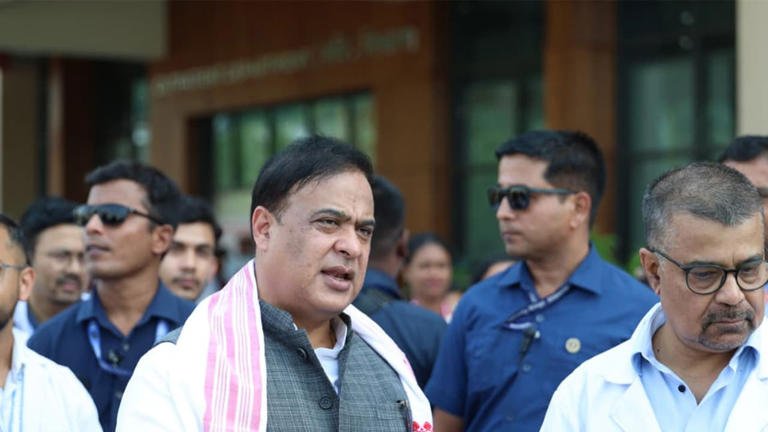
Assam Chief Minister Himanta Biswa Sarma reviewed the progress of the ambitious 3,000-bed hospital project at Guwahati Medical College and Hospital (GMCH), reaffirming the state government’s commitment to strengthening healthcare infrastructure and expanding access to quality medical services. The review focused on assessing the pace of construction, monitoring project implementation, and ensuring that the world-class healthcare facility is completed within the stipulated timeline.
The Chief Minister examined the ongoing work at the project site and received detailed briefings from senior officials and engineers regarding construction milestones, infrastructure development, and future phases of implementation. He directed the concerned departments to maintain high construction standards while ensuring timely completion of the project.
The proposed expansion is expected to transform GMCH into one of the largest government healthcare institutions in the country, significantly increasing its capacity to provide advanced medical treatment to patients from Assam and across the Northeast.
Landmark Project to Strengthen Healthcare Infrastructure
The 3,000-bed hospital project represents one of the largest healthcare infrastructure initiatives undertaken by the Assam government. Once completed, the expanded facility will substantially enhance the state’s ability to deliver specialised medical services while reducing pressure on the existing healthcare system.
The project aims to accommodate the growing demand for quality healthcare by increasing inpatient capacity, improving diagnostic facilities, expanding specialised departments, and introducing modern medical technologies.
Officials believe the expansion will position GMCH as a premier referral centre capable of treating complex medical cases while serving patients from neighbouring northeastern states.
The hospital is also expected to strengthen emergency care, critical care services, and advanced clinical treatment across multiple medical disciplines.
Chief Minister Stresses Timely Completion
During the review meeting, Chief Minister Himanta Biswa Sarma emphasised the importance of completing the project within the prescribed schedule. He instructed executing agencies to closely monitor every phase of construction while maintaining quality standards and ensuring efficient utilisation of resources.
The Chief Minister observed that timely completion would allow the facility to begin serving patients sooner and significantly improve healthcare delivery across the region.
He also stressed the importance of continuous coordination among various government departments, construction agencies, technical experts, and hospital authorities to avoid unnecessary delays during implementation.
According to officials, regular monitoring will continue throughout the construction period to ensure smooth execution of the mega healthcare project.
Modern Medical Facilities Planned
The expanded GMCH campus is expected to feature state-of-the-art medical infrastructure designed to meet the healthcare needs of a rapidly growing population. The project includes plans for advanced operation theatres, intensive care units, emergency services, specialised treatment centres, diagnostic laboratories, and upgraded outpatient facilities.
Modern medical equipment and digital healthcare technologies are expected to enhance patient care while improving operational efficiency within the hospital.
The expanded infrastructure will also support advanced clinical research, medical education, and specialised training programmes for healthcare professionals.
Officials believe the integration of modern healthcare technology will improve diagnosis, treatment outcomes, and overall patient experience.
Major Boost for Medical Education
Beyond patient care, the hospital expansion project is expected to significantly strengthen medical education in Assam. Guwahati Medical College and Hospital serves as one of the state’s premier teaching institutions, and additional infrastructure will create better learning opportunities for undergraduate, postgraduate, and super-speciality medical students.
The expanded campus will provide improved teaching facilities, modern laboratories, research infrastructure, simulation centres, and enhanced clinical exposure for future doctors.
The government believes that strengthening medical education alongside healthcare infrastructure will help address the growing demand for qualified healthcare professionals across Assam and the Northeast.
Enhanced academic facilities are also expected to encourage research and innovation in various fields of medicine.
Improving Healthcare Access Across Northeast India
The upgraded GMCH is expected to serve not only the people of Assam but also patients from other northeastern states who frequently travel to Guwahati for specialised medical treatment.
As one of the region’s largest tertiary healthcare institutions, GMCH receives thousands of patients every day. The additional bed capacity will reduce overcrowding while improving access to specialised healthcare services for patients from remote and underserved areas.
Officials noted that the expansion will strengthen Assam’s position as a regional healthcare hub, offering advanced treatment that may otherwise require patients to travel to metropolitan cities.
The project aligns with the government’s broader vision of improving healthcare accessibility throughout Northeast India.
Government Focus on Healthcare Development
The review of the GMCH project reflects the Assam government’s sustained emphasis on expanding healthcare infrastructure across the state. Over the past several years, the government has undertaken multiple initiatives to establish new medical colleges, upgrade district hospitals, improve primary healthcare centres, and strengthen emergency medical services.
Chief Minister Himanta Biswa Sarma has repeatedly stated that healthcare remains one of the government’s highest priorities, with continued investment in infrastructure, technology, human resources, and medical education.
Officials believe that large-scale projects such as the GMCH expansion will complement these broader reforms by creating a stronger and more resilient healthcare ecosystem.
The government continues to invest in improving healthcare accessibility in both urban and rural areas through infrastructure expansion and capacity building.
Employment and Economic Benefits
Apart from improving healthcare services, the 3,000-bed hospital project is expected to generate substantial employment opportunities during both the construction and operational phases.
Construction activities have already created jobs for engineers, architects, contractors, technicians, and skilled labourers. Once operational, the expanded hospital will require additional doctors, nurses, technicians, administrative staff, and support personnel.
The project is also expected to stimulate local economic activity by increasing demand for medical equipment, pharmaceuticals, hospitality services, transportation, and other allied sectors.
Officials believe that investments in healthcare infrastructure contribute not only to better public health outcomes but also to long-term economic development.
Vision for a World-Class Healthcare Institution
Chief Minister Himanta Biswa Sarma reiterated that the government’s objective is to develop GMCH into a world-class healthcare institution capable of delivering comprehensive medical services while maintaining high standards of patient care, education, and research.
He expressed confidence that the completed project would significantly strengthen Assam’s healthcare system while benefiting millions of people across the Northeast.
With regular progress reviews, close monitoring, and sustained government support, the 3,000-bed GMCH hospital project is steadily moving towards becoming one of India’s largest public healthcare facilities. Once completed, it is expected to transform healthcare delivery in the region by expanding treatment capacity, improving medical education, supporting advanced research, and providing accessible, high-quality healthcare services for generations to come.