

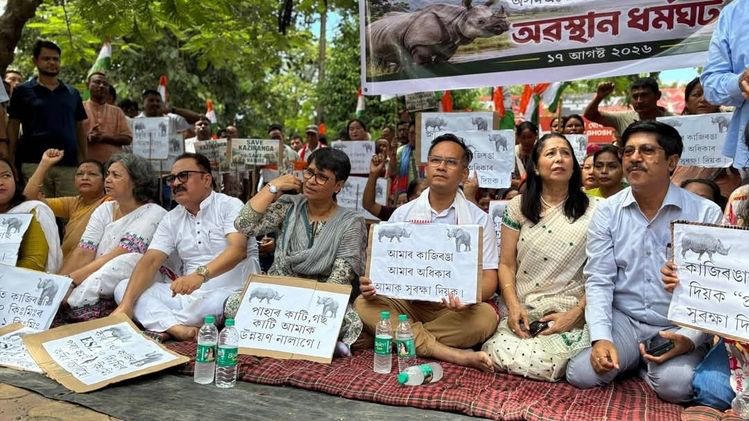
The Assam Pradesh Congress Committee (APCC), led by state Congress president Gaurav Gogoi, staged a protest in Kohora on August 17 against the Assam government’s proposal to reduce the Eco-Sensitive Zone (ESZ) around Kaziranga National Park. The Congress has opposed the proposal, warning that a smaller protective zone could put wildlife habitats and movement corridors under greater pressure.
The Assam government has proposed a site-specific ESZ around Kaziranga that would reduce the current default 10-kilometre buffer to a range of around one to three kilometres, depending on the location. The proposal has triggered a political and environmental debate over how Assam should balance development with conservation.
Gaurav Gogoi Leads Protest in Kohora
Gaurav Gogoi led Congress workers and supporters during the protest near Kaziranga. The demonstration focused on the proposed reduction of the park’s ESZ.
Congress leaders argued that Kaziranga needs a strong protective buffer because wildlife regularly moves beyond the national park’s boundaries. They said authorities must consider these movement patterns before changing the existing protection framework.
Gogoi and other party leaders also questioned the timing and possible consequences of the proposal. They argued that reducing environmental safeguards could increase pressure from construction and commercial activity around the protected area.
Congress Opposes Reduction of ESZ
The Congress has strongly criticised the proposed change. Party leaders said the existing 10-kilometre default zone provides an important layer of protection around Kaziranga.
The ESZ does not form part of the national park itself. Instead, it acts as a buffer around protected areas where certain activities face additional regulation.
The Congress argues that reducing this buffer could make areas near the park more vulnerable to development pressure. It has also raised concerns about the possible impact on wildlife corridors and flood escape routes.
Kaziranga faces annual flooding. During floods, animals often move towards higher ground outside the park. Congress leaders have warned that development along these routes could create additional risks for wildlife and increase encounters between animals and people.
Government Proposes Site-Specific ESZ
The Assam government’s proposal does not simply remove environmental protection around Kaziranga. It seeks to replace the current default 10-kilometre buffer with a site-specific zone.
Reports indicate that the proposed ESZ would range between one and three kilometres from the park boundary in different areas. The government has argued that the existing default 10-kilometre rule creates difficulties for towns and communities located near Kaziranga.
Chief Minister Himanta Biswa Sarma has said the current 10-kilometre buffer will remain in force until the Centre formally notifies the state’s proposed site-specific ESZ plan. This means the existing protection continues for now.
Development Versus Conservation Debate
The dispute has created a wider debate over development and environmental protection in Assam.
The state government has argued that the existing ESZ can restrict legitimate infrastructure and development projects around Kaziranga. Officials have pointed to the needs of nearby towns and communities.
The proposed changes could give authorities greater flexibility to plan infrastructure in areas surrounding the park. Supporters of the proposal say development should continue where it does not directly threaten protected habitats.
Environmental groups and opposition parties, however, want stronger safeguards. They argue that Kaziranga’s ecosystem extends beyond the park’s formal boundary and that wildlife needs sufficient space to move safely.
Congress Raises Mining Concerns
The Assam Congress has also alleged that reducing the ESZ could make it easier for commercial mining and other activities to expand near Kaziranga.
The party has alleged that the proposal could provide greater legal room for corporate interests. However, these claims remain allegations from the opposition and have not established that the government intends to facilitate any specific company’s mining activities.
Congress leaders have therefore called for greater transparency around the proposal. They want authorities to explain the scientific basis for the proposed boundaries and disclose how the new limits could affect wildlife habitats.
Wildlife Corridors Remain a Major Concern
Wildlife corridors have become one of the central issues in the debate.
Kaziranga is home to the greater one-horned rhinoceros, elephants, tigers and numerous other species. Animals do not always remain within the park’s boundaries. Their movements become particularly important during the annual flood season.
Elephants and other large animals may move through surrounding areas in search of higher ground, food and safe passage. If development blocks these routes, animals may come into closer contact with human settlements.
Congress leaders have therefore warned that reducing the ESZ without properly mapping wildlife movement could increase human-wildlife conflict.
Kaziranga’s Global Importance
Kaziranga National Park holds major ecological importance for Assam and India. UNESCO recognises the park as a World Heritage Site because of its exceptional biodiversity and importance for the conservation of the one-horned rhinoceros.
The park also supports populations of elephants, tigers, wild water buffalo and other species. Its surrounding landscape plays an important role in maintaining this ecosystem.
For this reason, changes to the protective zone around Kaziranga have attracted attention beyond Assam.
The debate is not only about the size of the ESZ. It also concerns how authorities will manage development around one of India’s most important wildlife landscapes.
Earlier Protests Add to Opposition
The latest Congress protest comes after several weeks of public concern over development around Kaziranga.
Environmental activists and local groups have previously protested against proposed construction projects in areas close to the national park. One such controversy involved opposition to a proposed five-star hotel near the protected landscape. Activist Pranab Doley and others faced arrest after protests connected to the issue.
These developments have added to concerns among environmental and civil-society groups about increasing commercial pressure around Kaziranga.
Government Says Existing Protection Continues
The Assam government has attempted to clarify that the current 10-kilometre default ESZ remains applicable until the Centre approves and formally notifies the proposed site-specific boundaries.
This means the proposed reduction has not yet replaced the existing protection framework.
The final decision will involve the central government and the relevant environmental approval process. Until then, the current default arrangement remains in place.
Congress Demands Greater Scrutiny
The Assam Congress wants the government to reconsider the proposal and conduct a detailed assessment before making any changes.
Gogoi and other party leaders have argued that environmental protection should remain a priority. They have called for greater scrutiny of the potential effects on wildlife corridors, flood routes and biodiversity.
The party also wants the government to explain why different areas require a smaller ESZ and what scientific studies support the proposed boundaries.
Debate Over Kaziranga’s Future Continues
The Kaziranga ESZ reduction 2026 controversy has now become a major political and environmental issue in Assam. The Congress-led protest has brought the debate into sharper focus, with Gaurav Gogoi warning about the possible consequences of reducing the protective zone.
The Assam government, meanwhile, maintains that the proposed site-specific ESZ can balance conservation with the needs of people living around Kaziranga. The current 10-kilometre default protection will remain until the Centre takes a final decision.
The coming stages of the process will determine the future boundaries of the ESZ. The key challenge will be finding a balance between development and conservation.
For Assam, the debate carries significance far beyond politics. Kaziranga remains one of the state’s most valuable natural assets. Any change to the landscape around it will need to consider wildlife movement, flood patterns, local communities and long-term ecological protection.