

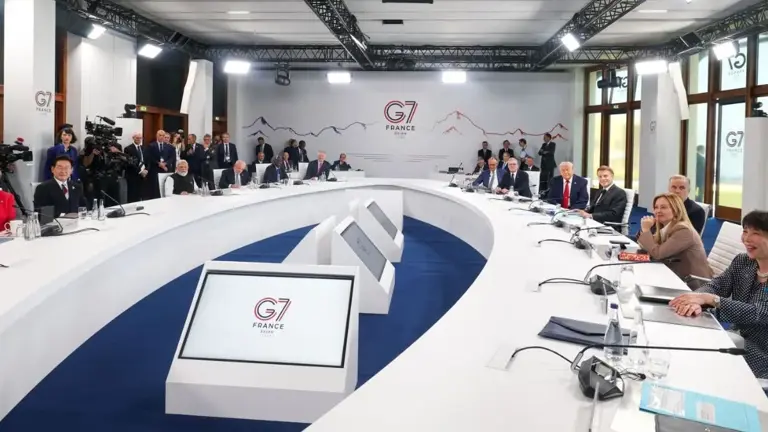
Prime Minister Narendra Modi urged world leaders at the G7 Summit to take coordinated steps to protect vulnerable countries from the growing impact of the ongoing crisis in West Asia. Addressing the gathering of major global economies, Modi emphasized the need for collective action to prevent the conflict from triggering wider economic, humanitarian, and geopolitical consequences, particularly for developing nations.
The Prime Minister highlighted that instability in West Asia extends far beyond the region and affects countries across the world through disruptions in energy supplies, trade routes, food security, and investment flows. He stressed that nations with limited economic resilience are often the most affected by such global crises.
Modi called on world leaders to adopt a balanced and inclusive approach that prioritizes peace, stability, and the welfare of ordinary people. He noted that the international community has a shared responsibility to prevent vulnerable nations from bearing the heaviest burden of geopolitical conflicts.
His remarks reflected India’s longstanding position that global challenges require cooperative solutions and multilateral engagement.
Concern Over Escalating Tensions in West Asia
The Prime Minister expressed concern about the continuing tensions in West Asia and the risks posed by prolonged instability in the region. West Asia remains a strategically important area due to its role in global energy markets, international trade, and geopolitical affairs.
According to Modi, any escalation of tensions could have serious implications for economic recovery and international stability. Rising uncertainty can affect markets, increase transportation costs, and create additional pressure on already fragile economies.
He emphasized that the consequences of conflict are rarely confined to national borders. Instead, they often spread through interconnected global systems, affecting countries far removed from the immediate area of conflict.
The Prime Minister urged leaders to work collectively toward reducing tensions and encouraging dialogue. Peaceful engagement, he said, remains the most effective path toward long-term stability and prosperity.
His remarks resonated with broader concerns among global leaders regarding the potential impact of regional conflicts on the international economy.
Vulnerable Nations Face Disproportionate Challenges
A key focus of Modi’s address was the need to support vulnerable countries that often lack the resources necessary to absorb major economic shocks. Developing nations frequently face severe challenges when global crises disrupt trade, energy supplies, and financial markets.
The Prime Minister noted that many countries continue to recover from the economic effects of recent global disruptions. Additional instability could place further strain on public finances, development programmes, and social welfare systems.
Rising energy prices, inflationary pressures, and supply chain disruptions can significantly affect lower-income nations. These countries often have limited fiscal capacity to respond effectively to external shocks.
Modi stressed that the international community must remain sensitive to these realities. Global policy responses should consider the needs and vulnerabilities of developing economies rather than focusing solely on major economic powers.
He argued that inclusive decision-making remains essential for achieving equitable and sustainable outcomes.
Energy Security Emerges as Major Concern
Energy security featured prominently in the Prime Minister’s remarks. West Asia plays a critical role in global energy production, making stability in the region essential for maintaining reliable supplies and stable prices.
Modi observed that disruptions in energy markets can have widespread consequences. Higher fuel costs affect transportation, manufacturing, agriculture, and household expenses, creating challenges for governments and citizens alike.
Developing countries often face greater difficulties in managing sudden increases in energy prices. Such shocks can strain budgets and undermine development efforts.
The Prime Minister called for greater international cooperation to ensure energy security and market stability. He emphasized the importance of diversifying energy sources, strengthening supply chains, and promoting sustainable energy transitions.
According to Modi, global energy resilience requires collaboration among producers, consumers, and international institutions.
The issue remains particularly relevant as countries seek to balance economic growth with environmental sustainability.
Protecting Global Supply Chains
Another important theme of the Prime Minister’s address was the need to safeguard global supply chains. Recent years have demonstrated how geopolitical tensions and regional conflicts can disrupt trade networks and affect economic activity worldwide.
Modi pointed out that supply chain disruptions often lead to shortages, higher costs, and reduced economic efficiency. These effects can be especially damaging for countries that depend heavily on imports for essential goods and resources.
He encouraged world leaders to strengthen cooperation aimed at improving supply chain resilience. Diversification, infrastructure investment, and international coordination can help reduce vulnerabilities and improve reliability.
The Prime Minister also highlighted the importance of maintaining open and secure trade routes. Smooth trade flows remain essential for economic stability and global prosperity.
Ensuring uninterrupted movement of goods and services, he said, benefits both developed and developing economies.
Humanitarian Considerations Must Remain Central
Beyond economic concerns, Modi emphasized the humanitarian dimensions of the West Asia crisis. Conflicts often result in displacement, loss of livelihoods, and significant human suffering.
The Prime Minister urged leaders to ensure that humanitarian considerations remain central to international responses. Assistance should reach affected populations promptly and efficiently, regardless of political or geographic considerations.
He stressed that ordinary citizens frequently bear the greatest burden during conflicts. Therefore, efforts to reduce suffering and protect vulnerable communities must remain a priority.
Modi also called for stronger international cooperation in addressing humanitarian challenges arising from regional instability. Coordinated action can improve the effectiveness of relief efforts and support long-term recovery.
His remarks reflected India’s broader commitment to humanitarian assistance and development cooperation.
India Advocates Dialogue and Diplomacy
Throughout his address, the Prime Minister reiterated India’s support for dialogue, diplomacy, and peaceful resolution of disputes. He argued that lasting stability can only be achieved through constructive engagement and mutual understanding.
Modi emphasized that military confrontations and prolonged conflicts often create long-term challenges that affect multiple generations. Therefore, diplomatic solutions remain the most sustainable path forward.
He encouraged all stakeholders to pursue dialogue and avoid actions that could escalate tensions further. Building trust and fostering cooperation, he said, are essential for maintaining regional and global stability.
India has consistently advocated peaceful approaches to international disputes and supports multilateral efforts aimed at conflict resolution. The Prime Minister reaffirmed this position during the summit.
His call for diplomacy aligned with broader international efforts to promote stability and prevent further escalation.
Role of G7 in Addressing Global Challenges
Modi highlighted the important role that the G7 can play in addressing complex global challenges. As a forum comprising some of the world’s largest economies, the G7 possesses significant influence in shaping international responses to crises.
The Prime Minister encouraged member nations to work closely with developing countries and international organizations. Collaborative approaches can produce more effective and inclusive solutions.
He emphasized that global challenges require global cooperation. No country, regardless of its economic strength, can address interconnected issues entirely on its own.
The G7, he suggested, should continue supporting initiatives that promote economic stability, sustainable development, and international peace. Such efforts can contribute to a more resilient and equitable global order.
Modi’s remarks underscored the importance of multilateral engagement in addressing shared concerns.
A Call for Inclusive and Responsible Leadership
Concluding his address, Prime Minister Modi urged world leaders to demonstrate inclusive and responsible leadership during a period of heightened global uncertainty. He stressed that decisions taken today will have lasting consequences for economies, communities, and future generations.
The Prime Minister’s message focused on protecting vulnerable countries from the adverse effects of the West Asia crisis while promoting peace, stability, and cooperation. His appeal reflected concerns about the broader economic and humanitarian implications of regional conflicts.
By emphasizing energy security, supply chain resilience, humanitarian support, and diplomatic engagement, Modi outlined a comprehensive approach to addressing the challenges arising from the crisis.
The address reinforced India’s commitment to multilateral cooperation and its advocacy for the interests of developing nations. As discussions at the G7 Summit continue, the Prime Minister’s call for collective action serves as a reminder that global challenges require shared responsibility and coordinated solutions to ensure a more stable and inclusive future.