

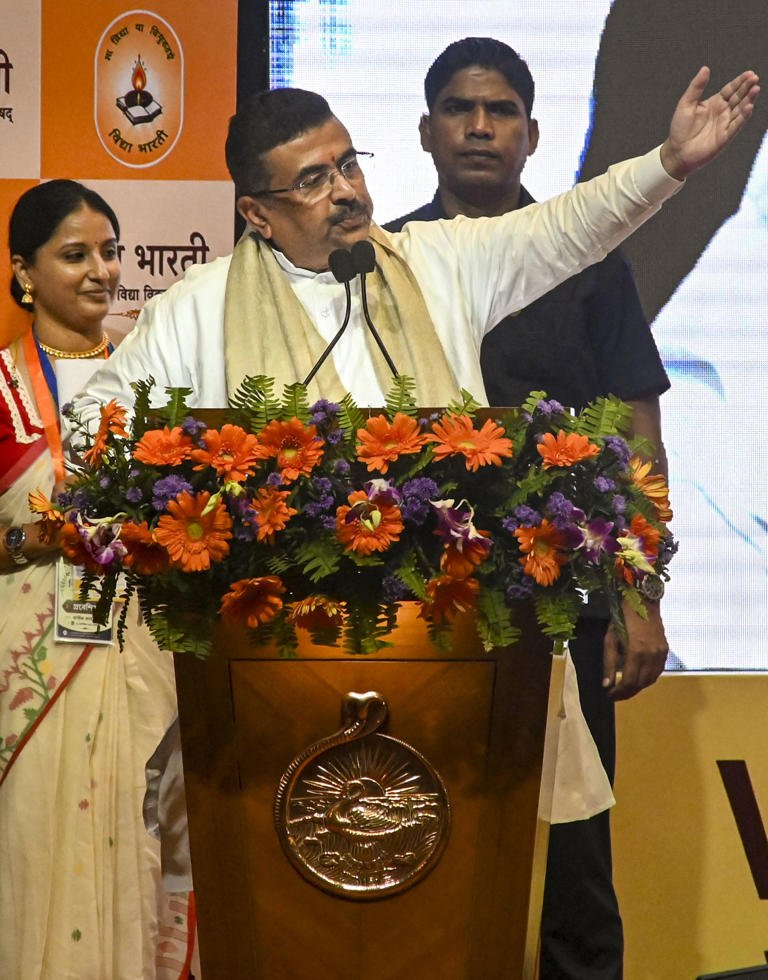
West Bengal Chief Minister Suvendu Adhikari has warned schools that the state government could stop financial aid and other forms of support if they fail to comply with rules regarding the mandatory rendition of the full version of Vande Mataram during school prayers.
The Chief Minister said schools must ensure that students participate fully in singing the national song. He also stressed that merely standing during the rendition would not amount to complete participation.
Adhikari made the remarks while addressing the annual programme of Vivekananda Vidya Bharati Vikas Parishad, an RSS-affiliated organisation, at Ramakrishna Mission in Kolkata’s Golpark.
According to reports, the Chief Minister said some schools had objected to the full rendition of Vande Mataram. He said the state government had made its position clear and warned that financial assistance could stop if institutions did not follow government guidelines.
The remarks have renewed debate over the role of patriotic observances in educational institutions and the government’s approach towards compliance in state-run and government-aided schools.
CM Warns Schools Over Government Aid
Suvendu Adhikari said schools must strictly follow the government’s instructions regarding the rendition of Vande Mataram.
He warned that institutions receiving government aid could face consequences if they refused to comply with the prescribed requirements.
The Chief Minister referred to instances where, according to him, some people had initially objected to singing the complete rendition.
He said some later agreed to stand during the song but did not actively participate in singing it.
Adhikari then stressed that students must actively join the rendition.
He said standing silently would not fulfil the requirement if students did not participate in the singing.
The Chief Minister’s warning indicated that the government intends to take a strict approach towards the implementation of its directive.
The issue is particularly important for government-run and government-aided educational institutions, which receive financial and administrative support from the state.
Adhikari’s comments have therefore placed the question of school compliance at the centre of the wider political debate in West Bengal.
Vande Mataram Was Made Mandatory in School Assemblies
The controversy follows an earlier government decision to make the singing of Vande Mataram mandatory in morning assemblies at government-run and government-aided schools in West Bengal.
The School Education Department issued directions requiring schools to include the national song as part of the beginning of the school day.
School authorities were also instructed to ensure student participation.
The decision formed part of the new state government’s broader approach towards education and the promotion of what it describes as Indian cultural and nationalist values.
The latest warning from the Chief Minister focuses on the implementation of that directive.
Adhikari has now indicated that the government expects schools to follow the rules strictly.
The warning has also raised questions about how institutions will interpret and implement the requirement of full participation.
Schools may need to ensure that their morning assemblies follow the government’s prescribed format.
The government’s position makes it clear that it views compliance as an important part of its wider education policy.
Adhikari Says Full Participation Is Necessary
One of the strongest points made by the Chief Minister concerned the meaning of participation.
Adhikari said that simply standing during the rendition was not sufficient if students did not actively sing.
He referred to cases where individuals stood during Vande Mataram but, according to him, did not move their lips while the song was being sung.
The Chief Minister said full participation was necessary.
His remarks drew attention because they suggested that the government would closely examine whether schools were following the directive in both form and practice.
The statement also demonstrated the administration’s strict position on the issue.
For the government, the directive appears to go beyond the symbolic observance of standing during a patriotic song.
It expects active participation from students during the rendition.
The Chief Minister’s comments have consequently become a major talking point among educators, political observers and members of the public.
The issue could continue to generate discussion as schools adapt to the government’s instructions.
Government Links Policy With Education Reforms
During his address, Adhikari also spoke about the broader direction of the state’s education system.
He alleged that successive governments had weakened the education sector.
The Chief Minister said his administration was carrying out reforms aimed at strengthening Indian culture, traditions and nationalist values in education.
He criticised earlier governments over their handling of school education and curriculum-related matters.
Adhikari also referred to what he described as changes made to language and educational content under previous administrations.
According to him, the current government wants to restore what it considers the original educational and cultural values associated with prominent figures such as Iswar Chandra Vidyasagar and Swami Vivekananda.
The Chief Minister’s comments showed that the Vande Mataram directive forms part of a broader political and educational agenda.
The government has linked its education policies with questions of culture, heritage, national identity and discipline.
This wider context has made the debate over the song’s mandatory rendition more politically significant in West Bengal.
CM Highlights National Cadet Corps Proposal
Adhikari also discussed plans related to the National Cadet Corps, or NCC, during his address.
He criticised the previous government over what he described as the removal of NCC from educational institutions.
The Chief Minister said he had recently met Defence Minister Rajnath Singh and raised two important proposals.
According to Adhikari, he requested the establishment of more Sainik Schools in West Bengal.
He also said he planned to seek permission to make NCC mandatory in schools and colleges.
The Chief Minister stated that he had already sent a letter regarding the matter and received an assurance that the proposal would receive attention.
The remarks reflected the government’s wider emphasis on discipline, national service and patriotic education.
The proposed expansion of NCC and Sainik Schools could become another important part of the state’s changing education policy.
However, the implementation of such proposals will depend on further discussions and approvals involving the relevant authorities.
Political Debate Over Education Intensifies
The Chief Minister’s remarks have come amid continuing political disagreements over education in West Bengal.
Education policy has become an important subject of debate between the BJP-led state government and opposition parties.
Issues related to curriculum, teacher recruitment, school administration and cultural values have generated strong political reactions.
Adhikari used his speech to criticise the policies of previous governments.
He accused earlier administrations of weakening the education system.
The Chief Minister also argued that his government was attempting to bring significant changes to the sector.
The Vande Mataram issue has now added another dimension to this debate.
Supporters of the government’s policy may view the directive as an effort to strengthen national and cultural values.
Critics, however, may question the strict consequences proposed for institutions that do not comply.
The issue is therefore likely to remain part of wider political discussions surrounding education and identity in the state.
Schools Face Greater Pressure to Follow Guidelines
The Chief Minister’s warning has placed greater responsibility on school authorities.
Government-run and aided institutions will need to ensure that they understand and follow the state’s directions.
School heads may also need to monitor how morning assemblies are conducted.
The possibility of losing financial aid could have serious consequences for institutions that depend on government support.
For this reason, Adhikari’s statement has attracted considerable attention from the education sector.
The government has not presented the issue as an optional observance.
Instead, the Chief Minister has made it clear that the administration expects strict compliance.
The implementation of the directive may now become an important issue for school administrators.
Educational institutions will also closely watch whether the government issues further detailed guidelines regarding the full rendition of the song.
Any future clarification could determine how schools organise assemblies and monitor participation.
Bengal Government Takes Firm Stand on Compliance
The warning from Suvendu Adhikari signals a firm approach by the West Bengal government towards its Vande Mataram policy.
The Chief Minister has made it clear that schools must follow the directive regarding the mandatory rendition of the full version of the national song.
His warning that government aid and other support could stop has raised the stakes for institutions receiving state assistance.
The government’s position also reflects its broader effort to reshape educational policy around Indian culture, traditions and nationalist values.
Adhikari has linked the Vande Mataram directive with wider reforms in education, including proposals concerning NCC and Sainik Schools.
As the state government continues to introduce changes, schools are likely to remain under pressure to comply with official directions.
The issue could also continue to fuel political debate in West Bengal.
For now, the Chief Minister’s message remains clear: schools receiving government support are expected to strictly follow the rules on the rendition of Vande Mataram, and non-compliance could lead to serious consequences, including the withdrawal of financial assistance.