


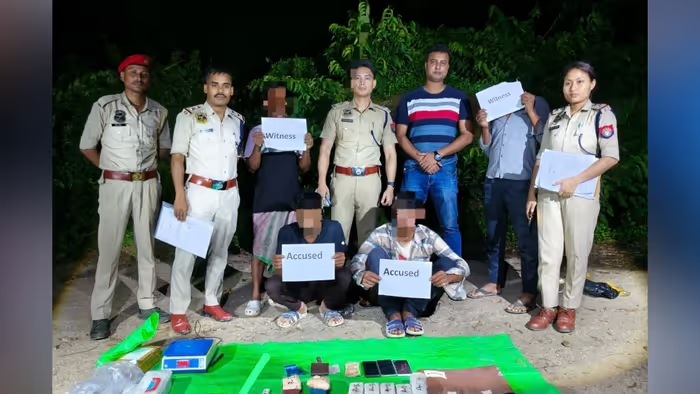
The Bishalgarh anti-drug crackdown intensified after police arrested a suspected drug peddler in Harish Nagar Tea Garden and seized heroin and Yaba tablets, according to a September 11 report. The operation followed information received by Bishalgarh Police about a suspected narcotics handover. Police subsequently produced the arrested man before the Bishalgarh magistrate’s court and sought custody for further interrogation.
The operation comes amid wider narcotics enforcement across Tripura. Moreover, recent investigations by the Narcotics Control Bureau and state police have focused on identifying people allegedly connected to larger trafficking networks. However, the available report on the Bishalgarh case does not establish that an entire regional network has already been dismantled.
Loktak Lake Fishermen Schemes: Manipur Expands Support for Sustainable Floating Livelihoods
Bishalgarh Anti-Drug Crackdown Leads to Arrest
The latest Bishalgarh anti-drug crackdown took place in Harish Nagar Tea Garden under Bishalgarh Police Station. Police arrested Asit Roy, who the report identified as a suspected drug peddler from the Office Tilla area of Bishalgarh. Officers also seized heroin and Yaba tablets during the operation.
According to the report, police had received information that Roy would meet other individuals in the Harish Nagar area in connection with a suspected drug consignment. Acting on that information, a Bishalgarh Police team was deployed for the operation.
Police subsequently arrested him and recovered the suspected contraband. The available report does not specify the exact quantity of heroin or the number of Yaba tablets seized. Therefore, those details should not be assumed or estimated.
The operation was conducted under the direction of Bishalgarh Police Station Officer-in-Charge Bijay Das, according to the report. Following the arrest, police moved the accused before the local magistrate’s court and sought remand for questioning.
Further investigation will determine whether other individuals allegedly connected with the case can be identified. At this stage, allegations against the arrested person remain subject to the legal process, and an arrest does not by itself establish guilt.
Investigation Focuses on Possible Wider Connections
The police action has drawn attention because investigators are seeking information about the suspected network allegedly connected with the seized substances. According to the report, officers intended to question the arrested man to obtain information about the wider group with which he was allegedly associated.
However, it is important to distinguish an individual arrest from the confirmed dismantling of a regional trafficking network. The available reporting confirms the arrest and seizure, but it does not provide evidence that all members of a broader network have been identified or arrested.
Consequently, investigators may now examine whether the case has connections with other narcotics investigations in the area. Such follow-up work can help authorities determine whether separate cases involve the same individuals or whether they represent unrelated incidents.
Tripura has witnessed several significant narcotics seizures in recent weeks. For example, the NCB Agartala Zonal Unit and its Aizawl Field Office reported a combined seizure of 22.299 kilograms of methamphetamine tablets in two separate operations in Mizoram and Tripura earlier in September. Three Tripura residents were arrested in the Tripura operation near Bishramganj.
Similarly, a joint operation by South Tripura District Police and the NCB earlier in September resulted in the seizure of a large quantity of Yaba tablets at Jolaibari. Three people were detained in connection with that case, while investigators began examining possible links in the trafficking chain.
These separate cases demonstrate the scale of ongoing enforcement activity, although they should not be treated as evidence that the Bishalgarh case is directly connected to those investigations.
Police Intensify Action Against Narcotics
The Bishalgarh case forms part of a broader enforcement effort against illegal narcotics in Tripura. Authorities have increasingly relied on intelligence-based operations, joint investigations and follow-up inquiries to identify people allegedly involved in the illegal trade.
The September 3 NCB operation near Bishramganj illustrates this approach. Officials intercepted a vehicle and later recovered methamphetamine tablets, leading to the arrest of three Tripura residents. The NCB said its investigation would examine the source, financial links and intended recipients connected with that case.
Meanwhile, South Tripura authorities have also worked with the NCB during recent narcotics investigations. The Jolaibari seizure involved district police and NCB personnel working together, with investigators saying they would examine forward and backward linkages.
Such coordination allows different agencies to share information while pursuing cases under the Narcotic Drugs and Psychotropic Substances Act and other applicable laws. Furthermore, follow-up investigations can help authorities establish whether suspected distributors operate independently or form part of larger organised groups.
In Bishalgarh, the next stage will depend on the information investigators obtain during the legal proceedings. If investigators establish additional connections, authorities may take further action through arrests, questioning or other lawful investigative measures.
At the same time, authorities must follow due process throughout the investigation. Allegations, seizures and arrests require judicial scrutiny, while the accused remains entitled to the protections provided under Indian law.
Drug Enforcement Draws Attention Across Tripura
The recent operations have renewed attention on Tripura’s wider challenge of preventing illegal narcotics from reaching local communities. The state’s geographic position near international borders has made border security and coordination among enforcement agencies important components of the government’s response.
Recent cases have involved different types of suspected narcotics and different enforcement agencies. Therefore, authorities face a continuing task of identifying the sources and intended recipients associated with individual seizures.
The Bishalgarh operation is significant primarily because police acted on information before an alleged handover could take place, according to the report. However, the exact circumstances and the wider extent of the suspected network remain matters for investigation.
The case also highlights why seizure figures alone cannot determine the scale of a trafficking organisation. Investigators normally need additional evidence to establish relationships between suspects, the origin of seized substances and the intended destination of a consignment.
Moreover, the authorities’ ability to pursue follow-up investigations will determine whether the latest arrest leads to further action. Police have indicated that questioning will be important in gathering information about the alleged network.
For the public, the broader issue remains the prevention of illegal drug distribution and the protection of communities from the harms associated with narcotics. Enforcement agencies can address suspected criminal activity through lawful investigations, while awareness and community cooperation can also support efforts to identify and report illegal activity.
The current Bishalgarh case therefore represents one part of a wider enforcement picture rather than proof that every narcotics channel in the subdivision has been eliminated.
Conclusion
The Bishalgarh anti-drug crackdown has resulted in the arrest of a suspected drug peddler and the seizure of heroin and Yaba tablets from the Harish Nagar Tea Garden area. Police have sought custody of the arrested man to continue their investigation and gather information about possible wider connections.
However, the available evidence does not support describing the operation as the complete destruction of a major regional drug network. Instead, the case currently represents a significant local enforcement action that could lead to further investigation.
Recent NCB and police operations elsewhere in Tripura show that authorities are simultaneously pursuing several narcotics cases. Consequently, continued coordination and evidence-based investigation will remain important in determining whether separate cases have broader connections.
As the Bishalgarh investigation proceeds, further developments will depend on the evidence gathered by police and decisions taken through the judicial process.
FAQs
What happened in the Bishalgarh anti-drug crackdown?
Bishalgarh Police arrested a suspected drug peddler in the Harish Nagar Tea Garden area and seized heroin and Yaba tablets, according to a September 11 report.
Who was arrested in the Bishalgarh case?
The arrested person was identified in the report as Asit Roy, a resident of the Office Tilla area of Bishalgarh. The allegations remain subject to the legal process.
What substances were seized?
Police reportedly seized heroin and Yaba tablets. The available report does not provide the exact quantities of either substance.
Has a major regional drug network been completely dismantled?
The available evidence does not establish that an entire regional network has been dismantled. Police are investigating possible wider connections following the arrest and seizure.
Are there other recent narcotics investigations in Tripura?
Yes. Recent operations by Tripura Police and the Narcotics Control Bureau have resulted in other significant seizures and arrests, including separate cases near Bishramganj and Jolaibari. These cases should not automatically be treated as connected to the Bishalgarh investigation.