

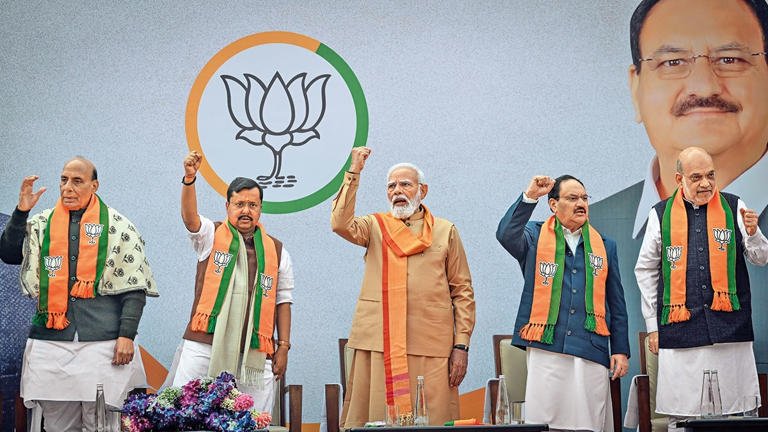
The Bharatiya Janata Party’s (BJP) reported “Mission 360” has once again brought the focus back on parliamentary arithmetic and the National Democratic Alliance’s (NDA) strength in the Lok Sabha. The political initiative has triggered discussions over whether the ruling alliance is just six Members of Parliament (MPs) short of securing the two-thirds majority often associated with major constitutional and legislative milestones.
While the BJP has consistently emphasised expanding its political footprint across the country, the phrase “Mission 360” has generated considerable interest among political observers analysing the alliance’s future electoral strategy and its parliamentary position.
The discussion is not only about numbers but also about the broader political objective of consolidating support ahead of future electoral contests.
Understanding the Two-Thirds Majority
A two-thirds majority in the Lok Sabha carries significant political importance, particularly in matters involving constitutional amendments that require special majorities under specified constitutional provisions.
Although different constitutional amendments may involve varying procedural requirements—including approval by both Houses of Parliament and, in certain cases, ratification by states—a two-thirds majority of members present and voting remains a key benchmark in parliamentary decision-making.
Political analysts often refer to the overall numerical strength of the House when discussing whether a government or alliance possesses sufficient numbers to comfortably pass legislation requiring broad parliamentary support.
The current debate centres on whether the NDA’s present strength leaves it approximately six MPs short of that broader numerical threshold.
Mission 360 Reflects Ambitious Electoral Strategy
Political observers view “Mission 360” as reflecting the BJP’s larger ambition of significantly increasing its parliamentary strength in future elections.
The strategy is widely seen as focusing on expanding the party’s presence in regions where it has traditionally had limited representation while consolidating support in existing strongholds. Achieving a larger mandate would not only strengthen the NDA’s legislative position but also provide greater political stability for implementing its policy agenda.
Party leaders have consistently highlighted organisational expansion, grassroots mobilisation, welfare outreach, and development initiatives as important components of their electoral strategy.
The discussion surrounding Mission 360 has therefore become closely linked with the BJP’s long-term political planning.
Parliamentary Numbers Continue to Shape Political Debate
The numerical strength of political alliances remains central to parliamentary functioning in India’s democratic system.
Every major piece of legislation depends on securing adequate support in Parliament, making alliance management and legislative coordination important aspects of governance. Political parties regularly assess parliamentary numbers while planning legislative priorities and electoral strategies.
For both the ruling alliance and the opposition, numerical strength influences committee representation, legislative negotiations, and the ability to build consensus on important national issues.
As a result, debates over parliamentary arithmetic frequently attract considerable political attention.
Opposition Continues to Monitor Government’s Numbers
The discussion surrounding Mission 360 has also prompted reactions from opposition parties, which continue to closely monitor the NDA’s parliamentary position.
Opposition leaders have maintained that parliamentary democracy depends not merely on numerical strength but also on debate, accountability, and consensus-building. They argue that legislative success should ultimately be measured by the quality of governance and public welfare rather than numbers alone.
At the same time, opposition parties remain focused on strengthening their own electoral position ahead of future political contests.
The evolving parliamentary landscape ensures that numerical discussions remain an important aspect of political discourse.
Importance of Coalition Politics
India’s parliamentary system has long been characterised by coalition politics, where alliances often play a decisive role in government formation and legislative functioning.
The NDA itself comprises multiple political parties that work together on common governance priorities while maintaining their individual organisational identities. Coalition partners contribute significantly to the alliance’s overall parliamentary strength and regional outreach.
Political analysts note that maintaining coordination among alliance partners remains just as important as expanding numerical strength through elections.
Successful coalition management often determines the effectiveness of parliamentary governance.
BJP Focuses on Organisational Expansion
Beyond parliamentary numbers, the BJP has consistently invested in expanding its organisational network across states and strengthening its grassroots presence.
The party has increasingly focused on reaching new voter segments, expanding its membership base, and increasing its influence in regions where it previously had limited electoral success.
Political observers believe such organisational efforts are aimed at improving electoral performance over the long term while reinforcing the NDA’s overall position in Parliament.
Mission 360 is therefore viewed not only as a numerical objective but also as a broader political campaign centred on organisational growth and electoral mobilisation.
Political Significance of the Debate
The discussion over whether the NDA is six MPs short of a two-thirds majority reflects the continuing importance of parliamentary arithmetic in Indian politics.
While numerical strength influences legislative capacity, constitutional procedures continue to require adherence to established parliamentary rules, institutional processes, and democratic safeguards. Political analysts note that electoral mandates, coalition dynamics, and legislative cooperation together shape the functioning of Parliament.
As political parties prepare for future electoral battles, discussions surrounding Mission 360 are likely to remain a significant part of the national political narrative. Whether the NDA eventually achieves the numbers associated with a two-thirds majority will depend on future electoral outcomes, alliance dynamics, and voter support. For now, the debate underscores the strategic importance of parliamentary strength and the BJP’s continuing efforts to expand its political footprint across India.