

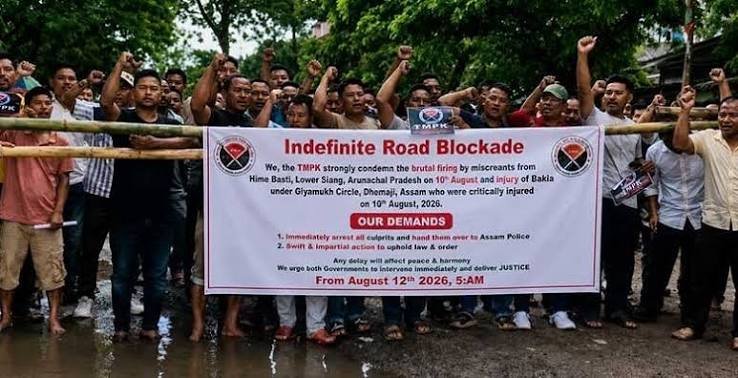
The Takam Mising Porin Kebang (TMPK) has temporarily suspended its economic blockade at Banderdewa following intervention by government ministers. However, the organisation has issued a 48-hour deadline demanding the arrest of individuals it alleges were involved in the border-related incident.
The decision provides temporary relief from the blockade while keeping pressure on authorities to take action. Moreover, the ultimatum means tensions could rise again if the organisation considers the government’s response inadequate.
The development highlights the continuing sensitivity surrounding Assam-Arunachal Pradesh border disputes and the importance of a prompt, lawful investigation.
Joi Barua NASA Project Makes a Powerful Leap From Assam to Space
TMPK Suspends Banderdewa Blockade
The TMPK Banderdewa blockade has reportedly been suspended after ministers intervened and engaged with representatives of the organisation.
The suspension creates an opportunity for authorities to address the concerns raised by TMPK without the immediate disruption associated with the blockade. Furthermore, the decision allows transportation and economic activity in the affected area to continue.
However, the suspension remains conditional on further government action.
48-Hour Deadline Issued
Despite suspending the blockade, TMPK has reportedly given authorities 48 hours to arrest those it describes as border miscreants.
The ultimatum places pressure on law-enforcement agencies to investigate the allegations and determine whether arrests are legally justified. Additionally, authorities must follow due process and establish individual responsibility through evidence.
The deadline could become a key test of whether the temporary suspension develops into a longer-term resolution.
Ministerial Intervention Helps Ease Tensions
Government intervention played a role in persuading TMPK to suspend the blockade.
Direct engagement between ministers and community representatives can provide a channel for resolving immediate grievances. Moreover, dialogue can prevent a local dispute from developing into wider economic or social disruption.
The latest intervention demonstrates the importance of political communication during periods of heightened tension.
Border Dispute Remains Sensitive
The development follows tensions surrounding an incident along the Assam-Arunachal Pradesh border.
Border disputes can involve questions of land, jurisdiction, community rights, and administrative responsibility. Furthermore, allegations involving violence can intensify existing disagreements and increase pressure on authorities.
A credible investigation will therefore remain important.
Arrest Demands Require Due Process
TMPK’s demand for arrests does not itself establish that the accused individuals committed offences.
Police authorities must investigate the incident, collect evidence, identify those responsible, and follow applicable legal procedures. Additionally, any arrests should rely on lawful grounds rather than solely on political or community pressure.
A transparent investigation can help protect both public confidence and individual rights.
Economic Disruption Temporarily Avoided
The blockade’s suspension could provide immediate relief to residents and businesses around Banderdewa.
Economic blockades can affect the movement of goods, vehicles, workers, and consumers. Moreover, prolonged restrictions can create difficulties for businesses and people who depend on regular transportation.
The temporary suspension therefore reduces immediate economic pressure.
Community Dialogue Remains Essential
The situation demonstrates the need for continued dialogue between community representatives and government authorities.
Officials can use the 48-hour period to communicate progress and explain the steps being taken. Furthermore, regular engagement can reduce misunderstandings and prevent renewed confrontation.
Community participation could also help identify practical measures for maintaining peace.
Inter-State Coordination Could Help
Because the dispute involves the Assam-Arunachal Pradesh border, coordination between authorities in both states could prove important.
Officials may need to share information, verify the location and circumstances of the incident, and coordinate law-enforcement responses. Additionally, joint communication could reduce conflicting claims about jurisdiction.
Stronger inter-state coordination could help prevent similar disputes in the future.
Temporary Suspension Is Not Final Resolution
Although the blockade has been suspended, the underlying dispute remains unresolved.
TMPK’s 48-hour ultimatum indicates that the organisation expects concrete action rather than assurances alone. Moreover, failure to address the demand could create the possibility of renewed protests or other forms of pressure.
Authorities therefore face a limited window to demonstrate progress.
What Happens Next?
Police and government officials will likely focus on investigating the incident and responding to TMPK’s demands within the stated timeframe.
Authorities may also continue discussions with community representatives to prevent the blockade from returning. Furthermore, maintaining transportation and essential services should remain a priority while the investigation proceeds.
The next 48 hours could determine whether the current de-escalation continues.
Conclusion
The TMPK Banderdewa blockade has been temporarily suspended following ministerial intervention, but the organisation has issued a 48-hour ultimatum demanding action against individuals it alleges were involved in the border-related incident.
Moreover, the suspension provides authorities with an opportunity to investigate the matter and address community concerns without further economic disruption. At the same time, any arrests must follow evidence-based investigation and established legal procedures.
Overall, continued dialogue, lawful investigation, and effective inter-state coordination will be essential to prevent renewed tensions after the 48-hour deadline.
FAQs
1. Why did TMPK suspend the blockade?
TMPK reportedly suspended the blockade at Banderdewa after ministerial intervention and discussions with government representatives.
2. What is the 48-hour ultimatum?
TMPK has reportedly given authorities 48 hours to arrest individuals it alleges were involved in the border-related incident.
3. Does the ultimatum prove that the accused are guilty?
No. Allegations do not establish guilt. Police must investigate the incident and follow applicable legal procedures.
4. What happens if the government does not meet the demand?
The situation could become tense again, particularly because the blockade has only been temporarily suspended.
5. Why is Banderdewa significant?
Banderdewa is an important location along the Assam-Arunachal Pradesh border, making disruptions there potentially significant for transportation and economic activity.