

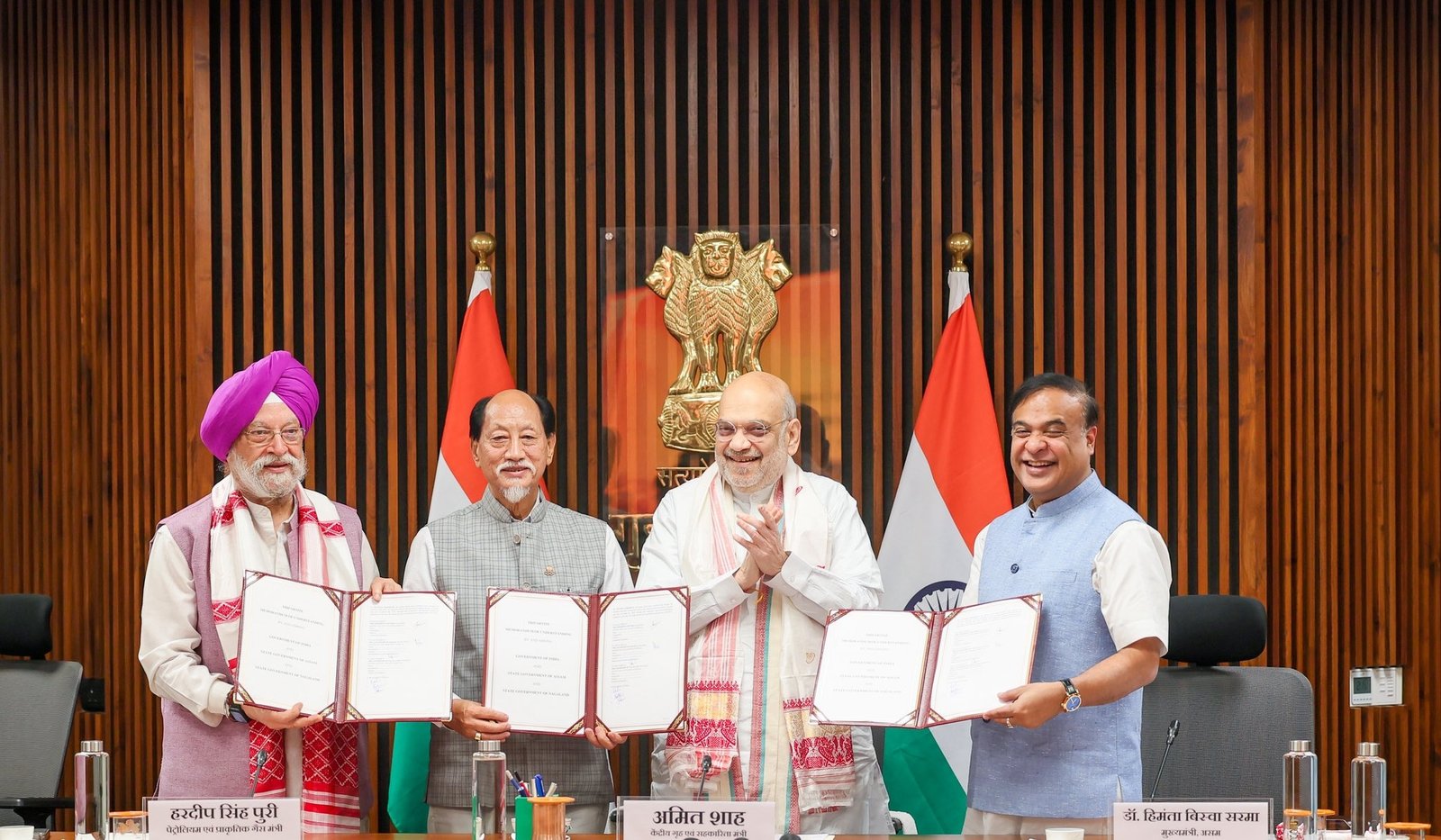
In a significant breakthrough for inter-state cooperation and resource management, the Central Government, Assam, and Nagaland have signed a tripartite Memorandum of Understanding (MoU) aimed at resolving a long-standing dispute over oil exploration activities along their shared border. The agreement seeks to address issues that have remained unresolved for nearly three decades while creating a framework for coordinated resource development, administrative cooperation, and regional economic growth. Moreover, the MoU has been viewed as an important step toward strengthening political dialogue and interstate collaboration in Northeast India.
Ambubachi Mela Preparations: Leadership Reviews Safety and Health Arrangements at Kamakhya Temple
Northeast India Records 80% Decline in Insurgency-Related Violence
Historic Agreement Ends Decades of Uncertainty
The tripartite agreement between the Centre, Assam, and Nagaland marks a major development in efforts to resolve one of the region’s most persistent resource-related disputes. Consequently, the signing of the MoU has attracted considerable political, economic, and strategic attention.
According to officials, the agreement establishes a cooperative framework for addressing issues related to oil exploration and resource management in disputed areas. Moreover, authorities emphasized that dialogue and institutional cooperation were instrumental in achieving the breakthrough. Therefore, the MoU is being viewed as a significant milestone in interstate relations.
Government representatives noted that the resolution process aims to promote mutual understanding while ensuring that development activities proceed through coordinated administrative mechanisms. As a result, expectations regarding future cooperation between the two states have increased.
Meanwhile, relevant agencies are expected to work on implementing the agreed framework.
Resource Cooperation and Economic Development Prioritized
The agreement highlights the growing emphasis on collaborative resource management and economic development in Northeast India. Moreover, resolving long-standing disputes can create opportunities for investment, infrastructure development, and improved administrative coordination. Therefore, the MoU is expected to have broader economic implications.
Economic analysts observed that natural resource development often requires sustained cooperation between multiple stakeholders and jurisdictions. Consequently, negotiated agreements and institutional frameworks play a crucial role in promoting stability and economic growth. Such arrangements can help unlock investment potential and support regional development objectives.
Furthermore, improved coordination in resource management may strengthen investor confidence and encourage future economic activity. As a result, policymakers remain optimistic about the long-term benefits of the agreement.
Meanwhile, stakeholders continue to evaluate the operational and economic implications of the MoU.
Interstate Cooperation Receives a Major Boost
The successful conclusion of the agreement reflects the importance of political dialogue, negotiation, and cooperative federalism in resolving complex regional issues. Moreover, the participation of the Central Government highlights the role of institutional mediation in facilitating consensus-building. Therefore, the development has been widely recognized as a positive example of collaborative governance.
Political observers noted that interstate disputes involving resources and territorial issues often require long-term engagement and sustained political commitment. Consequently, the latest agreement demonstrates the potential effectiveness of negotiated solutions and structured dialogue processes. Such efforts contribute to political stability and administrative efficiency.
Furthermore, enhanced cooperation between Assam and Nagaland may create opportunities for broader regional collaboration in other sectors. As a result, policymakers continue to emphasize the importance of institutional partnership.
Meanwhile, discussions regarding implementation and future cooperation remain ongoing.
Long-Term Stability and Development Remain Central Goals
The tripartite MoU underscores the broader objective of promoting peace, stability, and economic development throughout Northeast India. Moreover, authorities continue to emphasize that resolving historical disputes can contribute to stronger governance and improved regional integration. Therefore, the agreement is expected to have both strategic and developmental significance.
Experts emphasized that successful dispute resolution can improve public confidence, strengthen institutions, and create conditions for sustainable growth. Consequently, governments continue to prioritize dialogue-based approaches and cooperative frameworks. Such initiatives can contribute to long-term prosperity and regional stability.
Furthermore, the agreement may serve as a model for addressing other complex regional issues through consultation and cooperation. As a result, public and political attention remains focused on the implementation process.
Conclusion
The signing of the tripartite MoU between the Centre, Assam, and Nagaland represents a major step toward resolving a decades-old dispute over oil exploration and resource management. Moreover, the agreement highlights the importance of political dialogue, cooperative governance, and institutional coordination in addressing complex regional challenges.
As implementation progresses, the agreement is expected to contribute to economic development, strengthen interstate relations, and promote long-term stability in Northeast India. Therefore, the outcome of this historic initiative will continue to attract significant public and policy attention.
The latest breakthrough underscores the importance of negotiation, cooperation, and shared development objectives in shaping the future of the region.
FAQs
1. Who signed the tripartite MoU?
The agreement was signed by the Central Government, Assam, and Nagaland.
2. What issue does the agreement seek to resolve?
It aims to address a long-standing dispute related to oil exploration along the Assam-Nagaland border.
3. How long had the dispute remained unresolved?
The dispute had persisted for nearly three decades.
4. Why is the agreement considered important?
It promotes interstate cooperation, resource management, and regional development.
5. What broader objectives does the MoU support?
The agreement supports economic growth, political stability, and cooperative governance.