

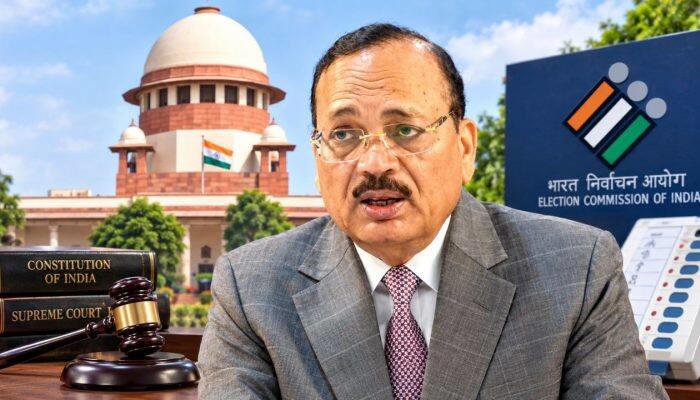
The Supreme Court has reopened a significant procedural question surrounding the Chief Election Commissioner and Other Election Commissioners (Appointment, Conditions of Service and Term of Office) Act, 2023, after a split verdict on whether challenges to the law should be examined by a larger Constitution Bench.
The law has attracted legal and political scrutiny because it removed the Chief Justice of India (CJI) from the committee responsible for selecting the Chief Election Commissioner (CEC) and other Election Commissioners.
The latest development could determine how the challenge to the law proceeds and, ultimately, which bench will examine its constitutional validity.
Why the CJI’s Exclusion Matters
The 2023 law provides for a three-member selection committee comprising the Prime Minister, the Leader of Opposition in the Lok Sabha and a Union Cabinet minister nominated by the Prime Minister.
This replaced the arrangement laid down by the Supreme Court in its 2023 judgment in the Anoop Baranwal case.
Before Parliament enacted the new law, the Supreme Court had directed that the CEC and Election Commissioners should be appointed on the recommendation of a committee consisting of the Prime Minister, the Leader of Opposition and the CJI, until Parliament made a law governing the appointment process.
The new legislation changed that arrangement by replacing the CJI with a Union Cabinet minister.
Supreme Court Bench Delivers Split Verdict
A two-judge Supreme Court bench comprising Justices Dipankar Datta and Satish Chandra Sharma considered whether petitions challenging the 2023 law should be referred to a Constitution Bench.
The judges reached different conclusions on the question.
Justice Datta did not agree with the government’s request to refer the matter to a larger bench at that stage, while Justice Sharma took the view that the case involved substantial questions of constitutional law requiring consideration by a larger bench.
Because of the disagreement, the matter was placed before the Chief Justice of India for appropriate further action.
The split verdict did not settle the underlying constitutional challenge to the appointment law.
Fresh Plea Seeks Recall of Split Verdict
The issue has now returned to the Supreme Court following an application seeking the recall or modification of the September order concerning the larger-bench reference.
The application was mentioned before a bench headed by CJI Surya Kant. Senior Advocate Gopal Sankaranarayanan requested that the application be listed for hearing.
The Chief Justice indicated that the request would be examined before the court takes further action.
This development means that the procedural route for deciding the challenge to the 2023 law remains open.
What the Petitioners Have Challenged
The petitions question the constitutional validity of the 2023 legislation, particularly the composition of the selection committee.
One of the central concerns raised by petitioners is whether an Election Commission that plays a crucial role in conducting elections can be selected through a mechanism in which the Union government has two representatives out of three.
The existing panel consists of the Prime Minister, the Leader of Opposition and the Union Cabinet minister nominated by the Prime Minister.
Justice Datta, in his separate opinion, had raised concerns about the extent of executive influence in the arrangement and emphasised that the Election Commission must not only be independent but also appear to be independent.
Government Defends Parliament’s Role
The legal debate also involves a larger constitutional question: the extent to which Parliament can determine the procedure for appointing constitutional authorities.
During earlier hearings, the government argued that Parliament has the authority to legislate on the appointment of Election Commissioners.
Article 324 of the Constitution provides that appointments to the Election Commission are to be made by the President, subject to any law made by Parliament on the matter.
The government has therefore defended the 2023 legislation as an exercise of Parliament’s law-making authority.
Why the Case Is Important
The dispute goes beyond the composition of a selection committee. At its core is the question of how institutional independence should be protected while allowing Parliament to establish a statutory appointment mechanism.
The Supreme Court’s eventual decision could have implications for the structure of the Election Commission and the process through which its top officials are selected.
The issue has gained additional attention amid ongoing legal and political disputes concerning Chief Election Commissioner Gyanesh Kumar and the functioning of the Election Commission.
What Happens Next?
The immediate question before the Supreme Court is not yet whether the 2023 law is constitutional. It is who should hear and decide that challenge.
The fresh application seeking reconsideration of the split verdict could determine whether the matter proceeds before a larger Constitution Bench or follows another route.
With the CJI now considering the request, the next listing could provide greater clarity on the judicial process that will determine the future of the law governing appointments to India’s top election body. indianexpress.com