

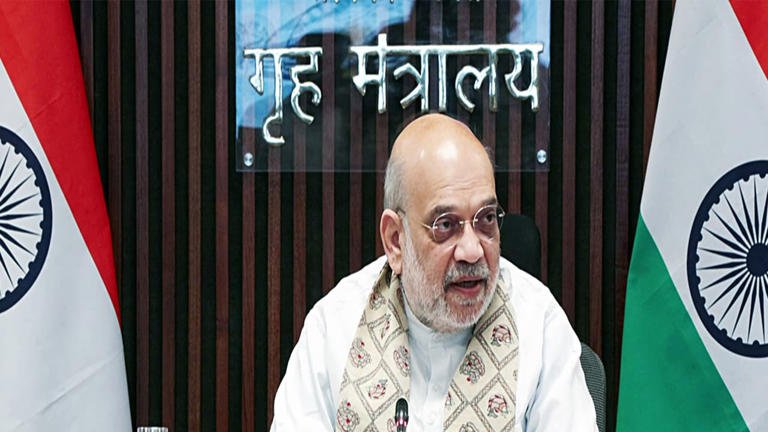
Union Home Minister Amit Shah has expressed confidence that the Yamuna will be cleaned by 2029. He made the statement after six states signed the Kishau Multipurpose Project agreement.
Shah spoke on Tuesday, September 15, during a meeting attended by the chief ministers of Uttar Pradesh, Uttarakhand, Himachal Pradesh, Rajasthan, Delhi and Haryana.
The agreement aims to advance the Kishau project on the Tons River. The project will create a major water storage facility for the Yamuna basin.
Shah linked the agreement to the long-term effort to improve the Yamuna’s environmental flow. He said the project would make 25 per cent of its water available to benefit the river and Delhi.
Kishau Agreement Signed by Six States
The chief ministers of six states signed the Kishau Project agreement in the presence of Shah and Union Jal Shakti Minister C. R. Patil.
The signatories included Uttar Pradesh Chief Minister Yogi Adityanath, Uttarakhand Chief Minister Pushkar Singh Dhami, Himachal Pradesh Chief Minister Sukhvinder Singh Sukhu, Rajasthan Chief Minister Bhajan Lal Sharma, Delhi Chief Minister Rekha Gupta and Haryana Chief Minister Nayab Singh Saini.
The agreement concerns the construction of a 232.6-metre-high concrete gravity dam on the Tons River. The river flows along the border between Uttarakhand and Himachal Pradesh.
The project will have a planned storage capacity of 1,562 million cubic metres. It will also irrigate around 97,000 hectares of land and generate 1,476 million units of clean hydropower.
Shah Links Kishau Project to Yamuna’s Environmental Flow
Shah said the Yamuna’s environmental flow had not received adequate consideration when water allocations took place in the past.
According to Shah, the available water was distributed among the states without leaving sufficient water for the river itself.
He said the Kishau agreement would change this situation by making 25 per cent of the project’s water available for the Yamuna and Delhi.
The Home Minister said this additional availability would also support environmental conservation.
His comments place the Kishau project within a wider water-management strategy for the Yamuna basin. The project has several objectives, including irrigation, water storage and hydropower generation.
Delhi Expected to Gain Major Benefits
Delhi is expected to receive significant benefits from the Kishau project.
Shah described Delhi as the biggest beneficiary of the agreement. The project could increase water availability for the national capital while supporting efforts to improve the Yamuna.
The government has also linked the project with broader water security needs. These include drinking water, agriculture, industrial use and development.
The project’s benefits will extend beyond Delhi. The six participating states will receive benefits based on the agreed water and project-sharing arrangements.
The agreement therefore brings together water management and development goals across the Yamuna basin.
Centre to Bear Around 90 Per Cent of Cost
The Centre has declared the Kishau Multipurpose Project a National Project.
Under the financial arrangement, the Government of India will bear around 90 per cent of the project’s financial burden. The participating states will cover the remaining 10 per cent under the agreed framework.
Uttarakhand had raised concerns about the financial implications of the project. Shah said the Centre would try to accommodate the state’s demands through its schemes.
He also said the Centre would assist Uttarakhand with the financial burden that may arise.
The assurance helped address one of the issues surrounding the project’s implementation.
Kishau Project Ends Long Water Dispute
The Kishau agreement follows years of discussions among the participating states.
Shah said an earlier agreement from May 12, 1994, provided for separate agreements for individual storage projects in the Yamuna basin.
He said this framework helped create the basis for the Kishau agreement.
The Lakhwar and Renukaji projects also played a role in the wider process. After disputes over those projects were resolved, discussions on Kishau moved forward.
A formal agreement on the Kishau project was reached on June 16, 2026. The Ministry of Jal Shakti then worked with the states on technical and economic issues before securing their consent.
Yamuna and Ganga Linked Through River System
Shah also connected the Yamuna’s restoration with the larger goal of a clean Ganga.
The Yamuna meets the Ganga at Prayagraj. Shah said the two rivers remain closely connected within the larger river system.
He argued that efforts to clean the Ganga cannot fully succeed without addressing the condition of the Yamuna.
“Until the dream of cleaning the Yamuna is fulfilled, the dream of a clean Ganga will also remain incomplete,” Shah said.
His statement reflects the government’s approach of linking river conservation across connected river systems.
Existing Yamuna Cleaning Efforts Continue
Shah said work to clean the Yamuna has continued under the Centre and Delhi government.
He specifically referred to efforts since Rekha Gupta became Delhi chief minister. According to Shah, the government has continued working towards improving the river.
The Kishau agreement now adds a water-availability component to these efforts.
However, cleaning a heavily polluted river involves several factors. Water availability alone does not address every source of pollution. Sewage treatment, industrial discharge, solid waste and effective enforcement also affect river quality.
The Kishau project is therefore one component of the wider Yamuna restoration effort.
Project Also Supports Irrigation and Hydropower
The Kishau project has objectives beyond the Yamuna.
The proposed reservoir will store 1,562 million cubic metres of water. The project will support irrigation across approximately 97,000 hectares.
It will also generate 1,476 million units of clean hydropower.
These components could provide benefits to several participating states. The project also aims to strengthen water availability for different economic activities.
The government has described the project as a multipurpose development initiative because it combines water storage, irrigation, hydropower and environmental objectives.
Six States Commit to Joint Implementation
Shah said the agreement became possible because all six states worked towards a common arrangement.
He expressed confidence that the states would maintain the same cooperation during implementation.
The next stages will involve technical work, financial arrangements and project execution. The Centre and state governments will need continued coordination as the project progresses.
The impact on the Yamuna will also depend on how the additional water availability translates into actual environmental flow and broader pollution-control measures.
For now, the Kishau agreement gives the Yamuna basin a new inter-state framework for water management.
2029 Target Puts Focus on Implementation
Amit Shah’s 2029 target now places greater attention on the pace and effectiveness of Yamuna restoration efforts.
The Kishau project could contribute additional water to the river. It will also support irrigation, drinking water needs and hydropower generation.
At the same time, the wider goal of a cleaner Yamuna will require coordination among multiple agencies and governments.
The signing of the Kishau agreement marks a significant step in inter-state water cooperation. Its longer-term environmental impact will depend on project implementation and the success of other pollution-control measures.
Shah has set 2029 as the target for a clean Yamuna. The coming years will determine how the project and other restoration measures contribute to that goal.