

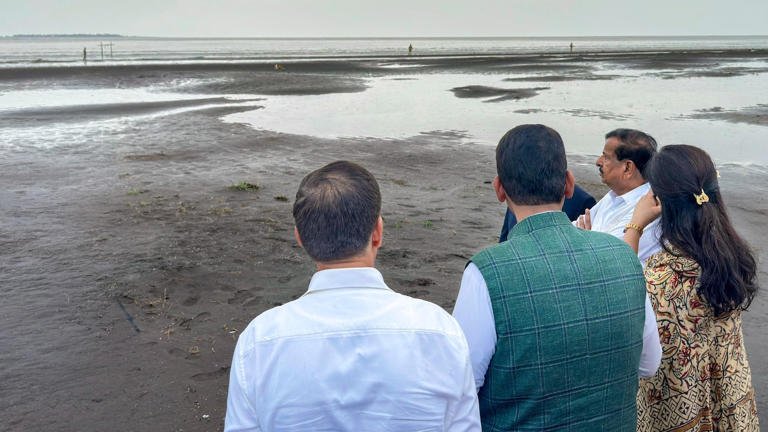
Maharashtra Chief Minister Devendra Fadnavis has directed officials to undertake a detailed feasibility study for the proposed offshore airport near Mumbai, signalling the state’s intent to explore a long-term solution to meet the growing demand for aviation infrastructure in the Mumbai Metropolitan Region. The proposed project, if found viable, could emerge as one of India’s most ambitious aviation infrastructure developments.
The directive comes amid increasing passenger traffic, expanding commercial activity, and projections indicating that Mumbai’s existing airports may eventually face capacity constraints despite ongoing expansion efforts. The feasibility study will examine the technical, environmental, financial, and operational aspects of establishing an airport on reclaimed land or an offshore platform.
Officials said the study would provide a comprehensive assessment before any decision is taken regarding the project’s implementation.
Feasibility Study to Assess Project Viability
The Chief Minister instructed the concerned departments and technical experts to conduct a detailed evaluation covering every aspect of the proposed offshore airport. The study is expected to examine engineering feasibility, environmental sustainability, air traffic requirements, marine conditions, financial viability, connectivity options, and long-term operational efficiency.
Officials will also assess international examples of offshore airports to identify best practices and technological solutions suitable for Maharashtra’s coastline.
The government emphasised that the study is intended to determine whether such a large-scale infrastructure project can be developed safely, sustainably, and economically while meeting future aviation demands.
Only after receiving detailed technical reports will further decisions regarding the project be considered.
Addressing Mumbai’s Growing Aviation Demand
Mumbai remains one of India’s busiest aviation hubs, handling millions of domestic and international passengers annually. With rapid urbanisation, economic growth, expanding tourism, and increasing business travel, aviation demand continues to rise steadily.
While the existing airport and the under-construction Navi Mumbai International Airport are expected to significantly enhance regional capacity, long-term forecasts indicate that additional infrastructure may eventually become necessary to accommodate future growth.
Officials believe that proactive planning today can help ensure that Maharashtra remains prepared to meet aviation requirements several decades into the future.
The proposed offshore airport is therefore being explored as a long-term strategic infrastructure option rather than an immediate replacement for existing facilities.
Vision for World-Class Aviation Infrastructure
Chief Minister Devendra Fadnavis has consistently emphasised the importance of developing modern infrastructure capable of supporting Maharashtra’s expanding economy. The proposed offshore airport aligns with the state’s broader vision of creating world-class transportation infrastructure that enhances connectivity, attracts investment, and strengthens economic competitiveness.
Officials noted that globally competitive aviation infrastructure contributes significantly to tourism, international trade, logistics, and business development.
If found feasible, the offshore airport could complement existing aviation facilities while establishing Mumbai as one of Asia’s leading aviation centres.
The government believes that investing in future-ready infrastructure is essential for sustaining long-term economic growth.
Engineering and Environmental Considerations
One of the primary objectives of the feasibility study will be to examine the engineering challenges associated with constructing an offshore airport. Experts will evaluate marine geology, coastal stability, weather patterns, sea-level conditions, and the structural requirements necessary for safe airport operations.
Environmental sustainability will also receive significant attention during the assessment process. Officials stated that any future project must comply with environmental regulations while minimising ecological impact on marine ecosystems and coastal biodiversity.
Detailed environmental impact assessments would form an essential component of future planning should the project move beyond the feasibility stage.
The government reiterated that infrastructure development must balance economic progress with responsible environmental stewardship.
Improving Regional Connectivity
If implemented, the proposed offshore airport could significantly strengthen connectivity within the Mumbai Metropolitan Region and across western India. Improved aviation capacity would facilitate domestic and international travel while supporting trade, tourism, and business expansion.
Officials observed that enhanced airport infrastructure can stimulate investment by improving accessibility for industries, multinational companies, exporters, and logistics operators.
The project would also require integration with highways, metro systems, suburban rail networks, and other modes of public transport to ensure seamless passenger movement.
Comprehensive transportation planning will therefore form an important component of the feasibility assessment.
Potential Economic Benefits
Large-scale infrastructure projects often generate substantial economic benefits through investment, employment generation, and industrial development. An offshore airport, if eventually developed, could create thousands of jobs during construction and operation while stimulating demand across sectors such as engineering, construction, aviation, logistics, hospitality, and tourism.
Officials noted that improved airport capacity would strengthen Maharashtra’s attractiveness as a destination for investment, conferences, international business, and tourism.
The project could also encourage growth in aviation-related industries, including aircraft maintenance, cargo handling, warehousing, and airport services.
The government views infrastructure expansion as a key driver of long-term economic competitiveness.
Learning from Global Models
Several countries have successfully developed offshore or reclaimed-land airports to address space constraints in densely populated urban regions. During the feasibility study, officials are expected to examine international models and technological innovations that have enabled the successful construction and operation of such facilities.
The assessment will focus on engineering techniques, operational safety, environmental management, disaster resilience, and financial planning adopted by similar projects around the world.
Officials believe that studying global best practices will help determine whether comparable solutions can be adapted to Maharashtra’s geographical and climatic conditions.
The government emphasised that international experience will serve as an important reference during the planning process.
Long-Term Infrastructure Planning
Chief Minister Devendra Fadnavis observed that planning for future infrastructure requires anticipating demand decades in advance. Rather than responding only when capacity constraints become critical, governments must proactively identify solutions capable of supporting sustained economic and population growth.
The proposed offshore airport reflects this long-term planning approach, recognising the importance of preparing for future transportation needs while ensuring that infrastructure development remains sustainable and technologically advanced.
Officials clarified that the current directive is limited to conducting a comprehensive feasibility study, and no final decision regarding project execution has yet been taken.
The findings of the study will guide subsequent policy discussions and infrastructure planning.
Towards a Future-Ready Aviation Network
The decision to initiate a detailed study on the proposed offshore airport marks an important step in Maharashtra’s long-term infrastructure planning strategy. By examining the project’s technical, environmental, financial, and operational feasibility, the government aims to determine whether such an ambitious development can contribute to Mumbai’s future aviation requirements.
As passenger traffic continues to grow and economic activity expands across the region, investments in modern transportation infrastructure will remain essential for sustaining development. The proposed offshore airport, if found viable, has the potential to become a transformative addition to Maharashtra’s aviation landscape, strengthening connectivity, supporting economic growth, and reinforcing Mumbai’s position as one of India’s premier global gateway cities.