

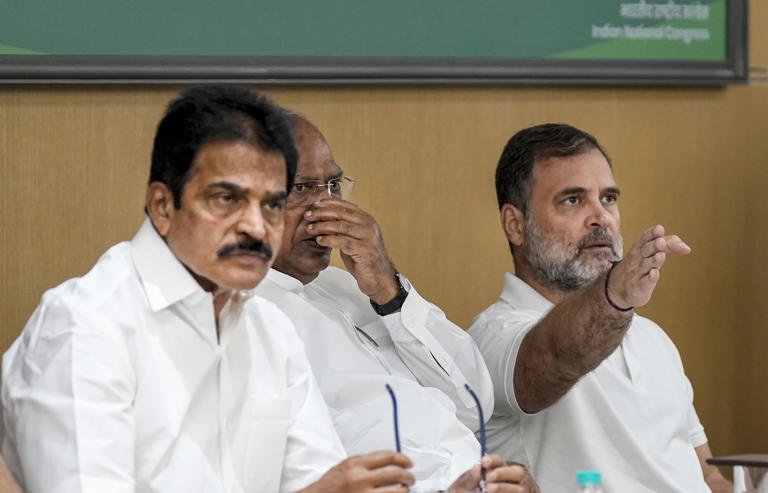
The Indian National Congress convened a crucial meeting of its general secretaries, state unit chiefs, and senior organizational leaders to discuss the party’s future strategy and chart out a roadmap for upcoming political and electoral challenges. The high-level deliberations focused on strengthening the party organization, improving grassroots outreach, enhancing coordination among state units, and formulating strategies to expand the party’s support base across the country.
The meeting comes at a significant time for the Congress as it seeks to consolidate its position in national politics and prepare for upcoming electoral contests. Senior leaders emphasized the importance of organizational unity, effective communication, and stronger engagement with the public to address contemporary political challenges.
Party sources indicated that the discussions covered a broad range of issues, including organizational reforms, campaign strategies, public outreach initiatives, and the role of state units in strengthening the party’s presence at the grassroots level.
Leadership Reviews Organizational Performance
One of the key objectives of the meeting was to review the functioning of the party organization across various states. Senior leaders assessed the performance of state units and examined the progress of ongoing organizational activities.
General secretaries and state chiefs reportedly presented reports on political developments in their respective regions, highlighting achievements, challenges, and priorities. The leadership reviewed the effectiveness of membership drives, public outreach programs, and efforts aimed at strengthening local party structures.
Party leaders stressed that a strong organizational foundation remains essential for electoral success and effective political engagement. They emphasized the need to ensure that party workers remain connected with grassroots issues and local communities.
The review process provided an opportunity to identify areas requiring additional support and intervention from the central leadership.
Focus on Strengthening State Units
A major theme of the discussions was the importance of empowering state units and improving coordination between the central leadership and regional organizations. Congress leaders acknowledged that state units play a critical role in expanding the party’s influence and addressing local concerns.
Participants discussed measures aimed at strengthening organizational structures at the district, block, and booth levels. Senior leaders emphasized the need for regular communication, efficient coordination, and active participation by local leaders and workers.
The party leadership reportedly urged state chiefs to intensify grassroots engagement and ensure that organizational activities remain focused on public issues. Stronger state units, leaders argued, can improve the party’s responsiveness and enhance its ability to connect with voters.
Efforts to improve coordination are expected to form a central component of the party’s future strategy.
Strategy for Upcoming Elections
The meeting also focused extensively on preparations for future elections. Congress leaders discussed strategies to improve electoral performance and expand the party’s support base in different regions of the country.
Participants reviewed recent electoral experiences and examined lessons that could help strengthen future campaigns. The leadership emphasized the importance of candidate selection, booth-level organization, voter outreach, and issue-based campaigning.
Leaders reportedly discussed ways to improve campaign efficiency and ensure greater coordination between national and state-level leadership. Special attention was given to states where the party seeks to expand its presence or regain political ground.
The discussions reflected the Congress leadership’s determination to approach future elections with a more structured and coordinated strategy.
Emphasis on Grassroots Outreach
Congress leaders highlighted the importance of strengthening grassroots outreach and maintaining regular engagement with citizens. According to party officials, public interaction remains essential for understanding local concerns and effectively communicating the party’s vision.
The leadership encouraged state units to organize outreach programs, public meetings, and community engagement initiatives. Such efforts are expected to help the party strengthen its presence among different social groups and regions.
Participants emphasized that successful political organizations must remain closely connected to the everyday concerns of citizens. Issues such as employment, inflation, agriculture, social welfare, and economic development were reportedly discussed as important areas for public engagement.
The party aims to increase its visibility and relevance through sustained interaction with communities across the country.
Organizational Reforms Under Discussion
The meeting also included discussions on organizational reforms aimed at improving efficiency and strengthening internal structures. Party leaders reportedly explored measures to streamline decision-making processes and enhance accountability within the organization.
The leadership emphasized the need to modernize organizational practices while maintaining the party’s traditional strengths. Discussions included improving communication channels, encouraging greater participation from younger leaders, and strengthening mechanisms for feedback from grassroots workers.
Several participants highlighted the importance of adapting to changing political and technological environments. Digital communication, social media outreach, and data-driven campaign strategies were among the topics reportedly discussed.
Organizational reforms are expected to remain an ongoing priority as the party seeks to improve its competitiveness.
Addressing National and Regional Issues
Apart from organizational matters, the meeting also provided an opportunity to discuss major national and regional issues. Congress leaders reviewed political developments across different states and examined public concerns regarding governance and policy matters.
Participants reportedly exchanged views on economic issues, social welfare, employment, education, healthcare, and federal relations. The discussions aimed to help the party develop coherent positions on issues affecting citizens across the country.
Leaders emphasized that the party’s political messaging should remain focused on addressing public concerns and presenting constructive alternatives. Effective issue-based engagement, they argued, can strengthen public confidence and improve political outreach.
The leadership encouraged state units to adapt national priorities to local contexts while maintaining overall organizational coherence.
Unity and Collective Leadership Highlighted
A recurring message throughout the meeting was the importance of unity and collective leadership. Senior Congress leaders stressed that organizational cohesion is essential for achieving political objectives and strengthening the party’s position.
Participants were encouraged to work collaboratively and prioritize the broader interests of the organization. The leadership emphasized that internal coordination and discipline are critical for effective political functioning.
The meeting also highlighted the role of experienced leaders in mentoring younger party members and fostering leadership development. Building a strong pipeline of future leaders was identified as an important organizational objective.
The emphasis on unity reflects the party’s efforts to project stability and strengthen internal structures ahead of future political challenges.
Looking Ahead
The Congress meeting of general secretaries and state unit chiefs marks an important step in the party’s efforts to formulate a comprehensive roadmap for the future. Through discussions on organizational strengthening, electoral strategy, grassroots outreach, and policy engagement, the leadership sought to establish clear priorities for the months ahead.
As political competition intensifies across the country, the Congress aims to strengthen its organizational capacity and improve its ability to connect with voters. The decisions and strategies emerging from the meeting are expected to influence the party’s activities at both national and state levels.
With a focus on unity, organizational reform, and public engagement, the Congress leadership hopes to build momentum and position the party more effectively for future electoral contests. The coming months will likely see increased activity as state units implement the strategies discussed during the high-level deliberations and work toward achieving the party’s long-term political objectives.